How Students Use AI to Innovate and Solve Problems
TL;DR
Students from top universities utilize Claude, an AI tool, to tackle complex challenges and create innovative projects. From detecting nuclear weapons in space to simplifying coding learning, these students demonstrate the transformative potential of AI in education and problem-solving. Their experiences highlight AI's role in facilitating rapid learning and innovation.
Transcript
All right. Hey everybody. How are you doing? Uh my name is Greg. I lead student outreach here at Anthropic and I am so excited to be sharing the stage with some of the brightest young minds in AI. Um just a little context for this panel. So uh at Anthropic, we've given out uh API credits to thousands of students to help them build things at sch... Read More
Key Insights
- Students are leveraging AI tools like Claude to build innovative projects across various disciplines.
- The Outer Space Treaty bans nuclear weapons in space, but verification mechanisms are lacking.
- AI-assisted simulations can help detect nuclear warheads in space using X-ray systems.
- AI tools enable students to learn coding through a top-down approach, starting with project ideas.
- Claude assists in developing applications that simplify course scheduling and codebase visualization.
- AI agents can hire humans for tasks, reversing traditional roles and enhancing productivity.
- Claude Cortex emulates expert panels for diverse insights, improving decision-making processes.
- AI's ability to provide structured, nuanced responses enhances its application in high-stakes areas.
Install to Summarize YouTube Videos and Get Transcripts
Explore YouTube Video Summarizer or Get YouTube Transcript Extractor
Questions & Answers
Q: How can AI help detect nuclear weapons in space?
AI can assist in detecting nuclear weapons in space by enabling simulations that use X-ray systems to inspect satellites. By leveraging AI tools like Claude, researchers can develop computational models to assess the feasibility of such inspections, despite challenges like space background noise. This approach addresses verification gaps in the Outer Space Treaty.
Q: What is the top-down approach to learning coding with AI?
The top-down approach to learning coding with AI involves starting with a project idea and using AI tools to attempt building the application, learning through iteration and problem-solving. This method contrasts with the traditional bottom-up approach, where basic skills are learned first. AI helps by providing guidance and solutions for unfamiliar coding challenges.
Q: How does CalgBt improve course scheduling?
CalgBt, developed by a UC Berkeley student, uses AI to enhance course scheduling by analyzing data to suggest courses with high average grades or available seats. This application draws real-time data from university systems, offering students a more efficient way to plan their schedules based on preferences and availability.
Q: What is SideQuest and how does it work?
SideQuest is a project where AI agents hire humans to perform physical tasks they cannot accomplish. For example, an AI agent needing flyers posted for an event can ping a nearby human to complete the task, verifying completion through live video streaming. This approach leverages AI's digital capabilities and human physical interaction strengths.
Q: What problem does Claude Cortex aim to solve?
Claude Cortex addresses the need for diverse input and deep analysis in high-stakes decision-making. It emulates a panel of experts by creating specialized agents for different perspectives, enabling parallel processing for comprehensive insights. This system enhances the quality and depth of recommendations, making it valuable in sectors like business and healthcare.
Q: How do AI tools facilitate rapid learning and innovation?
AI tools like Claude facilitate rapid learning and innovation by providing instant assistance and solutions for complex problems. They enable students to tackle projects beyond their current skill level, offering a platform for experimentation and iteration. This accelerates the learning process and fosters a new class of builders who can quickly bring ideas to fruition.
Q: What are the benefits of using AI in education?
AI in education offers numerous benefits, including personalized learning experiences, enhanced problem-solving capabilities, and the ability to tackle complex projects. AI tools provide students with resources to learn at their own pace, explore innovative solutions, and gain practical skills applicable to real-world challenges, thereby transforming traditional educational models.
Q: How does Claude enhance decision-making processes?
Claude enhances decision-making processes by structuring parallel reasoning pathways and delivering comprehensive insights. It allows for dynamic task creation and specialized agent deployment, ensuring focused and well-structured outputs. This approach provides a more nuanced understanding of complex issues, making it suitable for high-stakes environments where diverse perspectives are crucial.
Summary & Key Takeaways
-
Students from Stanford, UC Berkeley, and USC share their experiences using Claude, an AI tool, to drive innovation and solve complex problems. Projects range from detecting nuclear weapons in space to developing applications that simplify coding and course scheduling. These initiatives highlight AI's potential in enhancing learning and facilitating rapid innovation.
-
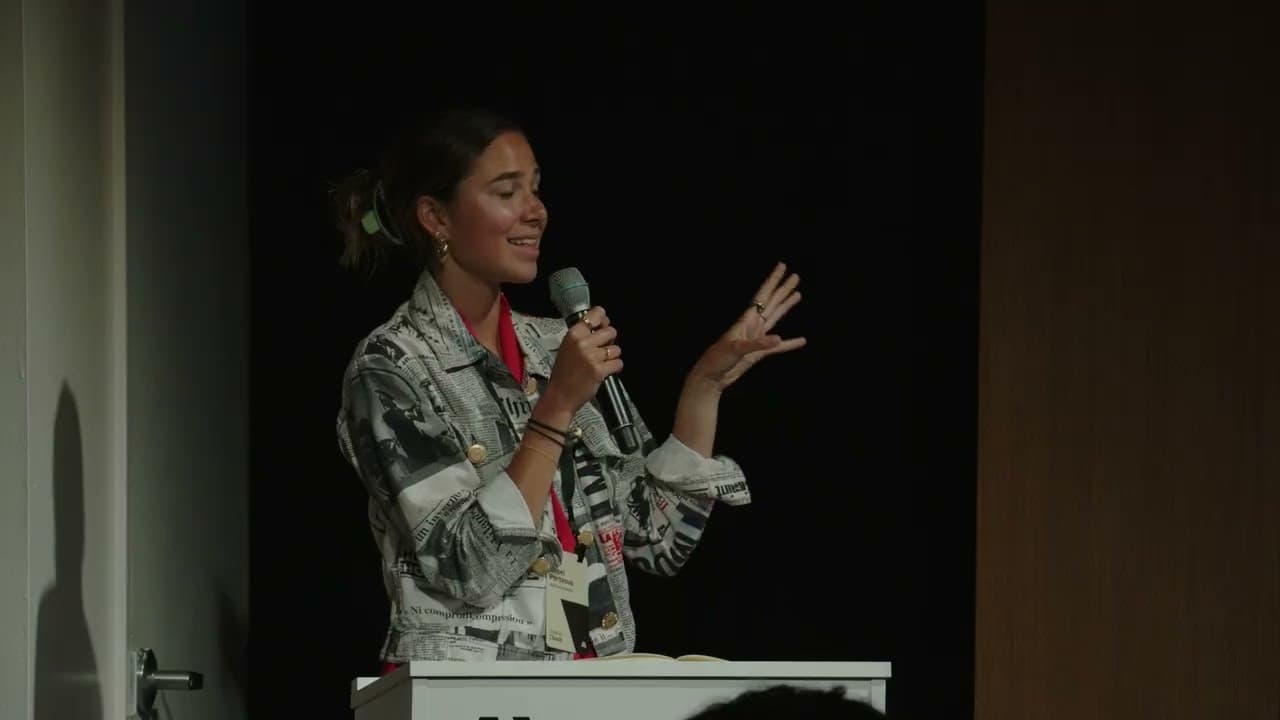
Isabelle Porteus from Stanford discusses using AI to simulate X-ray inspections of satellites for nuclear warheads, addressing gaps in the Outer Space Treaty. Mason Arditi from UC Berkeley shares his journey of learning to code with AI assistance, developing applications like CalgBt for course scheduling.
-
Rohil Agarwal and Daniel Gao from UC Berkeley and USC, respectively, present projects like SideQuest, where AI agents hire humans for tasks, and Claude Cortex, which emulates expert panels for diverse insights. These projects demonstrate AI's role in transforming education and decision-making processes.
Read in Other Languages (beta)
Share This Summary 📚
Summarize YouTube Videos and Get Video Transcripts with 1-Click
Try YouTube Summary with ChatGPT & Claude or YouTube Transcript Generator
Explore More Summaries from Anthropic 📚
Summarize YouTube Videos and Get Video Transcripts with 1-Click
Try YouTube Summary with ChatGPT & Claude or YouTube Transcript Generator