How Do AI Agents Work and When Should You Use Them?
TL;DR
Use an AI agent when a task is autonomous, recurring, and reviewable, and use a prompt when it requires live judgment, happens once, or lacks clear review criteria. Effective agents analyze information, plan actions, perform work, audit results, and adapt when the initial path fails, but they require precise goals, proof of success, and clearly defined steps.
Transcript
Most people think they're using AI well when they get a decent answer from Chad GPT. That was enough six months ago. It's not enough anymore. The next shift is AI agents. And the gap between people who understand them and people who don't, it's about to get very expensive. I've spent years in the boardrooms of billion-dollar companies. And the good... Read More
Key Insights
- The ARR framework identifies strong agent tasks as autonomous, recurring, and reviewable. A task that needs live judgment, occurs only once, or cannot be evaluated clearly is better suited to a direct prompt than to ongoing agent ownership.
- A chatbot predicts the next word and waits for additional user prompts, while an agent decides the next action. This distinction shifts the human role from guiding every step to defining the destination, constraints, and standards for a system that manages intermediate decisions.
- An AI agent can be modeled as four functional workers: an analyst finds patterns, a planner determines what matters and chooses the approach, an operator performs the work, and an auditor checks the output for weak logic, missing context, or poor conclusions.
- An agent adapts through an observe, orient, decide, and act loop. Its defining test is whether it can recognize that an expected path has failed, reconsider the situation, and select a better route instead of continuing to follow an unusable script.
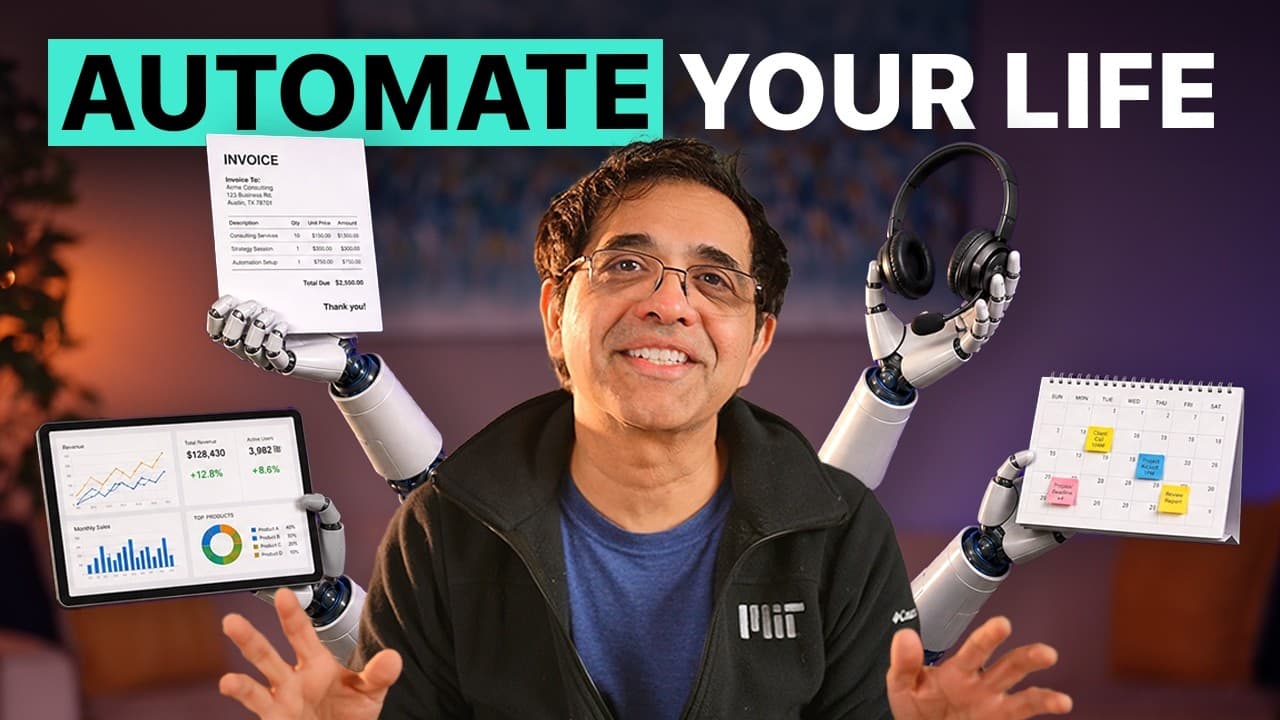
- An automated workflow follows a predetermined process, while an agent can reroute the process when circumstances change. In the grocery example, the agent notices unavailable items, finds substitutes, adjusts quantities for dinner guests, checks the calendar, and rebuilds the order.
- An agent is a multiplier of human thinking rather than a cure for poor processes. Vague goals, sloppy directions, and missing feedback can cause it to execute the wrong work quickly and confidently, formalizing weaknesses that already existed in the instructions.
- The GPS check evaluates whether automation is ready by testing goal, proof, and steps. The goal must fit into one clear sentence, proof must define what success looks like, and the steps must describe the work precisely without relying on handwaving.
- The strongest agent opportunities are narrow, specific, recurring tasks that people dislike but must complete. As content, code, and analysis become cheaper to produce, human judgment, taste, standards, and the ability to define valuable work become more important.
Install to Summarize YouTube Videos and Get Transcripts
Explore YouTube Video Summarizer or Get YouTube Transcript Extractor
Questions & Answers
Q: When should you use an AI agent instead of a prompt?
Use an AI agent when the task satisfies the ARR framework: it is autonomous, recurring, and reviewable. The agent should be able to operate without continuous live judgment, repeat the assignment on a schedule or trigger, and produce work that can be checked against clear standards. Use a prompt when the task happens once, requires immediate human judgment, or lacks reliable review criteria.
Q: What is the difference between a chatbot and an AI agent?
A chatbot predicts the next word and normally waits for the user to provide another prompt, while an AI agent decides what action to take next. The chatbot resembles a student driver who needs continuous guidance. The agent resembles a hired driver who receives a destination and handles the route, traffic, and intermediate decisions while the user supervises the outcome.
Q: What are the four functional roles inside an AI agent?
The four functional roles are analyst, planner, operator, and auditor. The analyst reads available information and identifies patterns. The planner decides what matters and creates an approach. The operator performs actions such as drafting or sending an update. The auditor reviews the result for weak logic, missing context, and careless conclusions, then supports refinement before completion.
Q: How can an AI agent produce a recurring weekly report?
An agent can review customer support tickets, sales notes, and product feedback every Monday, then identify the three largest recurring issues and summarize what changed. Its analyst finds patterns, its planner selects material for the brief, its operator writes and emails the update, and its auditor checks the reasoning and context before the leadership team receives the one-page report.
Q: How do AI agents adapt when the original plan fails?
Agents adapt by moving through an observe, orient, decide, and act loop. They notice that the expected path is not working, interpret the changed conditions, select another approach, and execute it. The practical test is whether the system can find a better route after its first option fails, rather than repeatedly following a script that no longer fits the situation.
Q: What is the difference between an agent and an automated workflow?
An automated workflow follows a predefined process and may break when unexpected conditions appear. An agent can reconsider and reroute the process. In the grocery example, a workflow fails when a usual item is unavailable, while an agent finds substitutes, adjusts quantities for six dinner guests, checks the calendar, and rebuilds the order around the changed circumstances.
Q: Why do AI agents fail in real business settings?
AI agents often fail because their human instructions contain vague goals, weak processes, unclear steps, or no reliable feedback mechanism. An agent does not repair poor thinking by itself. It formalizes and amplifies the thinking it receives, which means it can perform the wrong task faster and with greater confidence. Clear process design and standards must come before automation.
Q: How do you prepare a task for AI agent automation?
Run a GPS check covering goal, proof, and steps. Define the goal clearly in one sentence. Specify proof by describing what a good result looks like and how correctness will be evaluated. Then document every necessary step without handwaving. A narrow instruction with timing, inputs, categories, actions, and exceptions gives the agent stronger operational guidance than a broad request.
Summary & Key Takeaways
-
AI agents differ from chatbots because they determine their next action instead of merely predicting the next word or waiting for another prompt. The ARR framework identifies suitable agent tasks as autonomous, recurring, and reviewable. One-time tasks, unclear work, and activities requiring live human judgment are better handled with prompts.
-
An agent can be understood through four functional roles: analyst, planner, operator, and auditor. Together, these roles find patterns, choose a course of action, execute the work, and inspect the result. Agents also use an observe, orient, decide, and act loop to reroute when the original approach stops working.
-
Agents amplify the quality of the processes and instructions given to them, including weaknesses. A GPS check requires a clear goal, observable proof of success, and explicit steps. The strongest opportunities are narrow agents that own one repeated, disliked task for a specific workflow, market, and type of user pain.
Read in Other Languages (beta)
Share This Summary 📚
Summarize YouTube Videos and Get Video Transcripts with 1-Click
Try YouTube Summary with ChatGPT & Claude or YouTube Transcript Generator
Explore More Summaries from Sandeep Swadia 📚



Summarize YouTube Videos and Get Video Transcripts with 1-Click
Try YouTube Summary with ChatGPT & Claude or YouTube Transcript Generator