How Can Beginners Master AI in 30 Days? A 17-Minute, Seven-Step Road Map
TL;DR
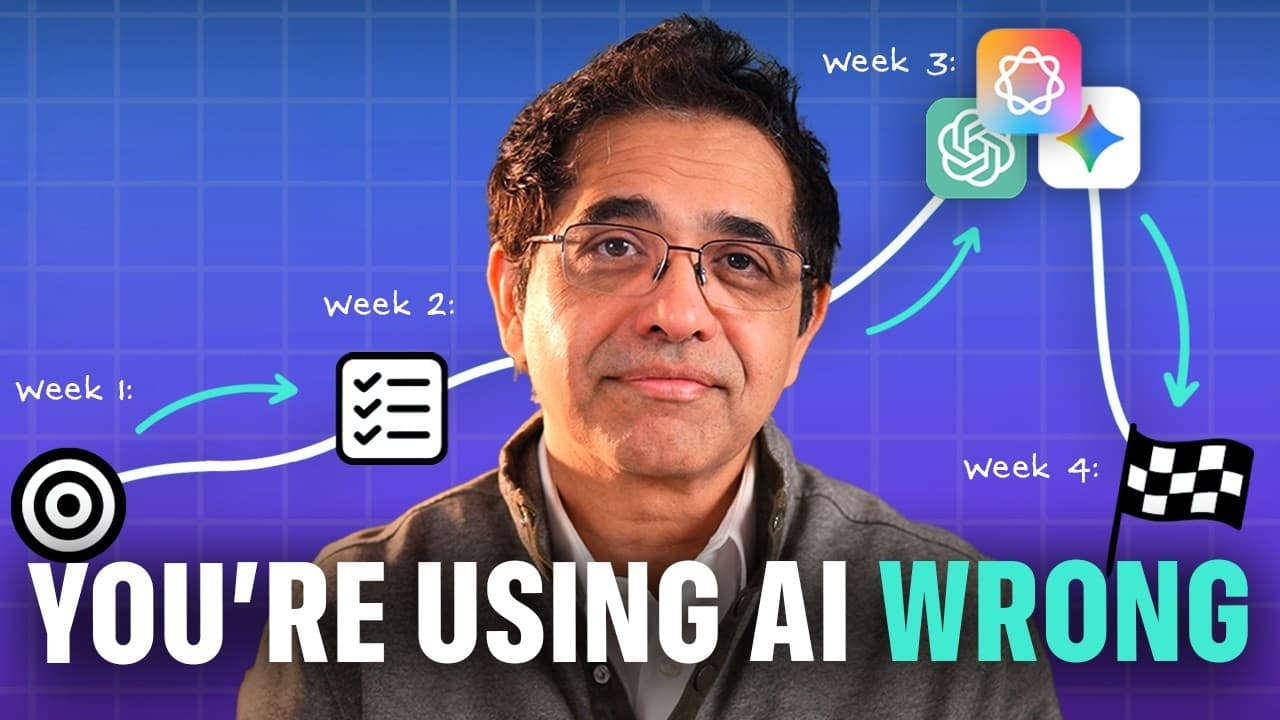
Beginners can master AI in 30 days by following a seven-step road map: understand how models predict language, write structured AIM prompts, focus deeply on one tool, supply useful context, iterate, verify outputs, and refine them with personal judgment. Week one centers on “machine English” and practicing Actor, Input, and Mission until structured prompting feels automatic. Read on for practical frameworks that make AI responses sharper and more personalized.
Transcript
Most people using AI are doing it wrong, which is why it's surprisingly easy to get ahead of 99% of them. I have spent over 20 years in tech and AI as a CEO, board member, investor, building billiondoll companies. And here's what I'm seeing. The gap between people who understand AI and those who don't is getting wider faster. In this video, I'll gi... Read More
Key Insights
- AI systems like ChatGPT predict language rather than understand it, working through tokenization and embedding spaces.
- Using structured prompts with the AIM framework (Actor, Input, Mission) enhances AI's response accuracy.
- Choosing a single AI tool to master initially can accelerate learning and improve proficiency.
- Context is crucial for AI outputs; using the MAP framework (Memory, Assets, Actions, Prompt) enriches AI interactions.
- Debugging your thinking by iterating on prompts helps improve AI responses and understanding of AI logic.
- Steering AI towards expert knowledge and frameworks can elevate the quality of AI-generated content.
- Verifying AI outputs through assumptions, sources, and cross-model checks ensures accuracy and reliability.
- Developing personal tastes and refining AI outputs with the OCEAN framework (Original, Concrete, Evident, Assertive, Narrative) leads to more authentic and insightful content.
Install to Summarize YouTube Videos and Get Transcripts
Explore YouTube Video Summarizer or Get YouTube Transcript Extractor
Questions & Answers
Q: How can a beginner master AI in 30 days?
Follow the seven-step road map by learning how AI predicts language, structuring prompts, focusing on one tool, adding context, iterating, verifying results, and refining outputs. During the first week, practice “machine English” and AIM prompts until you can write a structured prompt without thinking.
Q: What is the AIM framework for AI prompts?
AIM stands for Actor, Input, and Mission. Define who the model should act as, provide the context or data it needs, and state exactly what you want it to accomplish.
Q: How can I improve the accuracy and relevance of AI prompts?
Replace vague requests with sharp, targeted instructions using the AIM structure. For a résumé review, specify an expert résumé editor as the Actor, attach the résumé and job description as the Input, and request 10 specific improvement ideas as the Mission.
Q: Why should beginners focus on one AI tool?
Choosing one tool lets you learn its personality, cadence, limits, and strengths instead of skimming many tools. The speaker recommends spending the first week with one foundational model because going deep helps you recognize structures and patterns in other models later.
Q: Which AI tool should I learn first?
The road map suggests ChatGPT for the most mature option, Gemini for people deep in Google’s ecosystem, and Claude for business and project-based AI. The specific choice matters less than selecting one and learning it deeply.
Q: How does generative AI produce an answer?
Models such as ChatGPT and Gemini break text into tokens, convert those tokens into multidimensional vectors, and place them in an embedding space where similar ideas are closer together. They then use context, probability, and proximity to predict the most likely next token and generate an answer on the fly.
Q: Why is context important for AI outputs?
Even a highly capable AI can sound clueless when it lacks relevant context. The MAP framework, Memory, Assets, Actions, and Prompt, organizes background information and task details so the model can produce more relevant responses.
Q: How can I verify and personalize AI-generated content?
Check the model’s assumptions, request sources, and compare claims across models to improve reliability. Then apply the OCEAN framework, Original, Concrete, Evident, Assertive, and Narrative, to turn generic output into content that reflects personal taste and judgment.
Summary & Key Takeaways
-
Understanding AI as a predictive tool rather than a comprehension-based system is key to mastering it. By using structured approaches like AIM and MAP, users can significantly improve the quality of AI interactions. These frameworks help in creating precise and context-rich prompts, leading to better AI responses.
-
Choosing one AI tool to focus on initially allows for deeper understanding and faster skill development. Treating AI as a learning partner rather than just a tool helps in refining prompts and achieving personalized outputs. Debugging and iterating on prompts are crucial for improving AI responses.
-
Verification and expert guidance enhance the quality of AI outputs. Using the OCEAN framework helps in crafting responses that are not only accurate but also reflective of personal style and insight. This approach transforms AI from a generic tool into a personalized thinking partner.
Read in Other Languages (beta)
Share This Summary 📚
Summarize YouTube Videos and Get Video Transcripts with 1-Click
Try YouTube Summary with ChatGPT & Claude or YouTube Transcript Generator
Explore More Summaries from theMITmonk 📚





Summarize YouTube Videos and Get Video Transcripts with 1-Click
Try YouTube Summary with ChatGPT & Claude or YouTube Transcript Generator