How to Become Smarter Using AI in 18 Minutes
TL;DR
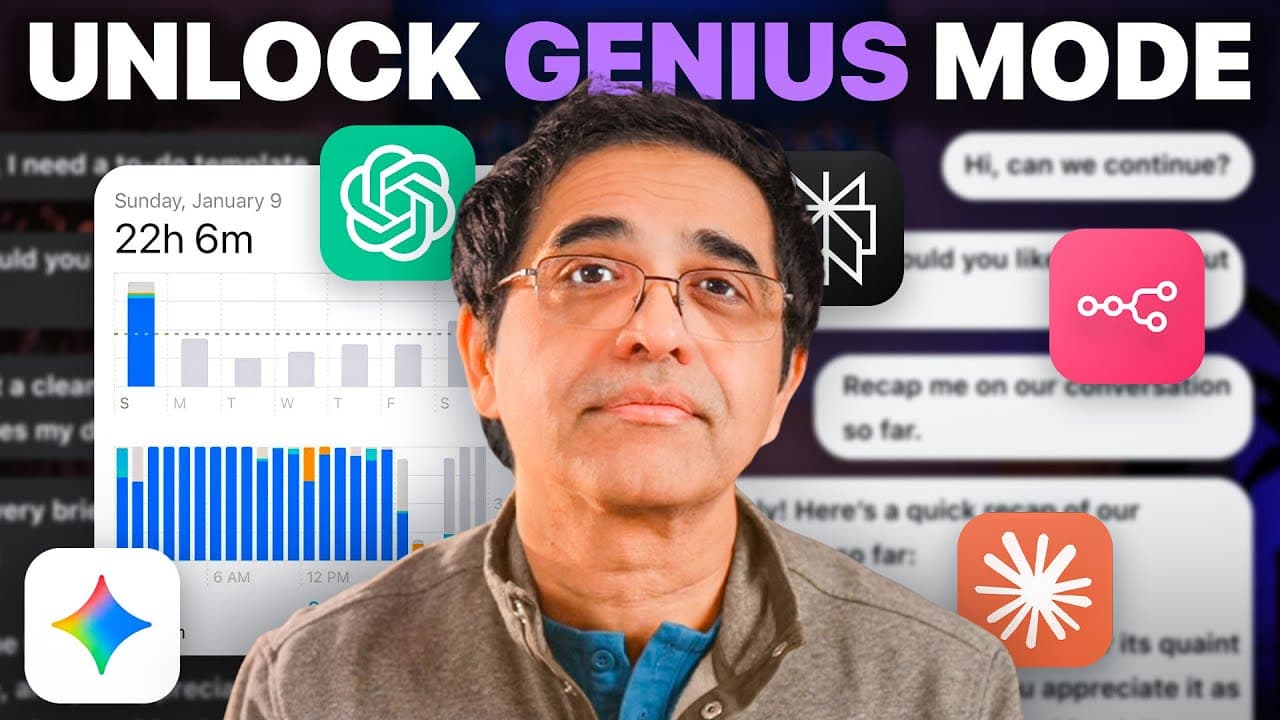
AI can enhance intelligence by optimizing how tasks are approached. The top 1% use AI to handle mundane tasks, allowing focus on high-impact areas. By understanding AI's probabilistic nature and leveraging it for both information and transformation tasks, one can cultivate deeper understanding and personal growth.
Transcript
Most people are letting AI destroy their ability to think, training AI to become their own replacement. Tragic, because AI can make you dangerously intelligent. I went from being homeless to an MIT grad and running and advising AI companies worth billions. And here's what I've learned. The top 1% use AI backwards. They don't prompt to get answers. ... Read More
Key Insights
- The top 1% use AI to train their brains rather than just for answers, allowing them to outsmart situations.
- Intelligent laziness involves using AI to handle low-value tasks, freeing time for high-impact areas.
- The DRAG framework helps identify tasks that can be delegated to AI, focusing human effort on critical tasks.
- AI is a probability engine, not a calculator, requiring careful question architecture for reliable outcomes.
- Progressive overload in learning involves using AI to progressively challenge understanding, enhancing intelligence.
- The intelligent fool approach emphasizes embracing ignorance and learning continuously for true intelligence.
- Neuroplasticity allows the brain to rewire through errors and challenges, fostering growth and learning.
- AI can serve as a 'spotter' in the intelligent gym, providing support but not replacing personal effort in learning.
Install to Summarize YouTube Videos and Get Transcripts
Explore YouTube Video Summarizer or Get YouTube Transcript Extractor
Questions & Answers
Q: How can AI improve personal intelligence?
AI can improve personal intelligence by handling routine tasks, allowing individuals to focus on high-impact areas. By using frameworks like DRAG, tasks can be delegated to AI, freeing time for critical thinking. Additionally, AI can support progressive learning, challenging understanding and fostering deeper insights.
Q: What is the DRAG framework in AI usage?
The DRAG framework categorizes tasks into four areas: Drafting, Research, Analysis, and Grunt work. These tasks can be delegated to AI, allowing individuals to focus on more critical, high-impact activities. This approach enhances productivity and frees cognitive resources for strategic thinking and decision-making.
Q: Why is AI not like a calculator?
AI is not like a calculator because it operates as a probability engine, providing different answers to the same question due to its probabilistic nature. This requires users to carefully structure questions and prompts to obtain reliable results, understanding that AI can make mistakes or generate varied responses.
Q: How does progressive overload apply to learning with AI?
Progressive overload in learning with AI involves gradually increasing the difficulty of tasks or questions to challenge and deepen understanding. By using AI as a spotter, individuals can receive support while being pushed to enhance their knowledge and skills, fostering continuous learning and intellectual growth.
Q: What is the intelligent fool approach?
The intelligent fool approach emphasizes embracing ignorance and continuously learning by asking questions and acknowledging what one doesn't know. This mindset encourages lifelong learning and adaptability, allowing individuals to grow intellectually and remain open to new ideas and insights, essential for personal and professional success.
Q: How does neuroplasticity relate to AI and learning?
Neuroplasticity, the brain's ability to rewire itself through experience, is enhanced by AI's ability to challenge users with complex tasks. By engaging with AI in problem-solving and learning, individuals can stimulate brain growth and adaptability, improving cognitive abilities and fostering lifelong learning.
Q: How can AI be used as a spotter in learning?
AI can be used as a spotter in learning by providing support and guidance without replacing personal effort. It can quiz, challenge, and provide feedback, helping individuals to test and expand their knowledge. This approach ensures active engagement and deepens understanding, promoting intellectual growth.
Q: Why is it important to balance AI capabilities with personal effort?
Balancing AI capabilities with personal effort is crucial because while AI can handle routine tasks and provide support, true intelligence and growth come from personal engagement and effort. Relying solely on AI can lead to cognitive atrophy, whereas actively using AI as a tool can enhance learning and adaptability.
Summary & Key Takeaways
-
AI can be used to enhance intelligence by focusing on high-impact tasks while delegating mundane tasks to AI. The DRAG framework helps identify what to outsource, allowing more time for critical thinking. Embracing AI's probabilistic nature and using it for progressive learning can lead to deeper understanding and personal growth.
-
The intelligent fool approach encourages continuous learning and embracing ignorance as a means to true intelligence. By using AI to challenge and support learning, individuals can cultivate a mindset of lifelong learning and adaptability, essential for personal and professional growth.
-
AI serves as a tool for both information and transformation tasks. By using AI to handle routine tasks and progressively challenge understanding, individuals can enhance their intelligence and achieve greater personal and professional success. The key is to balance AI's capabilities with personal effort and continuous learning.
Read in Other Languages (beta)
Share This Summary 📚
Summarize YouTube Videos and Get Video Transcripts with 1-Click
Try YouTube Summary with ChatGPT & Claude or YouTube Transcript Generator
Explore More Summaries from Sandeep Swadia | theMITmonk 📚



Summarize YouTube Videos and Get Video Transcripts with 1-Click
Try YouTube Summary with ChatGPT & Claude or YouTube Transcript Generator