How to Think Critically in the Age of AI
TL;DR
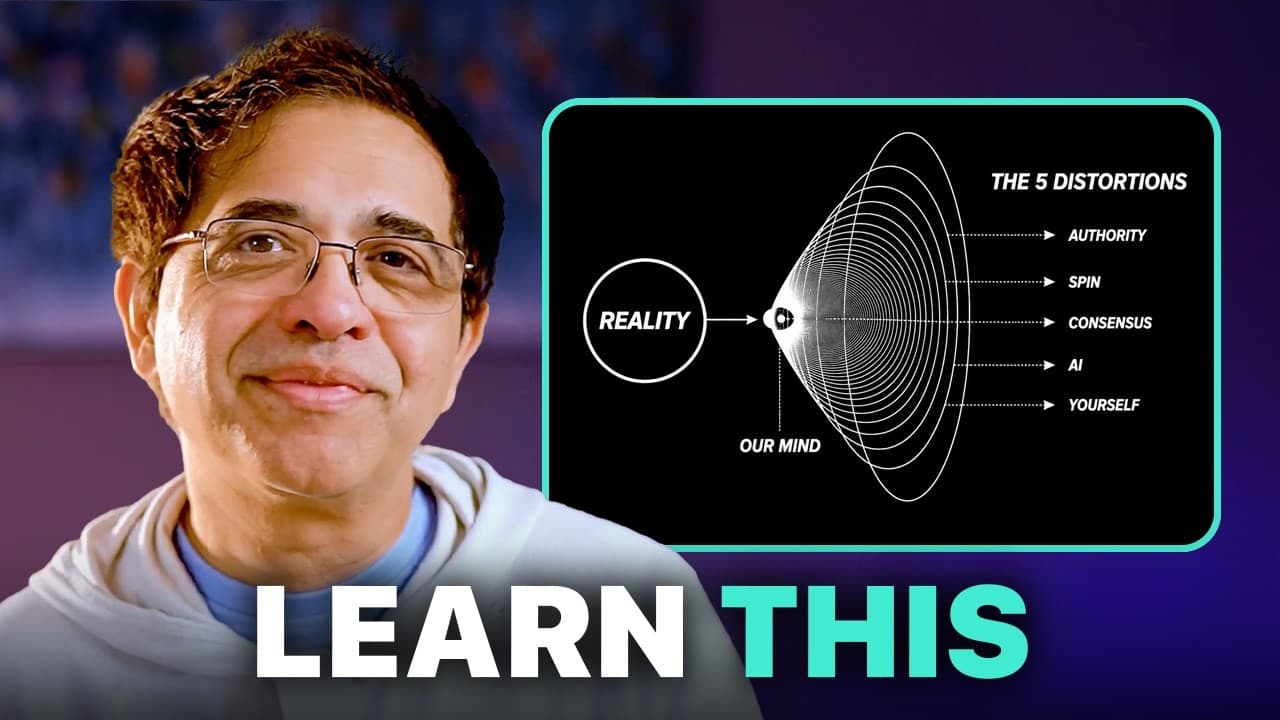
Strong judgment starts by asking what must be true for an impressive claim to be real, then examining evidence both for and against it. Question authority, translate polished marketing into precise claims, seek disagreement when a group appears unanimous, and use AI as a research assistant while independently checking its output for hallucinations and manipulation.
Transcript
People say AI is turning us into the stupidest generation in history. I don't buy it. The real danger is what I call the crisis of critical thinking. [music] Because in the age of AI, anything can be faked, and a lie looks exactly like the truth. That's where we need critical thinking. For those of you who are new here, I trained as a monk and then... Read More
Key Insights
- Critical thinking is the ability that protects judgment when AI-generated voices, videos, misinformation, and persuasive claims make lies appear credible. The central challenge is no longer merely finding information, but distinguishing authentic evidence from convincing imitations that look and sound real.
- Deepfakes can defeat familiar verification methods because a video call may contain convincing copies of trusted people. In January 2024, a Hong Kong finance employee transferred $25 million after apparent executives guided him through the process, but every person on the call was fake.
- Authority becomes dangerous when credentials, charisma, and confidence substitute for relevant evidence. Theranos assembled an impressive board, raised $700 million, and reached a $9 billion valuation, yet the cited board members lacked expertise in blood chemistry or medical devices.
- The key question for testing an impressive claim is, "What needs to be true for this to be real?" This question shifts attention away from reputation and presentation toward necessary conditions, verifiable evidence, and weaknesses that enthusiasm or fear of missing out may conceal.
- Marketing spin often works through technically defensible but incomplete phrases. Claims containing "up to," "as low as," "starting at," "clinically proven," or "recommended by experts" can sound informative while withholding the comparison, qualification, typical outcome, or conditions needed to evaluate them.
- The question mark move turns polished language into a claim that must be examined. Repeating "up to eight times faster" as a question prompts useful follow-ups, including faster than what, under which conditions, and whether the advertised promise represents the product a buyer will actually receive.
- Groupthink can make people publicly reject an answer they privately know is correct. In the described line-matching experiment, three out of every four participants followed a confidently wrong group, showing that social pressure can overpower direct observation even when the task itself is obvious.
- A single dissenter can weaken conformity and help people express their independent judgment. In the same experiment, most participants gave the correct answer when one actor also answered correctly, suggesting that seeking a contrary viewpoint can expose assumptions hidden by apparent consensus.
Install to Summarize YouTube Videos and Get Transcripts
Explore YouTube Video Summarizer or Get YouTube Transcript Extractor
Questions & Answers
Q: How can I think critically in the age of AI?
Start by treating impressive claims as propositions that require evidence, even when they come from familiar people, respected authorities, or convincing AI-generated media. Ask what must be true for the claim to be real, request evidence that supports it, and request evidence that challenges it. Use AI as a research assistant, but independently check its output for hallucinations, missing qualifications, and unsupported certainty.
Q: What question helps test whether a claim is real?
Ask, "What needs to be true for this to be real?" The question directs attention toward the conditions and evidence required for a claim to hold. It is especially useful when charisma, credentials, urgency, secrecy, or fear of missing out creates pressure to accept a conclusion. AI can assist by listing supporting and challenging evidence, but personal judgment remains necessary.
Q: How did the $25 million deepfake scam work?
In January 2024, an employee in the finance department of the Hong Kong company Arup received instructions presented as coming from the chief financial officer. After becoming suspicious, the employee requested a video conference. Apparent executives and team members joined and guided the transfer step by step, but the company later discovered that everyone on the call was a deepfake created from online clips.
Q: Why did investors fail to question Theranos?
The account identifies three pressures: the halo effect created by an impressive board, fear of missing the next major company, and secrecy around the technology. Elizabeth Holmes also projected charisma, confidence, intense commitment, and noble purpose. Investors allowed those signals to replace scrutiny, even though the company avoided clearly explaining how its blood-testing technology worked and the core technology never performed as promised.
Q: How can I detect misleading marketing language?
Listen for shiny phrases such as "up to," "as low as," "starting at," "clinically proven," and "recommended by experts." Add a question mark mentally, then ask what the phrase means precisely. Identify the comparison point, required qualifications, typical result, extra costs, and conditions. This exposes the gap between a technically defensible promise and the product or outcome a customer is likely to receive.
Q: What is the question mark move for evaluating claims?
The question mark move has two steps. First, notice polished terms that sound specific but may omit essential details. Second, repeat the claim in your mind as a question. For example, change "up to eight times faster" into "up to eight times faster?" Then ask faster than what and under which conditions. The method converts passive reception into active examination.
Q: Why does groupthink override obvious evidence?
Groupthink can make disagreement feel more uncomfortable than giving an answer a person knows is wrong. In the described line-matching experiment, seven actors confidently selected an incorrect line before the real participant answered. Three out of every four participants followed the wrong group, and participants later acknowledged knowing the correct answer. Social pressure, not visual uncertainty, distorted their public judgment.
Q: How can I resist groupthink when everyone agrees?
Seek a credible dissenting view and examine its evidence before accepting the apparent consensus. The line-matching experiment showed that when just one actor gave the correct answer, most participants also answered correctly. One dissenter reduced the pressure to conform. Agreement can contain genuine collective wisdom, but it can also reflect mass hysteria, confidence without proof, or repeated assumptions that nobody has tested.
Summary & Key Takeaways
-
Critical thinking becomes more valuable when deepfakes, AI-generated content, misinformation, and persuasive marketing make falsehoods resemble truth. A Hong Kong finance employee transferred $25 million after a video conference with apparent executives, only to discover that every person on the call had been generated as a deepfake using online clips.
-
Authority can replace evidence when charisma, credentials, urgency, and secrecy discourage basic questions. Theranos raised $700 million and reached a $9 billion valuation despite technology that never worked as promised. The recommended response is to ask what must be true for a claim to be real and examine supporting and challenging evidence.
-
Marketing and group consensus can distort judgment without making plainly false statements. Phrases such as "up to," "as low as," and "starting at" require precise follow-up questions. Likewise, the conformity experiment shows that confident group agreement can override an obvious answer, while one dissenter can help restore independent judgment.
Read in Other Languages (beta)
Share This Summary 📚
Summarize YouTube Videos and Get Video Transcripts with 1-Click
Try YouTube Summary with ChatGPT & Claude or YouTube Transcript Generator
Explore More Summaries from Sandeep Swadia 📚



Summarize YouTube Videos and Get Video Transcripts with 1-Click
Try YouTube Summary with ChatGPT & Claude or YouTube Transcript Generator