How to Use AI to Overcome Life's Blind Spots
TL;DR
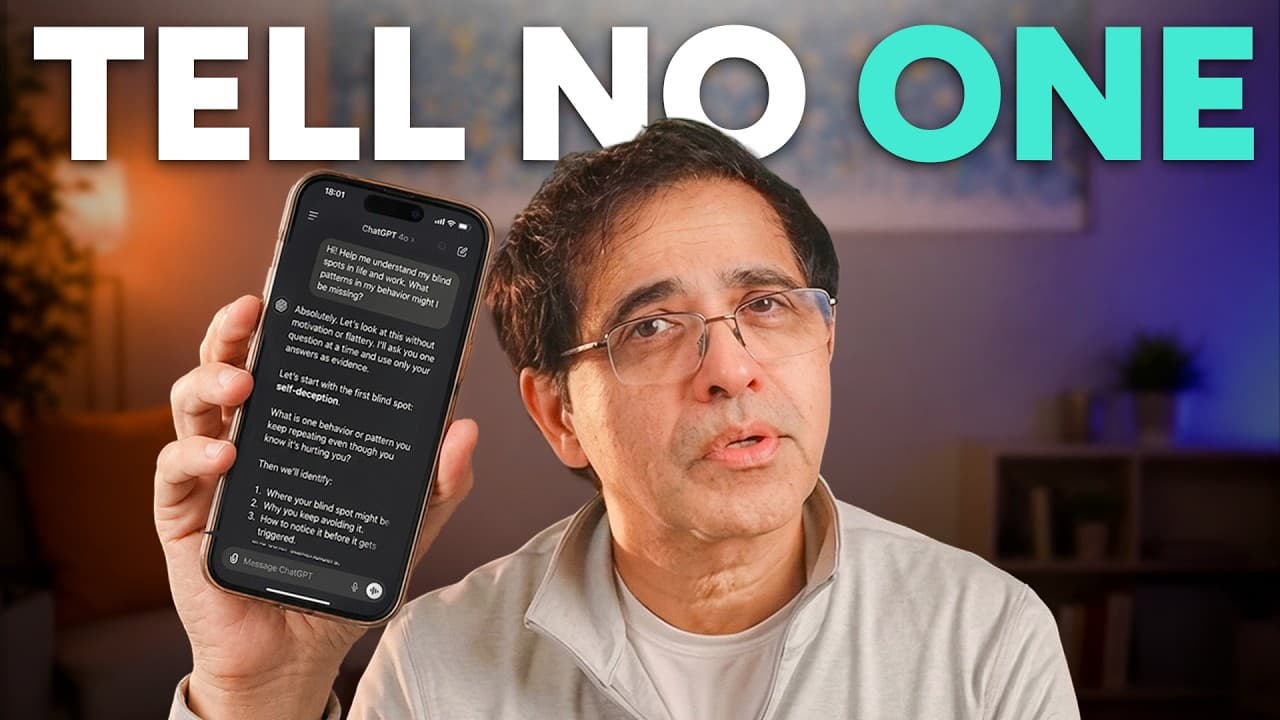
AI can help identify and address personal blind spots by acting as an investigator, counterparty, mapmaker, decision simulator, and debrief partner. By engaging with AI prompts, individuals can gain insights into self-deception, relationships, identity shifts, decision-making, and processing trauma. However, AI should be used as a tool for reflection, not as a replacement for professional help or personal judgment.
Transcript
This is how you use AI to change your life. Most of us use chat GPT or claude for productivity hacks or [music] to do work that we don't want to do. But can AI actually make a difference? Can it help you build a life worth waking up for? I think any thinking partner can if you use it the right way. So, we're going to look at the five blind spots th... Read More
Key Insights
- AI can act as an investigator to help identify personal behavior patterns and blind spots.
- Using AI as a counterparty can help rehearse difficult conversations by presenting the other person's perspective.
- The end of history illusion leads people to underestimate future personal changes, which AI can help map out.
- Decision-making can be improved by using AI to simulate potential outcomes and risks of different choices.
- AI can assist in processing trauma by helping to separate facts from personal narratives.
- Self-deception can be reduced by seeking concrete feedback from trusted individuals.
- Reframing conversations from accusations to observations can improve relationship dynamics.
- AI should not be mistaken for a therapist; it is a tool for self-reflection and perspective.
Install to Summarize YouTube Videos and Get Transcripts
Explore YouTube Video Summarizer or Get YouTube Transcript Extractor
Questions & Answers
Q: How can AI help identify personal blind spots?
AI can help identify personal blind spots by acting as an investigator that examines behavior patterns. By using specific prompts, individuals can explore recurring behaviors, understand their origins, and develop strategies to address them. AI provides a third-party perspective, helping to reveal patterns that may not be immediately obvious to the individual.
Q: How can AI improve difficult conversations?
AI can improve difficult conversations by simulating the other person's perspective, allowing individuals to rehearse and prepare. By acting as a counterparty, AI can help individuals understand potential objections and emotional responses, leading to more empathetic and effective communication. This preparation can transform confrontational dialogues into constructive exchanges.
Q: What is the end of history illusion?
The end of history illusion is a psychological phenomenon where individuals recognize past personal changes but underestimate their potential for future change. This illusion can hinder personal growth and adaptation. AI can assist by helping individuals map out potential future transformations, encouraging a mindset open to evolution and change.
Q: How can AI assist in decision-making?
AI can assist in decision-making by acting as a decision simulator, running premortem analyses on potential choices. By imagining worst-case scenarios and identifying potential pitfalls, AI helps individuals understand the risks and trade-offs of different options. This process aids in making informed decisions by highlighting possible outcomes and warning signs.
Q: How can AI help process trauma?
AI can help process trauma by acting as a debrief partner, facilitating reflection on difficult experiences. Through structured prompts, AI can help individuals separate facts from personal narratives, identify controllable factors, and determine lessons to carry forward. However, AI is not a substitute for professional therapy and should be used as a tool for reflection.
Q: Why is self-deception a common blind spot?
Self-deception is a common blind spot because individuals often create protective narratives that prevent them from confronting uncomfortable truths. AI can help by providing objective feedback and prompting deeper inquiry into personal behaviors. Additionally, seeking concrete feedback from trusted individuals can further reduce self-deception and promote personal growth.
Q: How can reframing conversations improve relationships?
Reframing conversations from accusations to observations can improve relationships by reducing defensiveness and fostering understanding. By focusing on specific behaviors and their impacts, rather than personal attacks, individuals can engage in more productive dialogues. This approach encourages curiosity and empathy, leading to healthier communication and relationship dynamics.
Q: What are the limitations of using AI for personal development?
AI's limitations in personal development include its inability to provide emotional support or replace human interaction. While AI can offer insights and facilitate reflection, it lacks the empathy and understanding of a trained therapist. Individuals should use AI as a tool for self-awareness and perspective, while seeking professional help for deeper emotional challenges.
Summary & Key Takeaways
-
AI can act as an investigator to help identify personal behavior patterns and blind spots. By using specific prompts, individuals can explore why certain patterns occur, how to recognize them, and what actions to take. However, AI should be used as a hypothesis generator, not a definitive diagnosis.
-
In relationships, AI can simulate the perspective of the other party, helping individuals prepare for difficult conversations. By understanding the other person's viewpoint, individuals can address relationship blind spots and improve communication. AI aids reflection but cannot replace personal interaction.
-
AI can help navigate identity shifts by mapping out strengths, weaknesses, and necessary changes for new life phases. By identifying what to carry forward and what to leave behind, individuals can better manage transitions. However, emotional aspects of change require personal introspection and support.
Read in Other Languages (beta)
Share This Summary 📚
Summarize YouTube Videos and Get Video Transcripts with 1-Click
Try YouTube Summary with ChatGPT & Claude or YouTube Transcript Generator
Explore More Summaries from Sandeep Swadia 📚


Summarize YouTube Videos and Get Video Transcripts with 1-Click
Try YouTube Summary with ChatGPT & Claude or YouTube Transcript Generator