How to Learn Fast and Remember Longer with TRAP
TL;DR
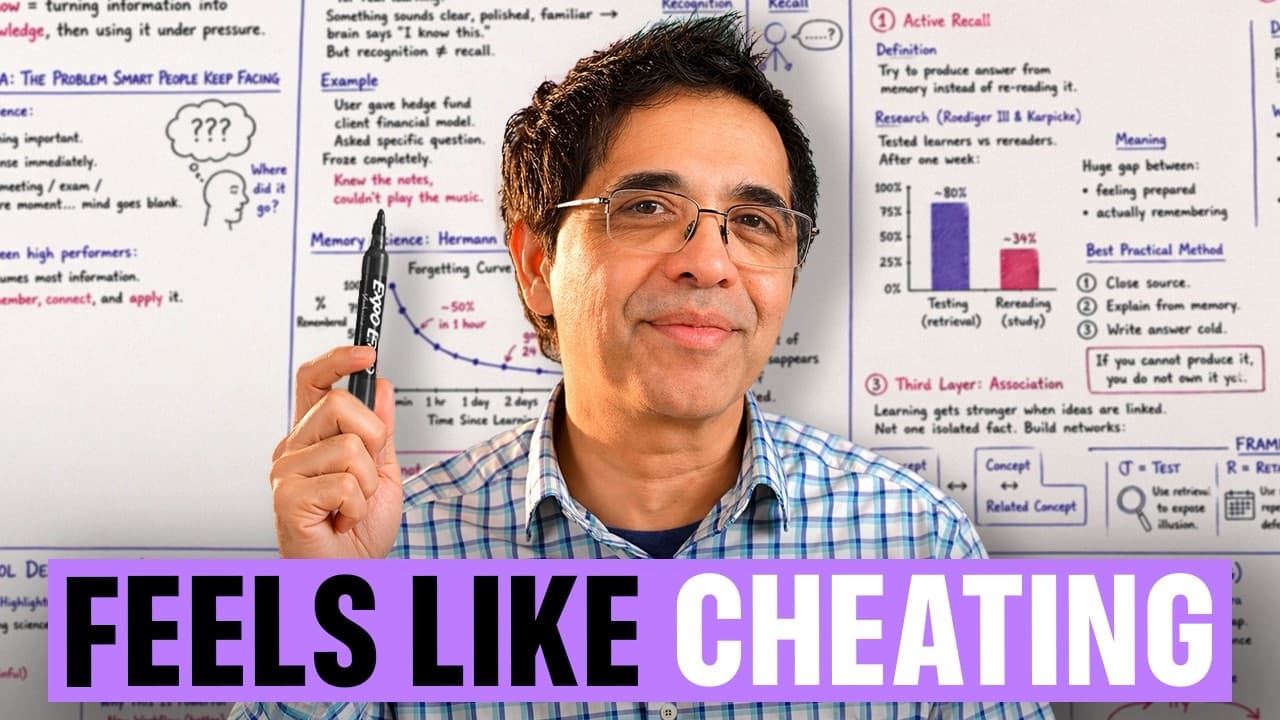
Durable learning comes from effortful practice, not easy recall. Use the four moves TRAP: Test, Retain, Associate, Perform, with spaced repetition and connecting ideas to existing knowledge. This approach counters the fluency illusion and leverages retrieval practice to strengthen memory for long-term use.
Transcript
There is a feeling every ambitious person knows. You read something important, it clicks, but then days later when you have to remember it under pressure, you go completely blank. For those who are new here, as CEO, board member, investor, I get to spend time in boardrooms of billion-dollar companies. And I see this pattern everywhere over and over... Read More
Key Insights
- Test is essential because effortful retrieval strengthens memory. When you test yourself, you reveal gaps and reinforce durable learning.
- Retain matters because timing of review controls memory durability. Spacing reviews prevents rubble rebuilding and supports lasting retention.
- Associate links new ideas to existing knowledge, creating a web that improves retrieval under pressure.
- Perform means applying what you learned to real tasks, turning knowledge into usable skill.
- Fluency illusion causes overestimate of understanding; true mastery requires practice beyond recognition.
- Desirable difficulties describe the benefit of harder practice, which leads to stronger memory.
- Memory is not just storage; it is a network of connections that informs under pressure.
- Tools like flash cards and note linking help automate scheduling and integration of knowledge.
Install to Summarize YouTube Videos and Get Transcripts
Explore YouTube Video Summarizer or Get YouTube Transcript Extractor
Questions & Answers
Q: How can I start applying the TRAP framework to new material?
Begin with Test by recalling what you learned without looking at the source, then check accuracy to identify gaps. This creates a baseline of what you truly know. Move to Retain by scheduling short, spaced reviews, ensuring you revisit the material before it fades. Then build associations to existing knowledge and finally, perform by using the concept in real tasks.
Q: What is the fluency illusion and why is it a problem for learners?
The fluency illusion is when ideas feel familiar and instantly clear, giving the false sense of mastery. This happens when you recognize notes but cannot play the music. It leads to poor retrieval under pressure and errors in applying knowledge. Recognizing this illusion helps learners adopt strategies that demand active retrieval and deeper understanding.
Q: Why is testing considered a powerful learning mechanism beyond grades?
Testing forces the brain to retrieve information, which strengthens memory more than passive rereading. In studies, groups that tested retained far more material after a week than those who reread, demonstrating that retrieval practice builds durable memory and reduces forgetting over time.
Q: How does space repetition contribute to durable learning?
Space repetition times reviews to occur at optimal intervals, aligning with how memory consolidates. Delaying review enough prevents easy recall and forces the brain to work harder, which strengthens retention. This approach helps move knowledge from short-term to long-term memory and reduces forgetting.
Q: What role do associations play in memory according to the video?
Associations connect new information to existing knowledge creating a web. This linking makes retrieval faster and more reliable under pressure. The video suggests asking how new ideas relate to what you already know and using analogies or related concepts to anchor learning.
Q: How can you use notes and tools to implement TRAP effectively?
Use notes to capture questions and answers as flash cards, and rely on AI or spaced repetition tools to schedule reviews. Linking notes across topics forms a web rather than isolated facts, which improves retrieval and comprehension during real-world use.
Q: What is the MIT IP or independent activities period mentioned, and why is it relevant?
MIT’s Independent Activities Period is a month when formal classes pause and students build something real with partners from different departments. This approach reinforces hands-on learning, experimentation, and creating tangible outcomes, which strengthens the ability to apply knowledge in real contexts.
Q: What is the overall message about learning in the AI era?
In the AI era, fluency and intelligence must be built by creating durable, interconnected knowledge networks rather than relying on instant answers. The video argues that true learning is about testing, retaining, associating, and performing, which helps you think clearly and act under pressure.
Summary & Key Takeaways
-
A concise framework is introduced to outlearn most people by using a four move system that aligns with how memory actually works. The video emphasizes that easy recall is often a sign of weak understanding and that deeper retention requires effortful retrieval and meaningful connections.
-
The speaker draws on cognitive science concepts like desirable difficulties, retrieval practice, and the forgetting curve, then shows how to apply them with practical tools like flash cards and cross-linking notes.
-
The video ends with a call to action to build a real mind by testing ideas, retaining key concepts, associating new insights with existing knowledge, and performing or applying what is learned, especially in the AI era.
Read in Other Languages (beta)
Share This Summary 📚
Summarize YouTube Videos and Get Video Transcripts with 1-Click
Try YouTube Summary with ChatGPT & Claude or YouTube Transcript Generator
Explore More Summaries from Sandeep Swadia 📚



Summarize YouTube Videos and Get Video Transcripts with 1-Click
Try YouTube Summary with ChatGPT & Claude or YouTube Transcript Generator