How to Trade Order Flow: A Complete Beginner Guide
TL;DR
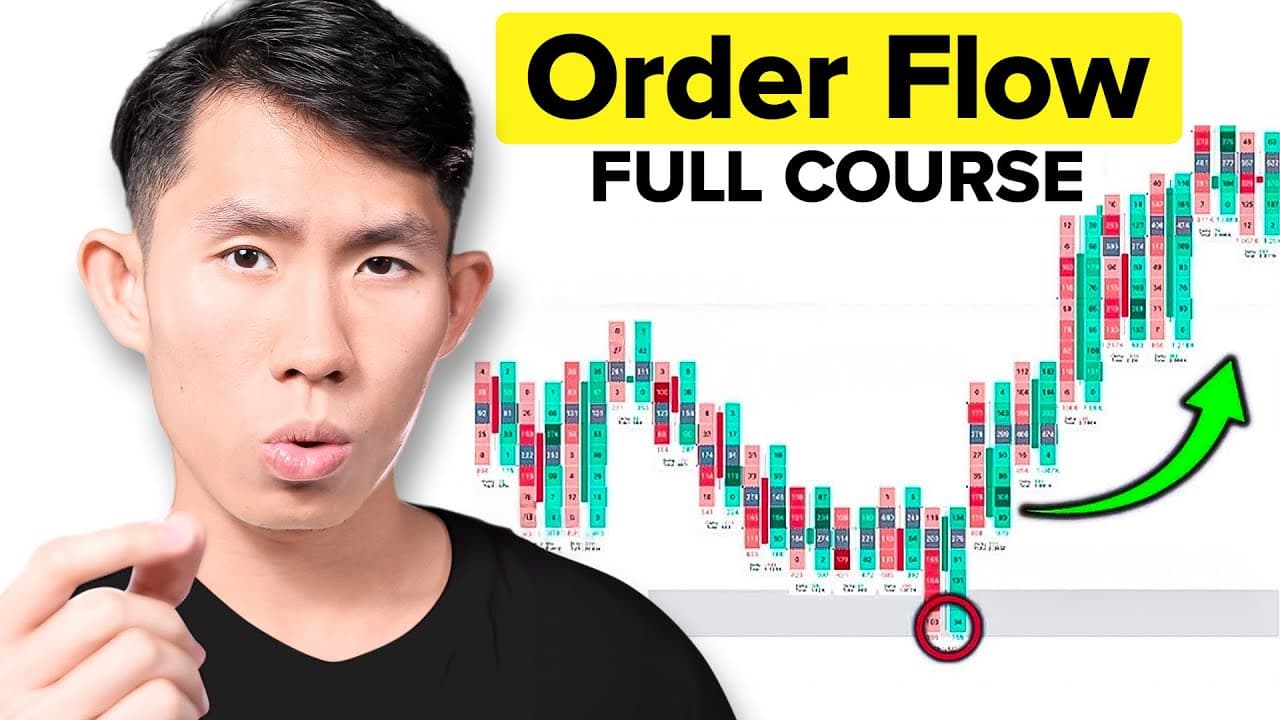
Order flow trading shows the interactions between buyers and sellers so you can identify who controls price, using the order book or footprint charts rather than lagging indicators like moving averages, Bollinger Bands, or RSI. Because the centralized order book displays every limit and market order, it reveals institutional activity early and lets you anticipate price changes before they happen.
Transcript
if you can Master orderflow you will be able to understand how the market truly operates and how price Works which is really the most important thing a Trader must understand and then you will be able to learn how to capitalize on large move before they even happen so that you can make consistent profits so welcome to autoflow ladies and gents so i... Read More
Key Insights
- Order flow trading is the process of analyzing the flow of trades being placed by other traders, institutional and retail, on a specific market or asset by watching the order book or footprint charts, which reveals the amount of buy and sell orders at a given time and price point.
- Successful trading comes down to figuring out who is in control of price, the buyers or the sellers, and being on the correct side of the market. Order flow makes that control visible by showing the interactions between the two sides directly.
- The main advantage of order flow is that it is not lagging, unlike moving averages, Bollinger Bands, and RSI. In trading the fastest finger wins, so seeing the raw order data gives an edge over traders relying on indicators that move slowly.
- A centralized order book shows every limit and market order that exists in the market, so there are no hidden orders. This makes order flow more reliable than derived indicators, because the numbers come straight from the source and liquidity does not lie.
- Order flow lets a trader spot institutional activity, what the financial institutions and investment funds are doing, earlier than the rest of the market. Seeing that activity first makes it possible to enter before the large moves actually happen.
- Auction market theory states that financial markets behave like any other business, with buyers and sellers actively seeking the fair value of an asset. It is based on the principles of supply and demand and the auction process, the same dynamic as selling a used car or a phone.
- In a balanced market, buyers and sellers agree on a price based on their perception of fair value. This produces lower volatility, stable price, and a sideways range where price consolidates instead of going anywhere.
- Imbalance occurs when there is disagreement about fair value and one side, buyers or sellers, becomes more aggressive. This creates a trending market that pushes price higher or lower until the imbalance fades, momentum runs out, and price consolidates back into balance.
Install to Summarize YouTube Videos and Get Transcripts
Explore YouTube Video Summarizer or Get YouTube Transcript Extractor
Questions & Answers
Q: What is order flow trading?
Order flow trading allows you to see the interactions between the buyers and the sellers in order to identify who is in control of price. It is the process of analyzing the flow of trades being placed by other traders, both institutional and retail, on a specific market or asset by watching the order book or footprint charts. This lets traders see the amount of buy and sell orders that are being placed at a certain time in the market at a given price point, which in turn allows them to anticipate changes in price before they even happen.
Q: Why use order flow instead of technical indicators?
Order flow is not a holy grail, but it tells you what price is doing and it is not lagging, meaning it does not move like a snail the way other trading indicators do. Traders still using moving averages, Bollinger Bands, RSI, or chart patterns are late to the party, because in trading the fastest finger wins. Order flow also comes straight from a centralized order book rather than being derived from past price, so it is more reliable and gives an edge over the retail space, since most retail traders never look at the order book at all.
Q: How does order flow help you see institutional activity?
Order flow lets you see what the big boys, the smart money, the financial institutions, and the investment funds are actually doing in the market. Because their buy and sell orders appear on the centralized order book alongside everyone else's, you can observe that activity earlier than the rest of the world. If you can see what institutions are doing before others do, you can trade alongside them and position yourself before the large moves actually happen, rather than reacting after price has already moved.
Q: What is auction market theory in trading?
Auction market theory states that financial markets are just like any other business in the world, meaning there are buyers and sellers who are both actively trying to seek the fair value of an asset. The theory is based on the principles of supply and demand and the auction process. It is the same dynamic as buying from a seller at a market, or looking for a buyer to fill your sell order when you sell a used car or an old phone. In the financial markets, this meeting of buyers and sellers produces the buy and sell orders that make up the order book and the order flow.
Q: How does the house auction example explain price movement?
A five bedroom house beside the beach is listed at $400,000. Because people perceive it as valuable, they bid $420,000 then $430,000, creating demand. With only one house and many bidders, demand exceeds supply and the price rises to $450,000, the new fair value. Then bad news arrives: the roof is falling apart and furniture is not included. Bidders back out, supply exceeds demand, and the price drops to $420,000. When good news comes out again, interest returns, demand exceeds supply, and price climbs back to $450,000.
Q: What is a balanced market?
In a balanced market, buyers and sellers agree on a certain price based on their perception of what is fair value. This agreement leads to lower volatility, and price remains quite stable. On a chart it shows up as a range or consolidation, with price going sideways and not really going anywhere. Markets cannot stay in balance forever, though, because new information eventually arrives, whether fundamental news or something technical based on price action, which pushes price away from that agreed fair value.
Q: What causes an imbalance in the market?
Imbalance occurs when there is a disagreement about fair value and one side of the market participants, either the buyers or the sellers, becomes more aggressive than the other. New information, fundamental or technical, is what triggers the shift away from the agreed fair value. The result is a trending market: the imbalance causes price to move higher or lower until it eventually fades away, runs out of momentum, and stops. At that point price starts consolidating again and returns to the balance phase.
Q: Why does price keep cycling between balance and imbalance?
The markets are an oscillation between imbalance and balance because price is always seeking fair value. In an efficient market, price cannot stay balanced forever, since new information eventually makes demand exceed supply or supply exceed demand. That imbalance, like a seesaw tipped to one side, creates inefficiency in price, and price then looks for balance again to form an efficient market. The loop repeats endlessly, which is why the same balance to imbalance pattern appears on any price chart.
Summary & Key Takeaways
-
Order flow trading is the process of analyzing the flow of trades placed by other traders, both institutional and retail, on a specific market or asset by watching the order book or footprint charts. It shows the amount of buy and sell orders being placed at a given time and price point, letting a trader anticipate changes in price before they happen.
-
The value of order flow is that it is not lagging. Traders still using moving averages, Bollinger Bands, RSI, or chart patterns are late to the party, because in trading the fastest finger wins. Order flow data comes straight from a centralized order book, so nothing is hidden, and market liquidity and hard numbers cannot lie about who is in control.
-
Financial markets run on auction market theory: buyers and sellers actively seek the fair value of an asset based on supply, demand, and the auction process. This drives a permanent oscillation between balance, where both sides agree on fair value and price ranges with low volatility, and imbalance, where one side turns aggressive and price trends until momentum fades.
Read in Other Languages (beta)
Share This Summary 📚
Summarize YouTube Videos and Get Video Transcripts with 1-Click
Try YouTube Summary with ChatGPT & Claude or YouTube Transcript Generator
Explore More Summaries from The Trading Geek 📚

Summarize YouTube Videos and Get Video Transcripts with 1-Click
Try YouTube Summary with ChatGPT & Claude or YouTube Transcript Generator