How Does the Gold Trading Strategy Claiming $1,000 a Day Work?
TL;DR
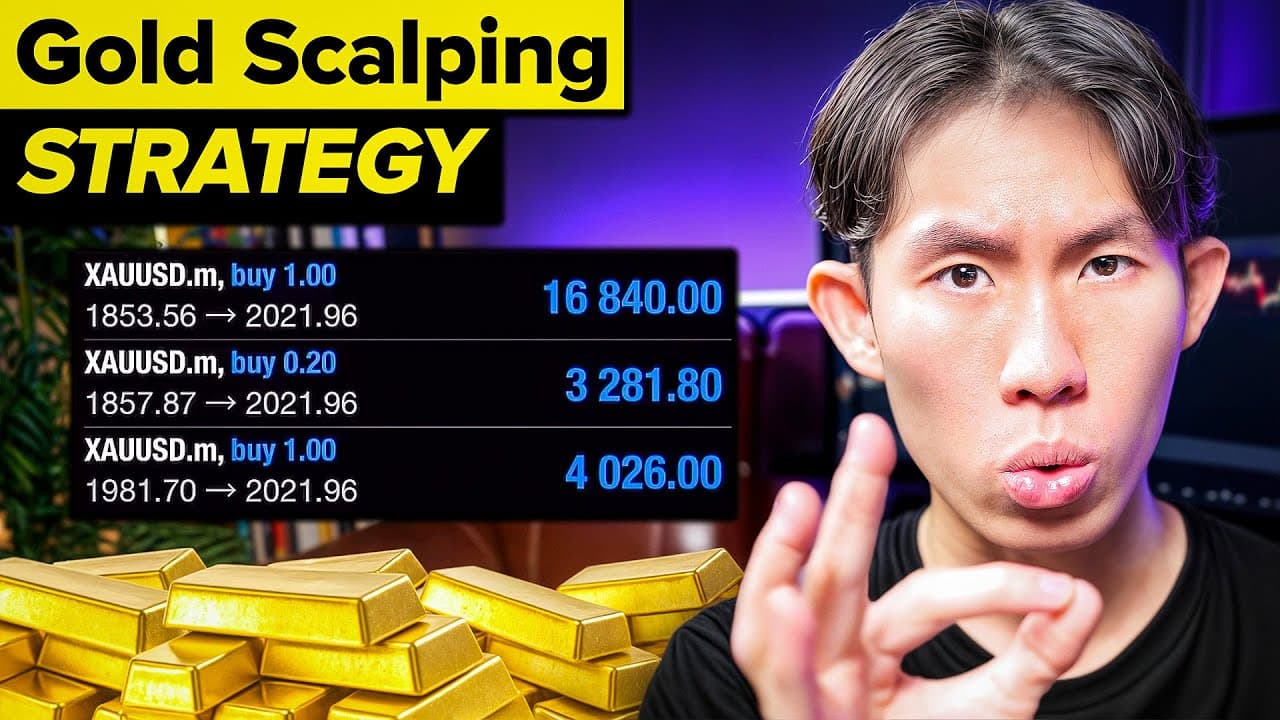
The strategy aims to make $1,000 a day trading gold by marking supply and demand zones, waiting for price to retest them, and entering only after a moving-average crossover and candlestick confirmation. The examples use the 8 EMA, identify entries on the 15-minute chart, and place stops beyond the relevant zone or market structure. Read on for the exact entry, stop-loss, and take-profit rules.
Transcript
this is the only gold trading strategy that you will ever need so in this video I'm going to show you how to make one thousand dollars a day trading gold so the strategy that we'll be using is called supply and demand and the whole G's of this strategy is that we're gonna be looking for aggressive buying and aggressive selling because you must unde... Read More
Key Insights
- Supply and demand strategy focuses on aggressive buying and selling zones.
- Retail traders should follow the market's smart money to succeed.
- Price retests at supply or demand zones offer optimal entry points.
- Confluences like moving average crossovers aid in trade decisions.
- This strategy works in all market conditions, including trending and ranging.
- Patience is crucial; wait for price to reach key levels before entering trades.
- Stop-loss and take-profit levels should be based on market structure.
- The strategy can be applied to both swing trading and scalping.
Install to Summarize YouTube Videos and Get Transcripts
Explore YouTube Video Summarizer or Get YouTube Transcript Extractor
Questions & Answers
Q: How does the gold trading strategy claiming $1,000 a day work?
The strategy identifies demand zones from aggressive buying and supply zones from aggressive selling. The trader waits for price to retest a zone, then looks for both a moving-average crossover and a confirming candlestick pattern before entering.
Q: How are supply and demand zones identified?
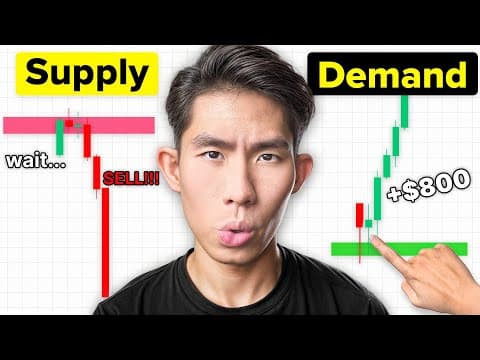
Multiple green candlesticks in a row indicate aggressive buying and can reveal a demand zone near the start of the upward move. Multiple red candlesticks, especially a large red candle, indicate selling pressure and can reveal a supply zone near the start of the decline.
Q: What confirmations are required before entering a trade?
The strategy requires two confluences: a moving-average crossover and a candlestick pattern showing buying or selling pressure. A zone alone is not enough because price can break through it and invalidate the setup.
Q: Which moving average and time frames does the strategy use?
The tutorial chooses the 8 EMA, while also mentioning the 9 EMA as an option. One example observes the setup on the one-hour time frame and moves to the 15-minute time frame to find the entry.
Q: Where should the stop-loss be placed?
For a sell, the stop-loss can be placed above the supply zone or above the last lower high. For a buy, it is placed below the demand zone.
Q: How is the take-profit level selected?
The take-profit is placed at the next key level where price previously stopped or reversed. The tutorial advises looking left on the chart to locate that prior reaction area.
Q: Can this supply-and-demand strategy work in different market conditions?
The speaker says it can be used in sideways or ranging markets, uptrends, downtrends, and reversals. The transcript demonstrates a ranging-market sell, an uptrend buy, and a downtrend supply-zone example.
Q: Why should traders wait instead of entering as soon as price reaches a zone?
Price may break through a supply or demand zone rather than reverse. In the downtrend example, price moves above the supply zone, showing why entering immediately could lead to a stop-out; the strategy waits for both confirmations instead.
Summary & Key Takeaways
-
The supply and demand strategy helps traders earn by identifying zones of aggressive buying or selling. Traders should follow smart money, waiting for price to retest these zones before entering trades. Key confluences like moving average crossovers and candlestick patterns confirm trade entries.
-
This strategy is versatile, applicable in trending, ranging, or reversing markets. Traders must be patient, waiting for price to reach key levels, and use confluences to ensure successful trades. Proper stop-loss and take-profit levels are essential for risk management.
-
By applying this strategy, traders can potentially make $1,000 a day trading gold. The approach involves understanding market structure, identifying supply and demand zones, and waiting for confluences to confirm entries, making it suitable for both swing trading and scalping.
Read in Other Languages (beta)
Share This Summary 📚
Summarize YouTube Videos and Get Video Transcripts with 1-Click
Try YouTube Summary with ChatGPT & Claude or YouTube Transcript Generator
Explore More Summaries from The Trading Geek 📚





Summarize YouTube Videos and Get Video Transcripts with 1-Click
Try YouTube Summary with ChatGPT & Claude or YouTube Transcript Generator