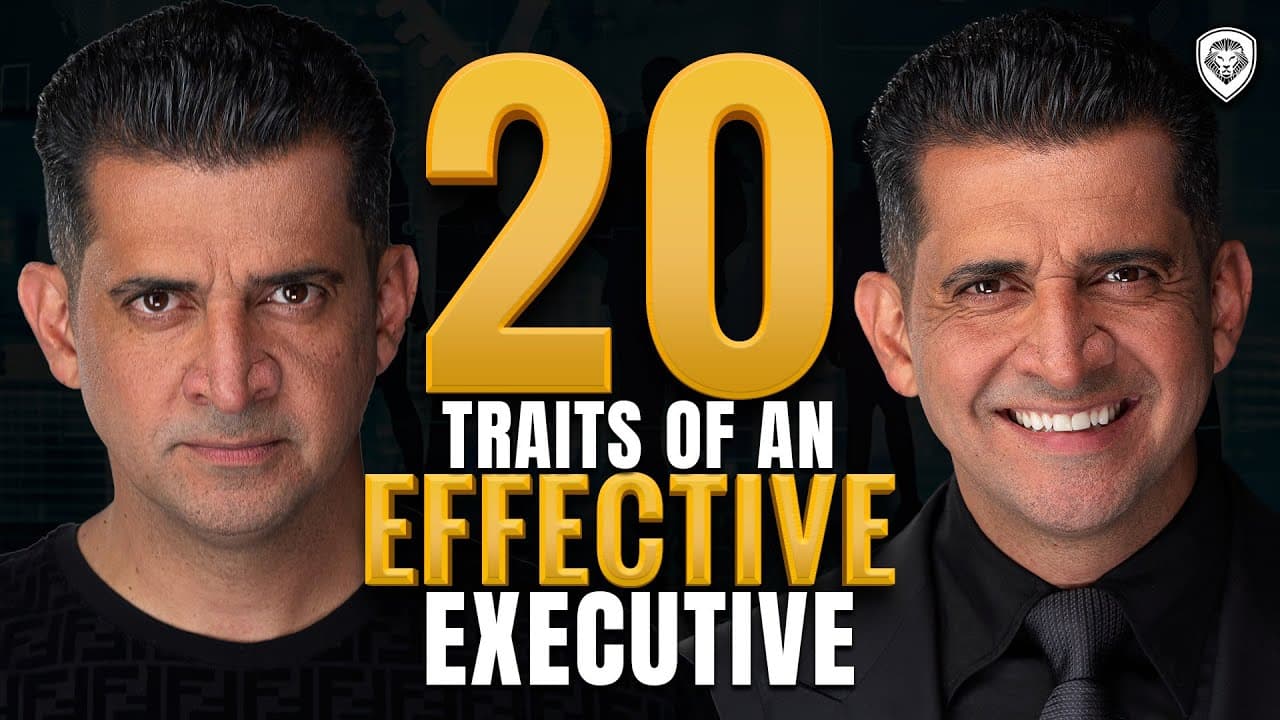
How to Become a Highly Effective Executive
TL;DR
Great executives earn trust by being reliable, developing capable people, confronting problems directly, and acting before risks become crises. They combine firm accountability with strong people skills, remain curious as their responsibilities grow, and make swift personnel decisions when poor performance or cultural mismatch threatens team morale and productivity.
Transcript
one great executive could be life-changing to company it's like winning the lottery matter of fact few years ago I read a book by Patrick lenion phenomenal author wrote a book titled five Temptations of a CEO he said the following most CEOs Executives you can replace it choose status over results choose popularity over accountability they're afraid... Read More
Key Insights
- Reliability is the leading quality associated with future executives because dependable leaders consistently complete their responsibilities. Their bosses, peers, and direct reports trust that important work will be handled without failures spilling over and creating additional work for the rest of the team.
- Great executives duplicate their capabilities by helping direct reports become more disciplined, punctual, professional, and effective. An executive’s leadership ability can be evaluated by identifying specific employees who improved meaningfully under that person’s management rather than considering only the executive’s individual strategic or operational skills.
- Effective executive coaching combines demanding standards with a relationship employees value. Strong coaches challenge people repeatedly, push them beyond comfortable performance levels, and still inspire loyalty because their pressure is understood as an effort to help each person contribute more and become better.
- Swift personnel decisions can protect team morale and productivity when a new hire is clearly underperforming or does not fit the culture. The transcript cites Cornerstone as reporting that 74% of executives agreed that quickly terminating underperformers positively affects morale and productivity.
- Strong people skills make difficult accountability conversations more productive. Effective executives directly address missed deadlines, repeated promises, and performance concerns while also recognizing positive qualities such as attitude, teamwork, and cultural fit, allowing them to communicate consequences without avoiding conflict or creating unnecessary resentment.
- Continuous curiosity remains important as an executive gains authority, compensation, and responsibility. The best executives continue reading, evaluating outside examples, considering new ideas, and asking how the company can improve, while encouraging the same learning orientation among the people they lead.
- Proactive leadership prepares for threats and opportunities before they become urgent. The transcript cites Harvard Business Review as saying proactive executives are 43% more likely to achieve successful outcomes, and it recommends planning around future events, backup systems, contracts, insurance, and force majeure scenarios.
- Accountability requires choosing productive conflict over superficial harmony. Effective executives do not preserve temporary comfort by ignoring missed commitments, poor performance, or cultural problems. They raise the issue directly because unresolved failures can damage trust and create heavier burdens for other members of the organization.
- More videos from this channel:
- More from this channel: Valuetainment
Install to Summarize YouTube Videos and Get Transcripts
Explore YouTube Video Summarizer or Get YouTube Transcript Extractor
Questions & Answers
Q: What is the most important quality of a great executive?
Reliability is presented as the most important executive quality. A reliable leader completes assigned work, keeps commitments, and can be trusted by the chief executive, the board, peers, and direct reports. When something breaks, colleagues know the executive will take ownership. An unreliable executive creates additional work because unfinished responsibilities spill over to other leaders.
Q: How do effective executives develop future leaders?
Effective executives develop future leaders by duplicating their best habits and capabilities in the people they manage. Their direct reports become more disciplined, meet deadlines, improve project management, arrive on time, maintain constructive attitudes, and present themselves professionally. The clearest evidence of executive leadership is a record of specific people who became measurably stronger performers under that executive’s coaching.
Q: What makes someone a strong executive coach?
A strong executive coach combines demanding feedback with a relationship that employees appreciate. The coach challenges people, pushes them to do more, and refuses to accept excuses, yet does so in a way that motivates rather than alienates them. Employees may find the pressure difficult, but they value the coach because the repeated challenge helps produce their best work.
Q: When should an executive terminate an underperforming employee?
An executive should act quickly when evidence shows that an employee is not going to perform effectively or fit the organization’s culture. Warning signs in the transcript include extreme anxiety among colleagues, bossy behavior, speaking down to people, and making everyone feel subordinate. Delaying the decision forces the leader and team to keep working around a known problem.
Q: How should executives handle difficult performance conversations?
Executives should state the performance problem clearly, reference the employee’s commitments, ask what is preventing delivery, and explain the consequences if the pattern continues. They can also acknowledge the person’s positive attitude, teamwork, or cultural fit. This approach preserves respect while making it unmistakable that repeated missed deadlines and broken promises cannot continue without corrective action.
Q: Why must executives remain curious as their careers advance?
Executives must remain curious because increased authority, compensation, and responsibility do not remove the need to improve. Strong leaders keep reading, studying recommendations, examining what other organizations are doing, and proposing new approaches. Their curiosity also influences their teams, creating an environment where people consistently search for better methods, useful information, and practical improvements.
Q: How can executives become more proactive?
Executives become more proactive by looking beyond immediate problems and preparing for events that could affect the organization months or years later. Examples include establishing backups, reviewing events 90 days or six months ahead, negotiating future contracts early, adding force majeure provisions, and considering insurance protection. Proactive thinking asks what might fail and prepares alternatives before failure occurs.
Q: Why is productive conflict important in executive leadership?
Productive conflict is important because avoiding uncomfortable discussions allows missed deadlines, weak performance, and cultural problems to continue. Great executives do not choose surface harmony simply because accountability may create tension. They address issues directly, particularly in startups and smaller businesses where poor performance is difficult to hide and operational pressure makes unresolved problems more damaging to colleagues.
Summary & Key Takeaways
-
Reliability is presented as the most important executive quality because one leader’s performance affects bosses, peers, and direct reports. A dependable executive takes ownership and completes important work without forcing colleagues to compensate for failures. That consistency gives the entire leadership team confidence that responsibilities will be handled properly.
-
Effective executives multiply their impact by developing other people into stronger performers and future leaders. They coach with a combination of pressure, encouragement, discipline, and personal connection. Their influence becomes visible when direct reports improve their execution, meet deadlines more consistently, present themselves professionally, and eventually become effective executives themselves.
-
Strong executives address personnel problems, missed commitments, and foreseeable risks without unnecessary delay. They can hold difficult conversations without making people feel personally attacked, remove employees who clearly do not fit, and anticipate future operational needs. Continued curiosity helps them identify improvements even as their authority, compensation, and responsibilities increase.
Read in Other Languages (beta)
Share This Summary 📚
Summarize YouTube Videos and Get Video Transcripts with 1-Click
Try YouTube Summary with ChatGPT & Claude or YouTube Transcript Generator
Explore More Summaries from Valuetainment 📚
Summarize YouTube Videos and Get Video Transcripts with 1-Click
Try YouTube Summary with ChatGPT & Claude or YouTube Transcript Generator