How Could AI Extend Human Lifespan by Decades?
TL;DR
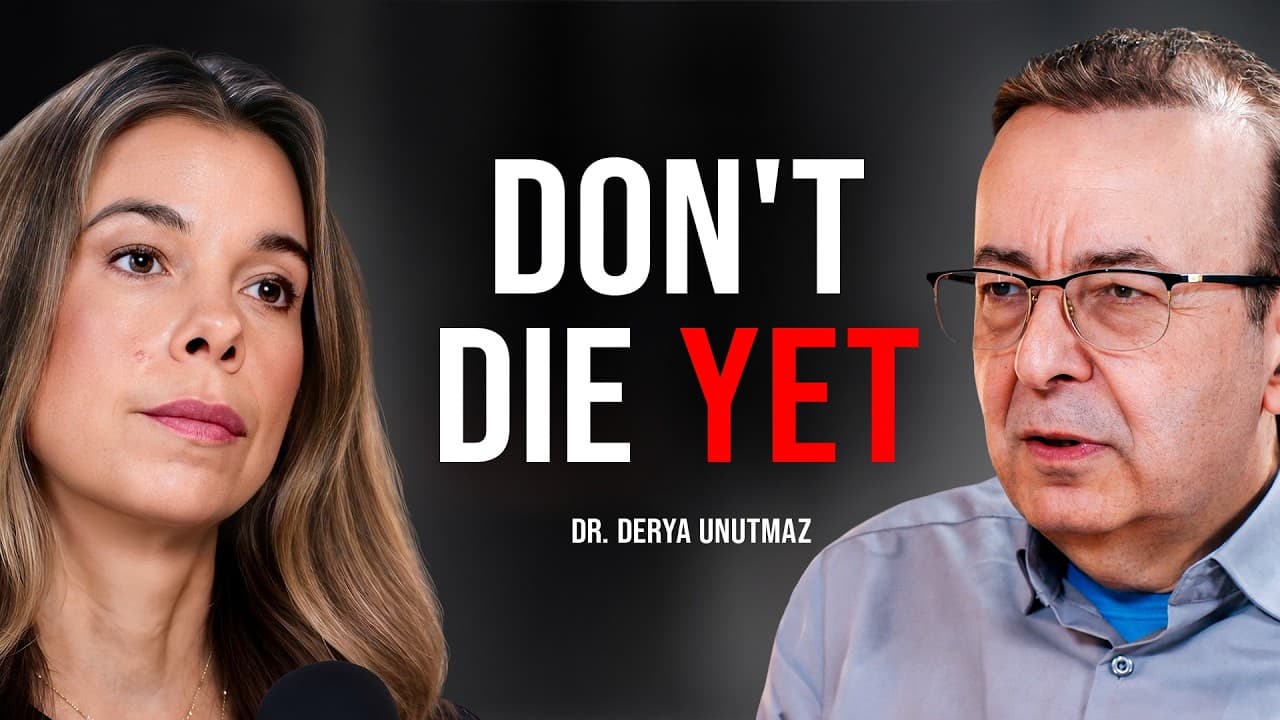
AI could extend human lifespan by rapidly analyzing biological data, selecting better experiments, accelerating drug design, and eventually enabling digital twins for clinical research. Dr. Derya Unutmaz predicts that these advances could create longevity escape velocity within eight to 10 years, make cancer curable within a decade, and permit age reversal within 15 to 20 years, although human misuse remains the central risk.
Transcript
This is probably the most critical time in human history. So try not to die for the next 10 years. >> Can you explain and unpack why you think that? >> The reason is that the technology because of AI is expanding exponentially. Cancer is going to be 100% curable probably less than a decade. We'll get to a point where we'll have hundreds of new drug... Read More
Key Insights
- AI is presented as an exponential accelerator of biomedical progress. Unutmaz argues that people naturally project technological change linearly, while the next decade could produce more advancement than the previous century because increasingly capable AI systems can compress research and development timelines.
- Longevity escape velocity is the point when each year a person survives brings medical advances that add more than one year to expected lifespan. Unutmaz predicts that humanity could reach this threshold within eight to 10 years through accumulating improvements in disease treatment and prevention.
- AI already reduces the time required to review scientific literature and analyze complex biological information. Unutmaz reports that newer reasoning models can examine datasets containing millions of data points, produce extensive analyses, explain what the results may mean, and suggest productive follow-up questions.
- AI-assisted experiment selection can reduce biological research workloads. Instead of researchers testing 100 possible experiments over a year, a model may identify two especially informative experiments that can be completed within a few weeks, while also proposing controls and generating hypotheses.
- AI-driven drug design can replace lengthy screening processes with computational generation and evaluation. Unutmaz expects pharmaceutical companies eventually to use AI in developing new drugs, potentially reducing work that previously required years to a process measured in hours or days.
- Digital twins are proposed as a way to address the slow pace of clinical trials. The concept depends on vast biological datasets and substantially more computing power, with AI modeling intended to help predict drug safety and efficacy before or alongside human testing.
- Cancer treatment is predicted to become increasingly personalized and potentially curable within a decade. This is presented as Unutmaz's optimistic forecast, based on AI accelerating biological understanding, drug discovery, experimental design, and the creation of treatments tailored to individual disease characteristics.
- Human misuse is identified as the main existential danger associated with AI. Unutmaz describes AI itself as an enabling force that gives people greater capabilities, while arguing that humanity remains the source of the most serious risk in how those capabilities are applied.
Install to Summarize YouTube Videos and Get Transcripts
Explore YouTube Video Summarizer or Get YouTube Transcript Extractor
Questions & Answers
Q: How could AI extend human lifespan by decades?
AI could extend lifespan by accelerating several connected parts of medicine: reviewing research, interpreting large biological datasets, generating hypotheses, choosing informative experiments, and designing drugs. Unutmaz argues that these improvements will accumulate until medical progress adds more than one year of expected life for every year a person survives, eventually opening the possibility of age reversal.
Q: What is longevity escape velocity in aging research?
Longevity escape velocity is the proposed point at which every additional year a person lives brings medical advances that add more than one year to that person's expected lifespan. Unutmaz predicts this threshold could arrive within eight to 10 years as new treatments repeatedly prevent deaths, cure previously fatal diseases, and provide enough time for further advances to emerge.
Q: Why does Dr. Derya Unutmaz expect rapid medical progress?
Unutmaz expects rapid progress because he views AI development as exponential rather than linear. He argues that increasingly capable reasoning models can complete literature reviews, data analysis, interpretation, experimental planning, and drug design far faster than traditional research workflows. In his forecast, these connected gains compound, making the next decade potentially more productive than the previous century.
Q: How is AI already helping scientists analyze biological data?
AI can analyze biological datasets containing millions of data points and connect changes across genes, metabolites, and other measurements. Unutmaz describes receiving a 40-page analysis from a model within minutes after supplying RNA sequencing data. Beyond organizing the results, the system offered an interpretation of their meaning and proposed the next questions researchers could investigate.
Q: How can AI help researchers choose better experiments?
AI can compare many possible experimental designs and identify the few most likely to answer a biological question effectively. According to Unutmaz, it can also recommend controls and simulate which approaches should produce the most useful output. That could replace a year spent trying 100 possibilities with a few weeks devoted to two carefully selected experiments.
Q: Could digital twins shorten clinical trials?
Digital twins are proposed as a possible response to the fact that rapidly generated drugs still require safety and efficacy testing in humans. Unutmaz describes the approach as depending on extremely large quantities of biological data and much greater computing capacity. AI could use that information to model individual biology and help make clinical evaluation faster and more predictive.
Q: Could AI make cancer curable within a decade?
Unutmaz predicts that cancer could become fully curable within less than a decade, but this is a forecast rather than an established result. His optimism rests on AI accelerating biological analysis, experiment selection, drug generation, and personalized treatment design. The broader argument is that much faster research cycles could continually produce new interventions for difficult and varied cancers.
Q: When could AI help reverse the aging process?
Unutmaz predicts that complete age reversal could become possible within 15 to 20 years. He describes a future in which a person aged 80 or 90 could return biologically to an age such as 30 or 40, potentially adding 50 or 100 years of life. The transcript presents this as an optimistic projection driven by accelerating technology.
Summary & Key Takeaways
-
Dr. Derya Unutmaz argues that exponential advances in AI could accelerate medicine enough to produce longevity escape velocity within eight to 10 years. At that point, each additional year lived could bring medical advances that add more than one year to expected lifespan through better disease prevention, treatment, and recovery.
-
Current AI systems can scan scientific literature, analyze biological datasets containing millions of data points, generate hypotheses, interpret relationships among genes and metabolites, and recommend high-value experiments. Unutmaz says these capabilities can compress months or years of scientific analysis into minutes or hours while reducing the number of experiments researchers must perform.
-
AI-generated drugs would still require evidence of safety and effectiveness in humans. Unutmaz proposes digital twins, built from extremely large quantities of biological data and much greater computing capacity, as a possible way to shorten clinical development. He also predicts increasingly personalized cancer treatment and eventual reversal of biological aging.
Read in Other Languages (beta)
Share This Summary 📚
Summarize YouTube Videos and Get Video Transcripts with 1-Click
Try YouTube Summary with ChatGPT & Claude or YouTube Transcript Generator
Explore More Summaries from FoundMyFitness 📚
Summarize YouTube Videos and Get Video Transcripts with 1-Click
Try YouTube Summary with ChatGPT & Claude or YouTube Transcript Generator