How are metal organic frameworks built and used
TL;DR
Metal organic frameworks are porous materials made by linking metal nodes with organic linkers to form three dimensional structures with cavities. These frameworks can store and separate gases, catalyze reactions, deliver drugs, and sense molecules, with tailor able cavities that fit specific targets. The prize highlights the modular chemistry behind these frameworks.
Transcript
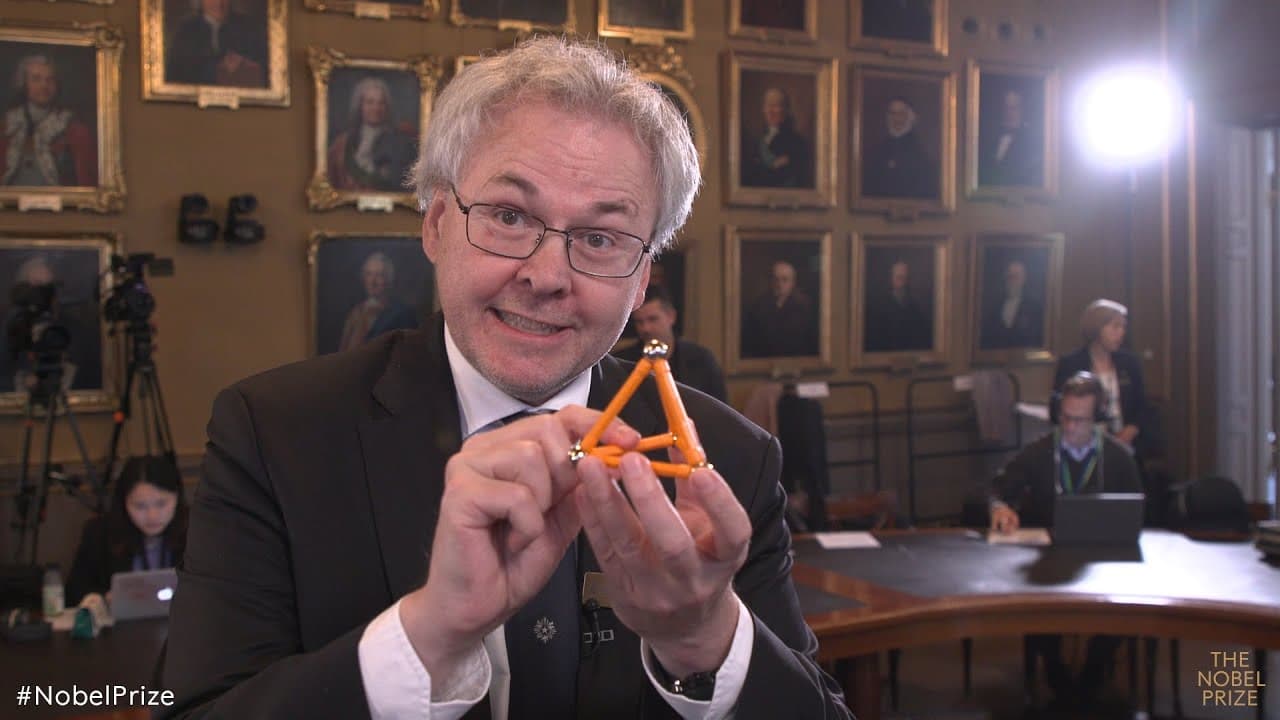
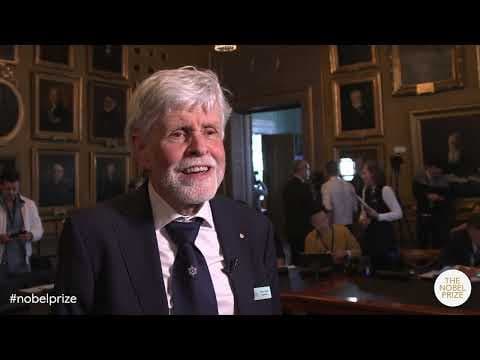
Professor Olaf Ramstrom, member of the Nobel Committee for Chemistry. What is this year's prize about? This year's prize is about metal organic frameworks and this is a type of structure, a porous structure which our laureates have developed over a number of years from very basic principles. So what they actually have done and I can show you a litt... Read More
Key Insights
- Metal organic frameworks are porous structures formed by metal nodes and organic linkers.
- Cavities inside the frameworks allow absorption and release of small molecules like water.
- Frameworks can be tailored to fit specific gas molecules or reactions.
- Inside the frameworks, catalytic groups can degrade harmful substances in air.
- Applications include gas storage, gas separation, and environmental remediation.
- Beyond storage, frameworks are explored for drug delivery and biological sensing.
- Laureates for the prize include three researchers from diverse regions and backgrounds.
- The development rests on basic coordination chemistry and modular assembly principles.
Install to Summarize YouTube Videos and Get Transcripts
Explore YouTube Video Summarizer or Get YouTube Transcript Extractor
Questions & Answers
Q: What are metal organic frameworks and how are they constructed?
Metal organic frameworks are porous materials built by combining metal nodes or clusters with organic linkers. The process involves dissolving the two components and allowing them to self assemble into a three dimensional network with cavities. The resulting structure can capture and release small molecules such as water, enabling applications in storage, separation, and catalysis. The chemistry is based on coordinating interactions and deliberate pattern formation to create defined pore sizes and chemical environments.
Q: Why are the cavities in these frameworks important for applications?
The cavities define the size and shape of the space where molecules can reside, so they can be tailored to fit specific gases or molecules. By adjusting the cavity dimensions and chemical groups inside, the framework can selectively admit certain molecules while excluding others. This selectivity is essential for gas separation, storage, and enabling catalytic reactions inside the pores.
Q: What are some practical uses mentioned for metal organic frameworks?
Practical uses include gas storage and separation to manage different gases, degradation of harmful substances in the air through catalytic groups, drug delivery where frameworks hold and release drugs at controlled times and places, and sensing where a binding event produces a detectable signal. These applications rely on the ability to tailor pore sizes and functional groups.
Q: Who are the laureates and what is notable about the award?
The laureates are Susumu Kitagawa, Richard Robson, and Omar M. Yaghi. The award recognizes the development of metal organic frameworks, highlighting their creation from basic coordination chemistry principles. The interview notes the laureates' surprise and their friendships, underscoring the collaborative nature of the achievement and its broad potential impact across multiple disciplines.
Q: How does the Nobel Prize interview describe the prize winning work?
The interview emphasizes that the prize-winning work builds remark able materials from simple chemical principles. It discusses how the materials can be tuned to specific cavities and functional groups, enabling selective interactions with target molecules, catalytic activities, and potential applications in air purification, drug delivery, and sensing. The description ties these outcomes to foundational coordination chemistry.
Q: What role do catalytic groups play inside the frameworks?
Catalytic groups integrated inside the framework can react with molecules that enter the pores, transforming them into less harmful compounds or enabling specific chemical conversions. This inside the pores catalysis provides a way to degrade pollutants in the air and to perform targeted chemical transformations while the framework maintains its structure and continues to function for storage or delivery.
Q: How can the structure be modified for different applications?
The structure can be modified by selecting different metal nodes and organic linkers, adjusting the size and shape of the cavities, and incorporating functional groups that interact with target molecules. This modular approach allows customization for gas selectivity, drug release kinetics, catalytic activity, and sensing responses, enabling a wide range of tailored applications.
Q: What is the significance of basic chemistry principles in this work?
The significance lies in taking basic principles of coordination chemistry and applying them to build complex, functional materials. By understanding how metal ions connect with organic linkers and how to control self assembly, researchers can design frameworks with precise pore structures, reactive sites, and predictable behaviors. This foundational knowledge enables scalable creation and diverse applications.
Summary & Key Takeaways
-
The video introduces metal organic frameworks as porous materials built from metal nodes and organic linkers, forming 3D structures with cavities that capture small molecules. It explains how the pores can be engineered for gas storage and separation, and how catalytic groups inside enable reactions and pollutant degradation.
-
Applications of these frameworks extend to drug delivery, sensing, and environmental cleanup, especially for clean air and targeted molecule interactions. The discussion touches on the ability to modify the framework to fit specific gases or molecules and to trigger controlled release.
-
The interview with Professor Olaf Ramström covers the Nobel Prize context, naming the laureates and highlighting the collaboration and surprise of awardees, while underscoring the foundational chemistry principles behind framework design and the broad potential impact across multiple fields.
Read in Other Languages (beta)
Share This Summary 📚
Summarize YouTube Videos and Get Video Transcripts with 1-Click
Try YouTube Summary with ChatGPT & Claude or YouTube Transcript Generator
Explore More Summaries from Nobel Prize 📚
Summarize YouTube Videos and Get Video Transcripts with 1-Click
Try YouTube Summary with ChatGPT & Claude or YouTube Transcript Generator