Why Use Ansible for Configuration Management?
TL;DR
Ansible helps system administrators automate configuration management across environments where manual work and platform-specific scripts become difficult to maintain. It is presented as a better fit for many repeatable infrastructure tasks involving Linux, Windows, packages, application dependencies, security, and server maintenance, while Python remains useful for automation tasks that require capabilities beyond Ansible.
Transcript
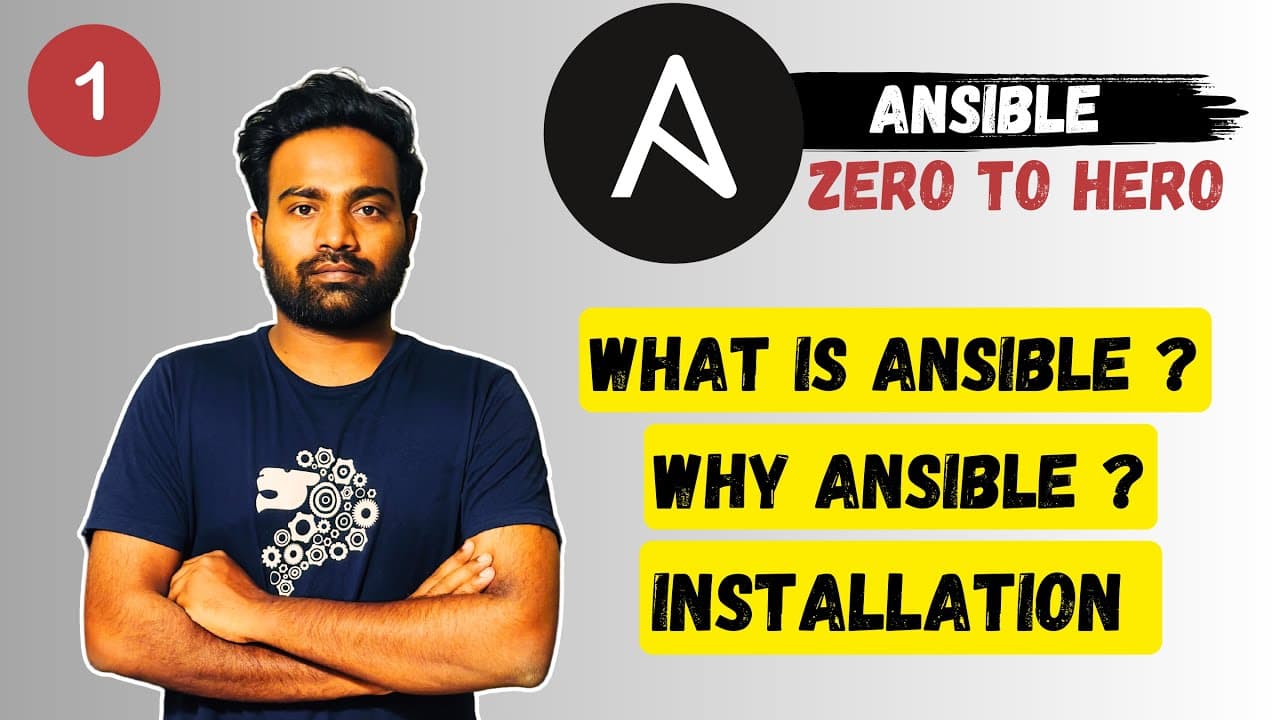
hello everyone my name is abishek and welcome back to my Channel today is the very first episode of our new Zero to Hero series that is anible Zero to Hero Series in this video we will learn introduction to anible and how to get started to be precise we will learn what is anible why anible and how anible works internally along with that we will als... Read More
Key Insights
- Configuration management is a primary system administration responsibility that includes maintaining operating systems, packages, libraries, application dependencies, web servers, and application servers. These components should remain supported, appropriately updated, secure, and suitable for the applications running on each managed machine.
- Manual server administration becomes harder when an organization operates multiple physical servers or virtual machines. A system administrator must repeatedly verify software versions, security conditions, dependencies, resources, and availability, which creates a strong reason to automate consistent configuration work.
- Shell scripting is limited by differences among operating systems and Linux distributions. A script created for Linux will not necessarily work on Windows, while commands written for CentOS may not work correctly on Debian or Ubuntu, making heterogeneous infrastructure more difficult to automate with one script.
- Ansible is presented as an automation tool for configuration management tasks that would otherwise be completed manually or through platform-specific scripts. Its value is clearest when administrators need to perform repeatable infrastructure operations across machines with different operating environments.
- Passwordless authentication is described as a prerequisite for executing Ansible against managed nodes. The course therefore places it before inventories, ad hoc commands, and playbooks, establishing connectivity as an essential foundation for later automation work.
- Ansible ad hoc commands are introduced before playbooks because they reveal the building blocks of Ansible and demonstrate how it communicates with managed nodes. Understanding these direct commands is intended to make the transition to structured playbook development easier.
- Ansible roles organize complicated automation and support reusable, prebuilt components through Ansible Galaxy. The course distinguishes roles from playbooks, examines the folders within a role, explains each folder's significance, and develops both a simple role and a more complicated project-oriented role.
- Ansible can be integrated with other automation and security practices. The planned course covers Vault integration, policy as code, network automation, Ansible Tower, role-based access control, and a project combining Terraform for infrastructure provisioning with Ansible for configuration management.
Install to Summarize YouTube Videos and Get Transcripts
Explore YouTube Video Summarizer or Get YouTube Transcript Extractor
Questions & Answers
Q: What is Ansible used for in configuration management?
Ansible is presented as a tool for automating configuration management tasks across managed machines. Those tasks include maintaining operating system distributions, packages, shared libraries, application dependencies, web servers, and application servers. It can reduce the need to perform these activities manually and address some difficulties created by using separate scripts for different operating systems or Linux distributions.
Q: Why should system administrators automate server configuration?
System administrators must keep operating systems and software on supported, secure versions while also maintaining application dependencies, CPU, memory, and server availability. Doing this manually across multiple physical servers or virtual machines requires repeated work and can become difficult to manage. Automation provides a way to perform recurring configuration activities more consistently across the machines for which an administrator is responsible.
Q: Why can shell scripts fail across different servers?
Shell scripts can depend on the operating system and distribution for which they were written. A script designed to automate tasks on Linux may not work on a Windows machine. Even among Linux servers, commands intended for CentOS can fail on Debian or Ubuntu. These differences make one shell script difficult to apply reliably across a mixed collection of managed systems.
Q: When should Ansible be compared with Python or shell scripting?
Ansible, Python, and shell scripting should be compared when choosing how to automate a specific task. The course proposes examining Ansible's advantages over shell and Python for certain automation activities, while also identifying tasks where Python may be preferable to Ansible. The appropriate choice depends on the automation requirement rather than treating one option as suitable for every situation.
Q: What should be learned before writing Ansible playbooks?
Passwordless authentication, Ansible inventory, and ad hoc commands are presented as foundations to learn before developing playbooks. Passwordless authentication enables communication with managed nodes, while inventory is a core Ansible concept. Ad hoc commands expose the building blocks of the tool and show how it interacts with managed nodes, making playbooks easier to understand afterward.
Q: What are Ansible roles and why are they useful?
Ansible roles are presented as a way to structure complicated automation beyond basic playbooks. They can help organize tasks through a defined folder structure and can support reusable, prebuilt roles obtained through Ansible Galaxy. The course covers why roles are used, how they differ from playbooks, what their folders mean, and how to create simple and more complicated roles.
Q: How do Ansible variables and precedence affect playbooks?
Ansible variables can be placed in multiple locations, including global variables, host variables, playbooks, defaults, and variable folders within roles. Because several definitions may exist, their order of precedence determines which value is applied. The course dedicates a session to this topic because learners can become confused about where variables should be placed and which definition takes priority.
Q: What advanced topics are included in the Ansible course?
The later course topics include conditionals, loops, error handling, securing Ansible files, Vault integration, policy as code, network automation, and Ansible Tower. It also covers role-based access control, an advanced project integrating Terraform with Ansible, and interview questions. Terraform is assigned infrastructure provisioning, while Ansible handles configuration management within the planned enterprise-level integration project.
Summary & Key Takeaways
-
Configuration management includes keeping operating system distributions, packages, shared libraries, application dependencies, web servers, and application servers on supported and secure versions. System administrators must also maintain server resources and availability. Performing these responsibilities manually becomes increasingly difficult as the number and variety of managed machines grow.
-
Shell scripts can automate administrative tasks, but scripts written for one operating system may fail on another. Differences between Windows and Linux, or between Linux distributions such as CentOS, Debian, and Ubuntu, create portability challenges. Ansible is introduced as an automation option for handling many repeatable configuration tasks across varied environments.
-
The 14-episode course progresses from Ansible fundamentals to passwordless authentication, inventories, ad hoc commands, playbooks, roles, variables, conditionals, loops, error handling, security, policy as code, network automation, Ansible Tower, Terraform integration, and interview preparation. The planned sequence moves from foundational concepts toward enterprise-oriented projects and advanced operational topics.
Read in Other Languages (beta)
Share This Summary 📚
Summarize YouTube Videos and Get Video Transcripts with 1-Click
Try YouTube Summary with ChatGPT & Claude or YouTube Transcript Generator
Explore More Summaries from Abhishek.Veeramalla 📚

Summarize YouTube Videos and Get Video Transcripts with 1-Click
Try YouTube Summary with ChatGPT & Claude or YouTube Transcript Generator