How to Manage Kubernetes Clusters in Production
TL;DR
Production Kubernetes management covers cluster creation, configuration, upgrades, and deletion through Kubernetes distributions or managed services. Local environments such as Minikube, kind, k3d, and MicroK8s are useful for learning and development, but production systems require enterprise capabilities, appropriate infrastructure, lifecycle management, and a support model suited to the organization.
Transcript
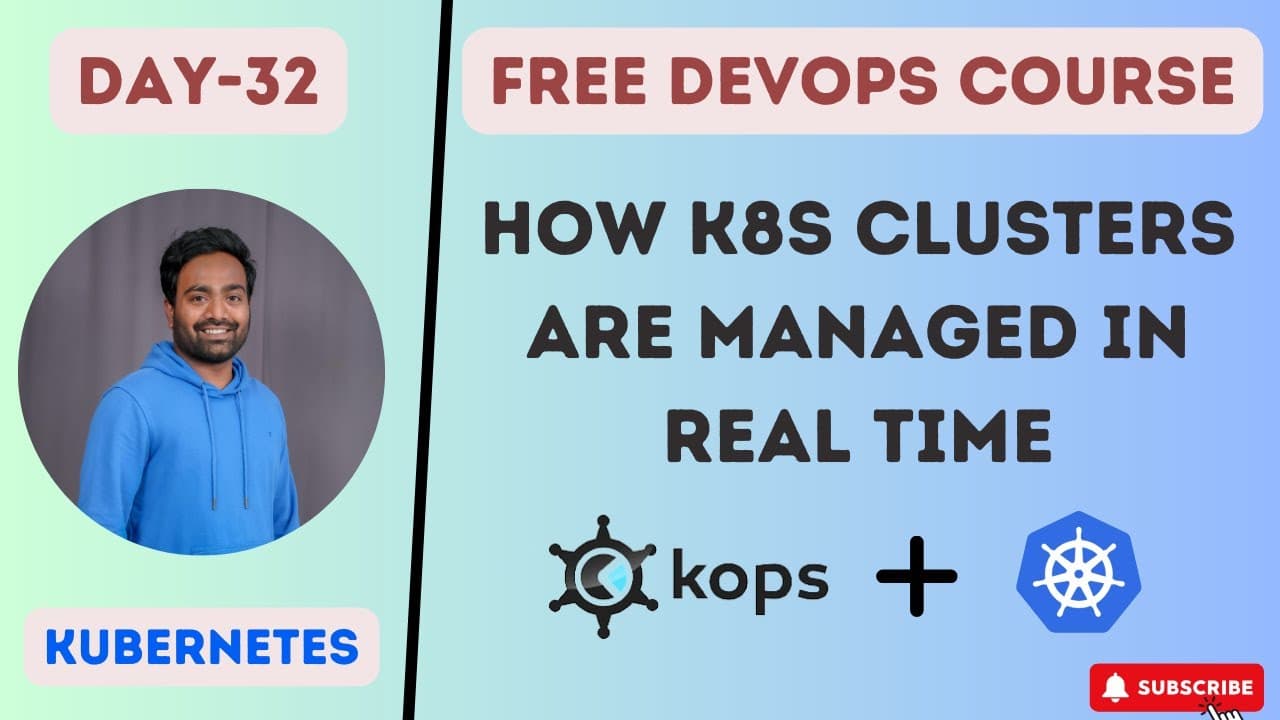
hello and my name is Abhishek and welcome back to my channel so first of all uh I would like to say sorry for the delay I was stuck in some other issues so I couldn't upload the video on time but yeah it's never too late so uh today we are at day 32 of our complete devops course and in this class I'm going to talk about kubernetes production system... Read More
Key Insights
- Local Kubernetes environments are development tools intended for learning, experimentation, and initial application testing. Minikube, kind, k3d, and MicroK8s can help users explore Kubernetes, but they should not be presented as equivalent to a full production installation during a DevOps interview.
- Production Kubernetes management is a lifecycle responsibility that includes creating, configuring, upgrading, and deleting clusters. DevOps and cloud engineers are expected to understand these operational tasks because organizations depend on them to maintain the infrastructure supporting deployed applications.
- A Kubernetes distribution is a platform built around the open source Kubernetes orchestration system. Vendors add management software, wrappers, user experience improvements, managed infrastructure, or customer support while preserving the underlying Kubernetes concepts and architecture.
- Managed Kubernetes services are valuable because their providers support the Kubernetes service itself. When Kubernetes is installed independently on cloud compute instances, the cloud provider supports its compute service but may direct Kubernetes-specific problems toward its managed Kubernetes offering.
- Commercial distributions are designed to provide accountable customer support for organizations paying for the service. Open source communities can also help resolve problems, but they follow their own priorities and timelines rather than a particular customer's contractual support expectations.
- Self-managed Kubernetes can be appropriate when an organization has the skills and operational model to maintain it. Organizations may also use it to control costs in development, staging, or pre-production environments where providing every developer with a separate managed cluster would be expensive.
- Production clusters require capabilities beyond a lightweight local setup. The transcript highlights high availability and greater resource needs, including the storage and memory consumed by etcd, as examples of concerns that become important in enterprise Kubernetes environments.
- Kubernetes knowledge transfers across distributions because products such as OpenShift, Rancher, Tanzu, EKS, AKS, and GKE are based on Kubernetes. Engineers who understand the core architecture and behavior can more readily learn the management experience offered by each distribution.
Install to Summarize YouTube Videos and Get Transcripts
Explore YouTube Video Summarizer or Get YouTube Transcript Extractor
Questions & Answers
Q: How do DevOps engineers manage Kubernetes clusters in production?
DevOps engineers manage the complete Kubernetes cluster lifecycle, including creation, configuration, upgrades, and deletion. They also select an appropriate Kubernetes distribution, prepare infrastructure, account for availability and resource requirements, and establish a support model. Production work therefore extends beyond deploying applications and requires ongoing responsibility for the platform on which those applications run.
Q: What is a Kubernetes distribution?
A Kubernetes distribution is a platform built around the open source Kubernetes container orchestration system. A provider may add software, management wrappers, a different user experience, managed infrastructure, or customer support. Examples named in the transcript include OpenShift, Rancher, VMware Tanzu, EKS, AKS, and GKE, all of which retain Kubernetes as their underlying foundation.
Q: Why should Minikube not be used as a production Kubernetes cluster?
Minikube is presented as a local Kubernetes environment intended for development, learning, and exploration rather than production operations. Lightweight local platforms may lack production capabilities such as high availability and do not promise to resolve production incidents. They remain useful for practicing Kubernetes concepts and testing software before it reaches more demanding environments.
Q: What is the difference between local and production Kubernetes environments?
Local Kubernetes environments prioritize easy setup and low resource use for learning, experimentation, and initial software testing. Production environments require fuller enterprise capabilities, stronger availability, adequate storage and memory, lifecycle maintenance, and a suitable support arrangement. Production operators must also handle operational problems and upgrades that a lightweight development platform is not designed to cover.
Q: Why do organizations use managed Kubernetes services?
Organizations use managed Kubernetes services to obtain a provider-backed platform and direct support for Kubernetes-related issues. The transcript contrasts this with installing Kubernetes independently on cloud compute instances, where the provider may support only the compute service. Managed offerings can therefore provide clearer responsibility when the Kubernetes platform itself encounters operational problems.
Q: Can organizations run open source Kubernetes directly in production?
Organizations can run open source Kubernetes directly in production when that approach matches their requirements and operational capabilities. The transcript notes that not every organization requires an issue to be resolved within a strict short timeline. Self-managed Kubernetes may therefore remain suitable when the organization can maintain it and accepts the available support model.
Q: How can organizations control Kubernetes costs across environments?
Organizations can reserve managed Kubernetes services for environments that need their operational features and support while using self-managed or lighter Kubernetes setups for development, staging, pre-production, or early application testing. The transcript explains that assigning a separate managed cluster to every developer could create substantial expense, especially across many teams and applications.
Q: What Kubernetes experience should a DevOps candidate discuss in an interview?
A DevOps candidate should discuss production-oriented Kubernetes distributions and describe practical responsibility for installation, configuration, upgrades, and broader cluster lifecycle management. The transcript advises against presenting Minikube or similar local environments as production platforms. Candidates should instead explain the distribution they used, how it was operated, and which production requirements shaped that choice.
Summary & Key Takeaways
-
Local Kubernetes environments are designed primarily for learning, experimentation, and application development. They do not represent every capability or operational issue found in production. DevOps and cloud engineers therefore need experience with production-oriented Kubernetes installations, including the infrastructure, availability, storage, configuration, maintenance, and support considerations involved in operating clusters.
-
A Kubernetes distribution builds services, wrappers, management features, or customer support around the open source Kubernetes platform. Examples discussed include OpenShift, Rancher, VMware Tanzu, EKS, AKS, and GKE. Understanding Kubernetes concepts and architecture provides a foundation for working with these distributions because each is based on the same orchestration platform.
-
Production cluster management covers the complete lifecycle, from creation and configuration through upgrades and deletion. Organizations choose between self-managed Kubernetes and commercial or managed distributions according to cost, scale, operational needs, and support expectations. Development and pre-production environments may use less expensive setups while production environments receive stronger capabilities and support.
Read in Other Languages (beta)
Share This Summary 📚
Summarize YouTube Videos and Get Video Transcripts with 1-Click
Try YouTube Summary with ChatGPT & Claude or YouTube Transcript Generator
Explore More Summaries from Abhishek.Veeramalla 📚


Summarize YouTube Videos and Get Video Transcripts with 1-Click
Try YouTube Summary with ChatGPT & Claude or YouTube Transcript Generator