What is Infrastructure as Code with Terraform?
TL;DR
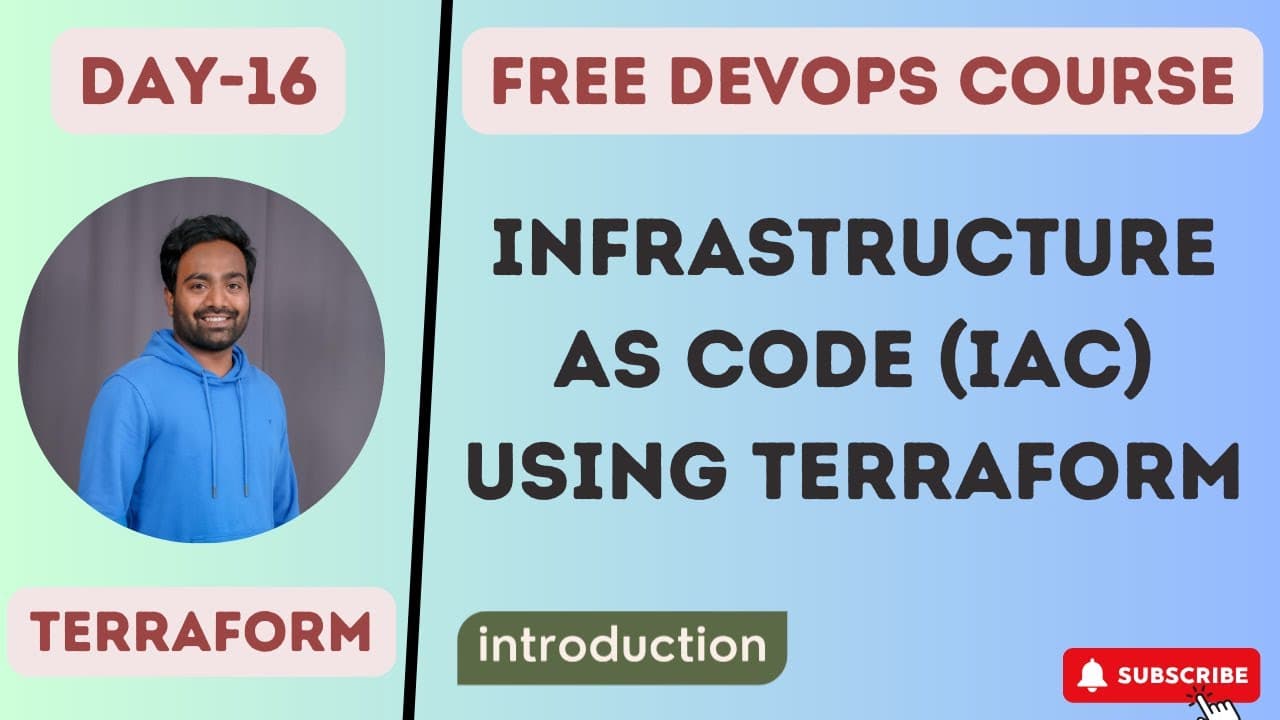
Infrastructure as Code (IaC) allows DevOps engineers to automate the setup of computing resources through code rather than manual processes. Terraform, developed by HashiCorp, simplifies this by enabling automation across multiple cloud providers using a single language, reducing the need to learn different tools for each provider.
Transcript
hello everyone my name is Abhishek and welcome back to my channel so today we are at day 16 of our complete devops course in the previous classes we talked about configuration management we talked about ansible and yeah I know few of you have uh doubts with respect to Dynamic inventory that is something that we did not talk in the previous class so... Read More
Key Insights
- Infrastructure as Code (IaC) is a method of managing and provisioning computing resources through machine-readable definition files, rather than physical hardware configuration or interactive configuration tools.
- Terraform, developed by HashiCorp, is a tool that allows for the automation of infrastructure across various cloud providers using a single language.
- The key advantage of Terraform is its ability to work with multiple cloud providers, enabling a smoother transition between them with minimal script modification.
- Terraform uses the concept of 'API as Code', which allows it to interact with the APIs of different cloud providers, automating resource management without manual intervention.
- Hybrid cloud models involve using multiple cloud providers simultaneously, which can complicate infrastructure management without tools like Terraform.
- Terraform simplifies the learning curve for DevOps engineers by offering a unified approach to infrastructure management, eliminating the need to learn multiple provider-specific tools.
- API as Code involves programmatically interacting with applications through their APIs, allowing for automation and integration without manual processes.
- Terraform scripts, once written, are converted by Terraform into API calls that communicate with the cloud provider, automating tasks like creating virtual machines or managing storage.
Install to Summarize YouTube Videos and Get Transcripts
Explore YouTube Video Summarizer or Get YouTube Transcript Extractor
Questions & Answers
Q: What is Infrastructure as Code?
Infrastructure as Code (IaC) is a method of managing and provisioning computing infrastructure through machine-readable definition files, rather than using physical hardware configuration or interactive configuration tools. It allows for automation of infrastructure setup, making it more consistent and efficient.
Q: How does Terraform facilitate cloud automation?
Terraform facilitates cloud automation by allowing users to define infrastructure as code using a simple configuration language. It interacts with cloud provider APIs to automate the creation, modification, and management of resources across multiple cloud platforms, simplifying the process and reducing the need to learn different tools for each provider.
Q: Why is Terraform beneficial for hybrid cloud models?
Terraform is beneficial for hybrid cloud models because it allows for seamless automation across multiple cloud providers. This enables organizations to leverage the strengths of different providers while maintaining a consistent infrastructure management approach, reducing complexity and improving flexibility in cloud resource management.
Q: What problem does Terraform solve for DevOps engineers?
Terraform solves the problem of needing to learn multiple cloud provider-specific tools for infrastructure automation. By providing a single language and toolset, Terraform enables DevOps engineers to automate infrastructure across various cloud providers, simplifying the learning curve and making transitions between providers smoother.
Q: What is 'API as Code' in the context of Terraform?
'API as Code' in the context of Terraform refers to the practice of using Terraform scripts to interact with cloud provider APIs programmatically. This allows for the automation of infrastructure management tasks, such as creating or modifying resources, without manual intervention, making the process more efficient and consistent.
Q: How does Terraform handle provider-specific differences?
Terraform handles provider-specific differences by using provider-specific modules and configurations. When transitioning between providers, minimal changes are needed in the Terraform scripts, such as updating provider details, allowing for a smooth migration process while maintaining infrastructure automation.
Q: What are the key components of a Terraform setup?
The key components of a Terraform setup include configuration files written in HashiCorp Configuration Language (HCL), provider definitions to specify the cloud platform, and resource blocks that define the infrastructure components to be managed. Terraform uses these components to generate API calls for the cloud provider.
Q: Why might organizations choose Terraform over other IaC tools?
Organizations might choose Terraform over other IaC tools because it supports multiple cloud providers with a unified approach, reducing the complexity and cost of managing infrastructure across different platforms. Its modular design and community-driven ecosystem also provide flexibility and a wide range of integrations.
Summary & Key Takeaways
-
Infrastructure as Code (IaC) enables automated management of computing resources using code. Terraform, by HashiCorp, streamlines this process by allowing automation across multiple cloud platforms with a single tool, reducing the need to learn various provider-specific tools.
-
Terraform employs 'API as Code', which lets it interact with cloud provider APIs to automate resource management, facilitating easier transitions between providers and supporting hybrid cloud architectures.
-
By using Terraform, DevOps engineers can write scripts that Terraform converts into API calls, automating infrastructure tasks like creating virtual machines and managing storage, all without manual intervention.
Read in Other Languages (beta)
Share This Summary 📚
Summarize YouTube Videos and Get Video Transcripts with 1-Click
Try YouTube Summary with ChatGPT & Claude or YouTube Transcript Generator
Explore More Summaries from Abhishek.Veeramalla 📚




Summarize YouTube Videos and Get Video Transcripts with 1-Click
Try YouTube Summary with ChatGPT & Claude or YouTube Transcript Generator