How to Become a DevOps Engineer in 3 Months
TL;DR
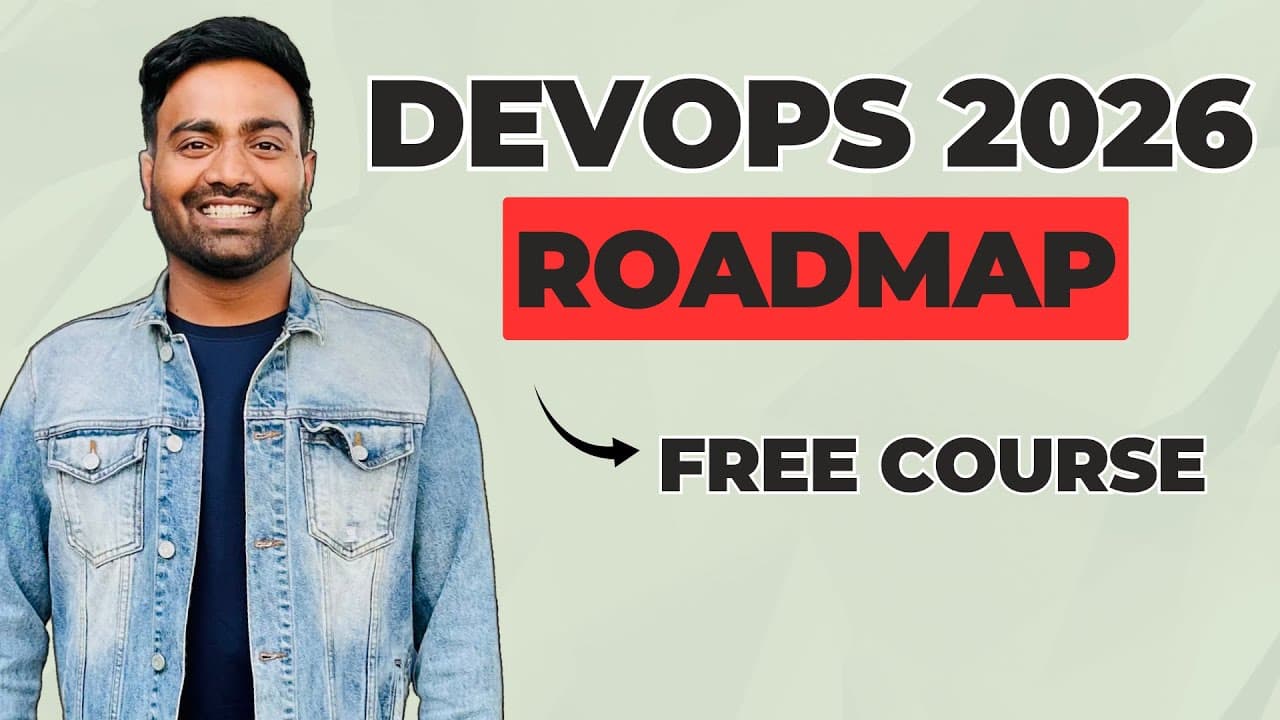
Start with DevOps fundamentals, then study one cloud platform, Terraform, Python, AI-assisted DevOps, and observability. The proposed three-month path prioritizes job-relevant knowledge, scenario-based interview preparation, and resume projects, with roughly 25 days each for fundamentals and cloud, 10 days each for Terraform, Python, and AI-assisted DevOps, plus 5 to 6 days for observability.
Transcript
Hello everyone, my name is Abhishek and welcome back to my channel. In today's video, I'll share the complete road map along with free resources to become a DevOps engineer in 2026. Let me tell you I share these road maps every year and more than thousand people got placed into DevOps roles just by following our road maps along with free resources ... Read More
Key Insights
- DevOps preparation is organized into six sequential stages: fundamentals, a cloud platform, infrastructure as code with Terraform, Python for DevOps, AI-assisted DevOps, and observability. The complete path is presented as a roughly three-month journey toward resume preparation and beginning job interviews.
- DevOps fundamentals should begin with what DevOps is, why organizations use it, its professional scope, and how it accelerates the software development life cycle. Understanding these prerequisites gives learners a reason and context for every concept or tool introduced later.
- Linux study should initially focus on fundamentals rather than months of advanced material. The suggested starting scope includes Linux advantages, its popularity, virtual machine creation, remote access through SSH, basic shell interaction, and the top 50 commands used by DevOps engineers in daily work.
- Git is important because developers use version control and DevOps engineers apply it to infrastructure as code. The roadmap recommends learning how version control works, how Git addresses the problem, and how to use GitHub, including accounts, organizations, open-source projects, and available AI features.
- Terraform should be introduced at a basic level before cloud study because its practical purpose depends on understanding AWS or Azure services. Early preparation should cover infrastructure as code, Terraform installation and configuration, and a basic script, followed by deeper study after learning a cloud platform.
- Container knowledge should include the distinction between containers and virtual machines, Docker architecture, networking, storage volumes, container execution, and image creation. A container-focused project is also recommended because practical implementation helps learners develop confidence rather than relying only on conceptual study.
- Kubernetes becomes easier when learners already understand Linux and containers. Initial job-focused coverage should include architecture, clusters, pods, deployments, StatefulSets, DaemonSets, ConfigMaps, Secrets, custom resource definitions, Helm, Kustomize, ingress, and the Gateway API before moving toward more advanced material.
- Advanced Linux and CI/CD should come near the end of the fundamentals stage. Advanced Linux coverage includes folder structure, logs, processes, memory, routine DevOps activities, and projects, while CI/CD is delayed because it spans multiple tools and concepts.
Install to Summarize YouTube Videos and Get Transcripts
Explore YouTube Video Summarizer or Get YouTube Transcript Extractor
Questions & Answers
Q: How can I become a DevOps engineer in three months?
Follow the proposed six-stage sequence: spend about 25 days on DevOps fundamentals, 25 days on either AWS or Azure, 10 days on Terraform, 10 days on Python for DevOps, 10 days on AI-assisted DevOps, and 5 to 6 days on observability. Include projects, scenario-based interview questions, and resume preparation so you can begin attending interviews after completing the path.
Q: What should I study first when starting DevOps?
Begin by understanding what DevOps is, why it is used, the scope of a DevOps role, and the responsibilities you may have inside a company. You should also understand where DevOps fits into the software development life cycle and how it accelerates that cycle. These prerequisites provide essential context before you begin Linux, Docker, or other tools.
Q: How much Linux should a DevOps beginner learn?
A beginner should initially study Linux fundamentals instead of spending two or three months on the subject. Start with why Linux is widely used and how it compares with Windows, then practice creating a Linux virtual machine, logging into it, using SSH, and running basic shell commands. The roadmap specifically recommends learning the top 50 shell commands used by DevOps engineers.
Q: Why should DevOps learners study Git and GitHub?
Git matters because developers use version control systems in their daily work, while DevOps engineers also use version control for infrastructure as code. Learners should understand the problem version control solves and how Git addresses it. GitHub is recommended because it is free, supports account and organization practice, offers AI features, and hosts the open-source ecosystem referenced in the roadmap.
Q: When should I learn Terraform in the DevOps roadmap?
Study only Terraform fundamentals during the initial DevOps stage, including infrastructure as code, installation, configuration, and a basic script. Do not spend 30 or 60 days on it before learning cloud services. Terraform is commonly used to create infrastructure on AWS or Azure, so deeper Terraform study becomes more meaningful after you understand one of those cloud platforms.
Q: What Docker and container topics should a DevOps beginner cover?
Start by understanding what containers are and how they differ from virtual machines. Then study Docker, its architecture, container networking, volumes and storage, starting containers, and creating images. The roadmap also recommends implementing a container-related project. That practical work is intended to strengthen confidence and demonstrate that you can apply the concepts instead of only describing them.
Q: What Kubernetes topics are essential for DevOps interviews?
The recommended starting scope includes Kubernetes architecture, cluster creation, pods, deployments, StatefulSets, DaemonSets, ConfigMaps, Secrets, custom resource definitions, Helm, Kustomize, ingress, and the Gateway API. These are presented as must-have topics for getting started with interviews. More advanced Kubernetes knowledge can be developed later through continued study and scenario-based interview experience.
Q: Why are AI-assisted DevOps and observability included for 2026?
AI-assisted DevOps is included because the roadmap argues that people in every professional stream should learn to use AI to work more efficiently in that stream. Observability is included because basic observability began appearing in most referenced DevOps job descriptions during the second half of 2025. The schedule assigns about 10 days to AI-assisted DevOps and 5 to 6 days to observability.
Summary & Key Takeaways
-
The roadmap divides DevOps preparation into six stages that can be completed in roughly three months. It assigns about 25 days to DevOps fundamentals, 25 days to AWS or Azure, 10 days each to Terraform, Python, and AI-assisted DevOps, followed by 5 to 6 days of observability study.
-
The fundamentals stage begins with the purpose, scope, roles, and responsibilities of DevOps, plus its relationship to the software development life cycle. It then introduces Linux, Git and GitHub, Ansible, basic Terraform, containers, Kubernetes, CI/CD, and advanced Linux topics in an order designed around tool dependencies.
-
The recommended strategy is to master must-have, job-related knowledge before pursuing advanced material. Learners should practice projects, prepare for scenario-based interview questions, and build resume evidence while progressing. The accompanying free three-month course organizes previously separate channel playlists into an ordered sequence intended to support interview readiness.
-
Key Insights includes these findings:
-
DevOps preparation is organized into six sequential stages: fundamentals, a cloud platform, infrastructure as code with Terraform, Python for DevOps, AI-assisted DevOps, and observability. The complete path is presented as a roughly three-month journey toward resume preparation and beginning job interviews.
-
DevOps fundamentals should begin with what DevOps is, why organizations use it, its professional scope, and how it accelerates the software development life cycle. Understanding these prerequisites gives learners a reason and context for every concept or tool introduced later.
-
Linux study should initially focus on fundamentals rather than months of advanced material. The suggested starting scope includes Linux advantages, its popularity, virtual machine creation, remote access through SSH, basic shell interaction, and the top 50 commands used by DevOps engineers in daily work.
-
Git is important because developers use version control and DevOps engineers apply it to infrastructure as code. The roadmap recommends learning how version control works, how Git addresses the problem, and how to use GitHub, including accounts, organizations, open-source projects, and available AI features.
-
Terraform should be introduced at a basic level before cloud study because its practical purpose depends on understanding AWS or Azure services. Early preparation should cover infrastructure as code, Terraform installation and configuration, and a basic script, followed by deeper study after learning a cloud platform.
-
Container knowledge should include the distinction between containers and virtual machines, Docker architecture, networking, storage volumes, container execution, and image creation. A container-focused project is also recommended because practical implementation helps learners develop confidence rather than relying only on conceptual study.
-
Kubernetes becomes easier when learners already understand Linux and containers. Initial job-focused coverage should include architecture, clusters, pods, deployments, StatefulSets, DaemonSets, ConfigMaps, Secrets, custom resource definitions, Helm, Kustomize, ingress, and the Gateway API before moving toward more advanced material.
-
Advanced Linux and CI/CD should come near the end of the fundamentals stage. Advanced Linux coverage includes folder structure, logs, processes, memory, routine DevOps activities, and projects, while CI/CD is delayed because it spans multiple tools and concepts.
Read in Other Languages (beta)
Share This Summary 📚
Summarize YouTube Videos and Get Video Transcripts with 1-Click
Try YouTube Summary with ChatGPT & Claude or YouTube Transcript Generator
Explore More Summaries from Abhishek.Veeramalla 📚
Summarize YouTube Videos and Get Video Transcripts with 1-Click
Try YouTube Summary with ChatGPT & Claude or YouTube Transcript Generator