How to Structure Facebook Ads for Better ROAS
TL;DR
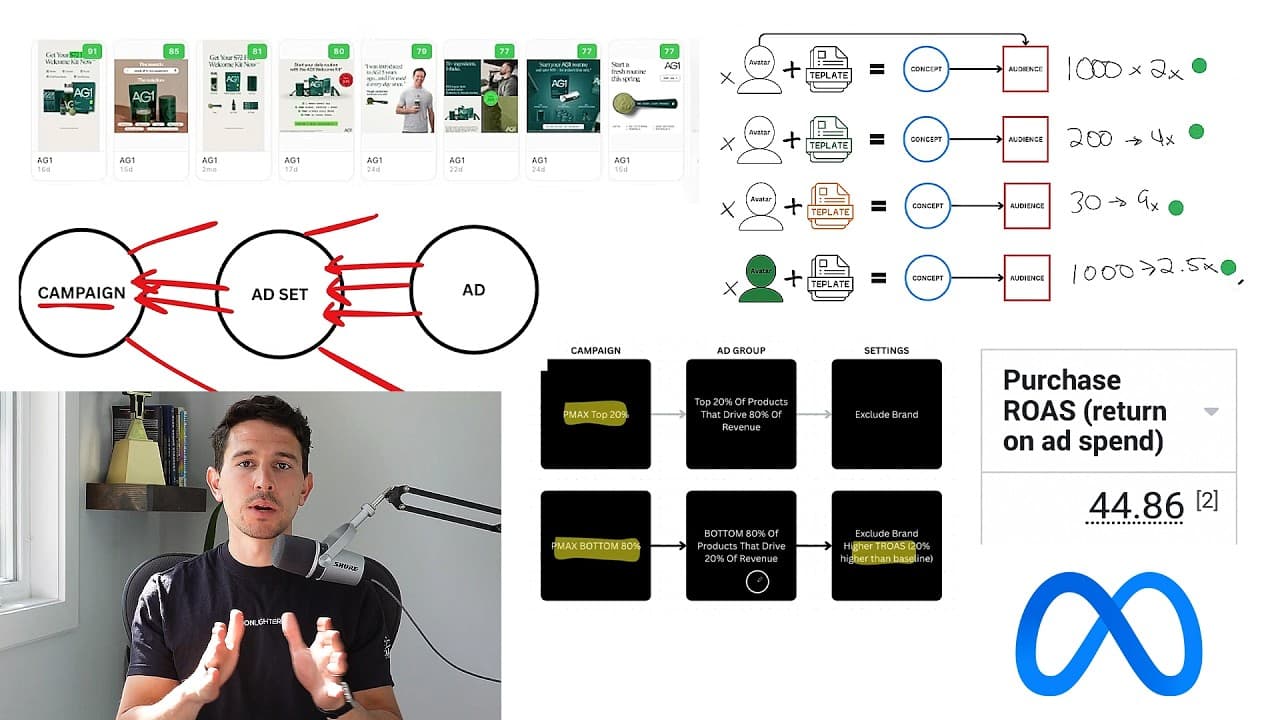
Combine creative testing and scaling in one prospecting CBO campaign, but limit testing to no more than 20% of total spend. Separate recent and all-time purchasers into a small retention campaign, exclude them from prospecting, and use a systematic maximum-spend threshold to control weak ads while preserving enough creative volume and diversity.
Transcript
You can follow all the Facebook ads advice out there and still feel like nothing's working. And that's because 99% of the Facebook ads advice that's out there is entirely wrong. I know this because I've spent over a decade managing Facebook ads for Gary V, BarkBox, and now over 100 brands at The Moonlight House Hold names like Jake Paul's W and eve... Read More
Key Insights
- A single prospecting CBO campaign can contain both testing and scaling. New creative packs are launched in separate ad sets, allowing controlled testing without creating a dedicated testing campaign that fragments spend and account structure.
- Creative packs should be separated by avatar and concept. A naming convention such as avatar followed by concept makes each ad set's intended audience and creative idea identifiable as additional rounds of advertising enter the account.
- Prospecting should optimize for website purchases using the maximum number of conversions. The recommended configuration uses broad targeting, no cost-per-result goal, standard attribution, and 7-day click, 1-day engage, and 1-day view settings while counting all conversions.
- A seven-day ad set minimum can force delivery to newly launched creative. The suggested minimum may equal the target CPA when account scale permits, but it should be removed after the evaluation period so forced spending does not continue unnecessarily.
- Testing spend should remain at or below 20% of the total advertising budget. For an account spending $100 per day, the stated rule limits the relevant testing minimum to no more than $20.
- Prospecting and retention audiences should be clearly separated. Past purchasers are excluded from prospecting and placed in a dedicated retention campaign, making increased prospecting spend more representative of efforts to reach new customers.
- Retention budgets should start small and be managed through frequency. The transcript suggests that a brand with only 1,000 lifetime customers could begin around $5, then scale gradually as the audience and business grow.
- A systematic maximum-spend threshold serves as a creative kill switch. It creates room for new ads and identifies creatives that spend excessively relative to target CPA or ROAS, while avoiding unnecessary removal of ads that remain near acceptable performance levels.
Install to Summarize YouTube Videos and Get Transcripts
Explore YouTube Video Summarizer or Get YouTube Transcript Extractor
Questions & Answers
Q: How should a Facebook ads prospecting campaign be structured?
The proposed structure uses one sales campaign named as a prospecting CBO, with campaign budget optimization handling both creative testing and scaling. Each new creative pack receives a new ad set organized by avatar and concept. The campaign targets broadly, excludes retention audiences, optimizes for website purchases, and uses audience segment reporting to distinguish engaged users and existing customers.
Q: How can new Facebook ad creatives receive enough spend?
Set a temporary ad set spending minimum for each new creative launch. The suggested approach uses a seven-day minimum that can equal the target CPA when the account's budget supports it. This forces spend toward new creative inside the main prospecting campaign. After seven days, remove the minimum so the campaign can allocate spending without that continuing constraint.
Q: How much of a Facebook ads budget should go to testing?
Testing should consume no more than 20% of the total advertising budget under the stated rule. If an account spends $100 per day, the testing minimum should not exceed $20. Larger accounts spending thousands per day may be able to set a minimum equal to their target CPA, provided total testing allocation remains within the 20% limit.
Q: What conversion settings should a prospecting ad set use?
The ad set should send conversions to the website, maximize the number of conversions, use the correct data set, and select purchase as the conversion event. The presented setup does not use a cost-per-result goal, dynamic creative, or flexible media. It applies standard attribution with 7-day click, 1-day engage, and 1-day view while counting all conversions.
Q: Why should retention have a separate Facebook campaign?
A separate retention campaign lets a brand address existing customers differently from new prospects and measure spending more clearly. Without separation, higher budgets can repeatedly reach existing customers, obscure acquisition results, and reduce efficiency. Excluding purchasers from prospecting means increased prospecting spend is directed toward new customers, while retention spending can support sales, launches, and customer-specific promotions.
Q: How should a Facebook ads retention audience be created?
The retention ad set should include custom audiences representing purchasers, such as buyers from the previous 180 days and all-time purchasers. The recommendation is to combine customer records imported from the CRM with pixel data. These same audiences should be excluded from prospecting, creating a clear division between prospective customers and people who have already purchased.
Q: What ads and budget should a retention campaign use?
A retention campaign can reuse high-performing ads and include offers, angles, or audience messages that have historically worked with existing customers. Unlike prospecting, it does not need separate ad sets for every creative pack and can use one or two ad sets. Its budget should begin small, be managed according to frequency, and increase gradually as appropriate.
Q: When should a Facebook ad be turned off?
Ads that spend heavily while producing zero purchases, or that reach two, three, or four times the target CPA or target ROAS threshold, are clear candidates for intervention. For borderline ads, the proposed system uses a maximum-spend threshold as a consistent kill switch. This preserves space for new creative while reducing irrational decisions and avoiding excessive removal of active ads.
Summary & Key Takeaways
-
The recommended account structure begins with one prospecting sales campaign using campaign budget optimization. Testing and scaling coexist inside this campaign, while each creative pack receives an ad set organized by avatar and concept. Broad targeting, purchaser exclusions, purchase optimization, and complete audience reporting keep acquisition focused on prospective customers.
-
New creative receives controlled delivery through a seven-day ad set spending minimum. The suggested minimum can equal the target CPA for larger accounts, but total testing spend should never exceed 20% of the overall budget. Removing the minimum after seven days prevents forced spending from continuing beyond the intended evaluation period.
-
A separate retention campaign targets purchaser audiences imported from both the CRM and pixel. Its small, frequency-managed budget supports customer-specific promotions, products, and messaging without distorting prospecting performance. As the account expands, a systematic maximum-spend threshold helps manage creative bloat and preserves room for new ads without indiscriminate shutdowns.
Read in Other Languages (beta)
Share This Summary 📚
Summarize YouTube Videos and Get Video Transcripts with 1-Click
Try YouTube Summary with ChatGPT & Claude or YouTube Transcript Generator
Explore More Summaries from Sam Piliero 📚



Summarize YouTube Videos and Get Video Transcripts with 1-Click
Try YouTube Summary with ChatGPT & Claude or YouTube Transcript Generator