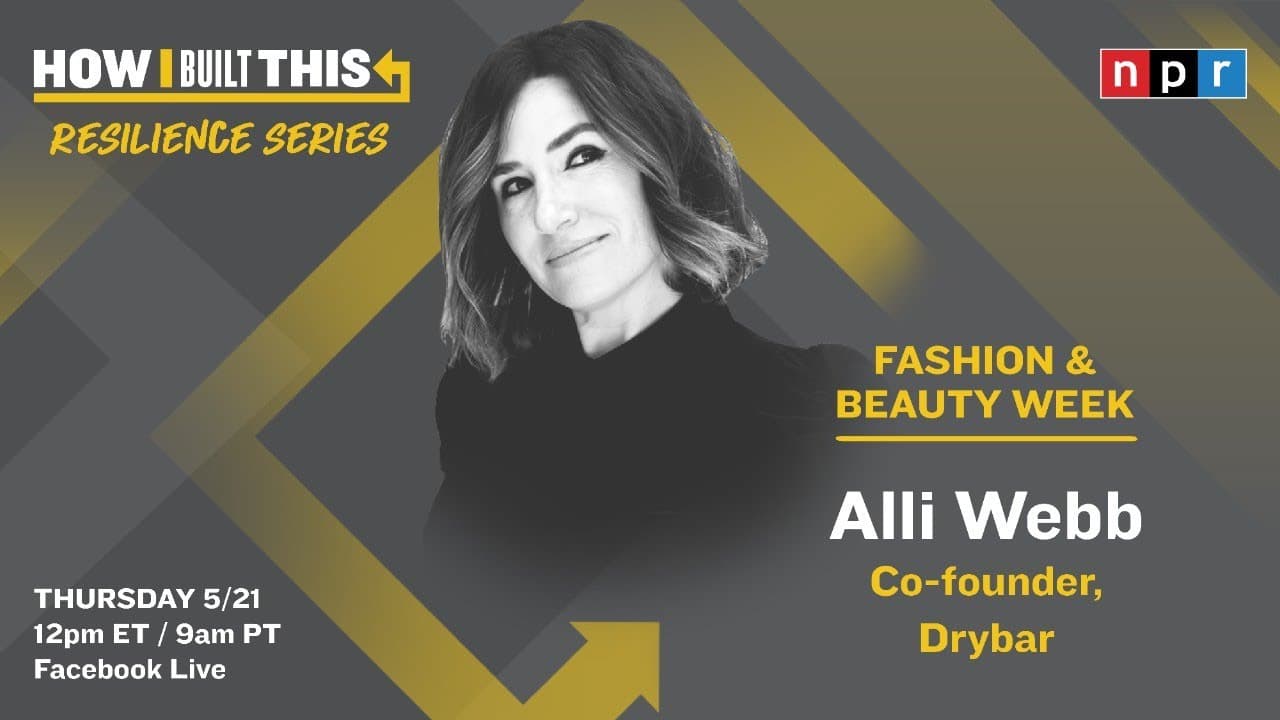
Alli Webb on Drybar and Salon Shutdowns with Guy Raz | How I Built This | NPR
TL;DR
Drybar reopened a limited number of salons with spaced seating, masks, virtual check-ins, and health screenings for clients and stylists. These safeguards reduced customer capacity, while delayed rent, staffing cuts, and furloughs helped the company and its franchisees preserve cash and avoid going out of business during the shutdowns.
Transcript
hello everyone and welcome to how I built this resilience Edition how how's everybody doing today this is it is fashion week fashion and beauty week all week here on how I built this resilience edition and we are taking your questions right now for Ali Wehbe co founder of Drybar you can submit those through Facebook or Twitter or YouTube we love yo... Read More
Key Insights
- Drybar began as a mobile blowout service, with Alli Webb traveling to clients before opening a physical location. Friends encouraged her to professionalize the service, and the concept eventually expanded to more than 120 locations across the United States and Canada by 2020.
- The acquisition primarily covered Drybar’s product business, which moved to Helen of Troy in January 2020. Webb remained closely involved with products, approved every item released, served on the board, and viewed the broader company from a less operational position.
- Founder expertise is different from scaling expertise, according to Webb’s account of her changing role. She understood the desired customer experience in precise detail, but recognized that growing a large company required experienced operators with skills beyond her strongest abilities.
- Drybar’s reopening protocols included masks for stylists, alternating occupied and empty chairs, virtual check-ins, and health screening for clients and employees. Customers waited in their cars instead of gathering inside before appointments, then received an alert when their appointment was ready.
- Reduced salon capacity was a direct consequence of physical distancing. Using every other chair meant Drybar could not serve nearly as many clients as before, even though early reports suggested that customers and stylists were accommodating and excited to return.
- Uncertainty about health guidance made reopening especially difficult for Webb. She described feeling nervous about close-contact services and hearing conflicting messages, while also recognizing that stylists needed to return because salon work provided their livelihood.
- Franchisees represented roughly 35 to 40 percent of Drybar’s nearly 150 stores at the time discussed. Many were small-business owners facing severe pressure, and landlord flexibility on delayed rent was described as a major factor helping locations avoid permanent closure.
- Business survival required immediate cost reductions across Webb’s ventures, including Drybar and the massage concept Squeeze. The response included cutting expenses, reducing compensation, and furloughing employees while leaders assessed changing conditions one day at a time.
Install to Summarize YouTube Videos and Get Transcripts
Explore YouTube Video Summarizer or Get YouTube Transcript Extractor
Questions & Answers
Q: How did Drybar reopen salons during COVID-19 shutdowns?
Drybar reopened only a small number of locations at first and introduced several protective procedures. Stylists wore masks, clients occupied alternating chairs, and both employees and customers completed health checks. The company also adopted virtual check-in, allowing customers to wait in their cars and receive an alert when their appointment was ready instead of gathering inside the salon.
Q: What safety protocols did Drybar use for clients and stylists?
Drybar required stylists to wear masks and arranged seating so that an empty chair separated each client. Health screening and temperature checks were prepared for people entering the salon, including clients and employees. Virtual check-in further reduced indoor waiting by keeping customers in their cars until staff notified them that they could enter for their appointment.
Q: How did distancing affect Drybar’s salon capacity?
Physical distancing substantially limited the number of appointments Drybar could handle because salons used only every other chair. A client sat in one chair, the next remained empty, and another client could use the following chair. Webb said this arrangement prevented the company from serving nearly as many customers as it had before the shutdowns, despite demand from people eager to return.
Q: How did Drybar franchise owners try to remain financially stable?
Drybar franchisees relied partly on landlords who allowed rent payments to be pushed back during the shutdown period. Webb described this flexibility as an important source of support that helped locations keep their businesses from disappearing completely. The broader response also involved reducing costs and preserving enough resources to survive until salons could begin operating again.
Q: What role did Alli Webb have at Drybar after the acquisition?
Webb remained heavily involved in Drybar’s product work and continued to approve every product released. She also served on the board, but no longer worked in the daily operational trenches as she had during the company’s earlier years. Her shift toward a more peripheral role followed a gradual process of hiring experienced people to manage and scale the business.
Q: Why did Alli Webb step back from Drybar’s daily operations?
Webb concluded that creating Drybar’s vision and designing its customer experience were different skills from operating and scaling a large organization. She believed she understood exactly how a Drybar location should look and feel, but acknowledged that growth required people with specialized management experience. Hiring strong operators allowed her to loosen the tight control she had maintained for years.
Q: What part of Drybar was acquired by Helen of Troy?
The January 2020 acquisition primarily involved Drybar’s product side. Webb expected Helen of Troy to expand the product line much more broadly, while she continued participating in product decisions and approving releases. The discussion distinguishes this product transaction from the salon operation, where company-owned and franchised locations were dealing with closures, restricted reopenings, and reduced customer capacity.
Q: How did salon shutdowns affect Drybar employees and related businesses?
The shutdowns heavily affected Drybar’s workforce of 4,000 stylists because close-contact salon work offered limited alternatives for earning income. Webb also described similar pressure at Squeeze, her massage concept. Both businesses had to reduce spending, cut compensation, and furlough people in an effort to avoid going out of business before normal operations could resume.
Summary
In this video, Ali Wehbe, co-founder of Drybar, talks about her current role in the company after its acquisition by Helen of Troy. She also discusses the challenges faced by franchise owners and their strategies for staying afloat during the shutdowns. Ali shares her insights on the importance of self-care and feeling good during difficult times, and how the beauty industry can still thrive in this context. She also talks about her own experiences and struggles as an entrepreneur, and gives advice on validating ideas and staying optimistic during challenging periods.
Questions & Answers
Q: Can you talk about your role in Drybar after the acquisition?
The acquisition of Drybar by Helen of Troy mainly involved the product side of the business. I am still heavily involved in product development, signing off on every product that goes out the door. While my role has shifted throughout the years and I am no longer in the day-to-day trenches, I continue to be on the board and maintain a peripheral view of the company.
Q: How are Drybar franchise owners coping with the shutdowns?
The majority of Drybar locations are franchise operations, and they have faced significant challenges during the shutdowns. Many franchise owners have been able to negotiate with landlords to postpone rental payments, which has helped them stay afloat. They have also made cutbacks and adjustments to their businesses to adapt to the current situation.
Q: How are Drybar locations being reopened safely?
Drybar has implemented new protocols to ensure the safety of both clients and stylists. Clients are now seated with one empty chair between them to maintain social distancing. Stylists are required to wear masks, and virtual check-ins have been implemented to minimize waiting times. Health checks for clients and stylists are also conducted prior to appointments.
Q: Is there a future for the beauty industry during this crisis?
Despite the challenges faced by the beauty industry, it is still important for people to feel good about themselves during difficult times. The way we feel on the outside often affects our internal well-being. Beauty services like blowouts and massages provide a sense of self-care and well-being, and I believe that people will continue to seek out these services once the situation improves.
Q: What advice do you have for entrepreneurs trying to validate their ideas?
Validating an idea can be a combination of data-driven analysis, talking to friends and experts, and following your intuition. It is essential to identify a need or a problem that your idea can solve, and to ensure that there is a market for it. It is also helpful to observe existing businesses or services that are not executed well and consider how you can improve upon them.
Q: How do you stay optimistic during this uncertain time?
In times of uncertainty, it is important to stay focused and keep working on the aspects of your business that can still progress. While it may be challenging, there are still opportunities to be explored and ideas to be developed. It is also important to maintain a sense of community and support one another during difficult times.
Q: What positive changes do you hope to see after this crisis?
This crisis has brought people together in ways we have not seen before, creating a sense of camaraderie and support. I hope that this sense of unity continues to grow and that we can come out of this period with a deeper understanding of what is truly important. There is an opportunity for people to let go of pettiness and focus on what truly matters, both in business and personal relationships.
Q: How do you come up with new business ideas?
New business ideas can come from various sources. Squeeze, a massage concept by Drybar, was born out of frustration with existing massage experiences and a desire to improve upon them. Other ideas could be sparked by personal experiences or by identifying gaps in the market. Collaboration with other entrepreneurs can also generate new ideas and opportunities.
Q: How do you deal with setbacks and turning struggles into strengths?
Confidence and self-belief are essential when facing setbacks and struggles. It is important to follow what feels right and exciting, even if it means taking unconventional paths. Embracing leaps and jumps in the pursuit of what you love can lead to unforeseen opportunities and personal growth. Remember that all experiences, even the seemingly disjointed ones, contribute to shaping who you become.
Q: How do you find optimism in difficult times for small business owners?
It is important to focus on the aspects of your business that can still progress or be improved, even during difficult times. Use this time to work on the back-end aspects of your business, research new opportunities, and plan for the future. While the future is uncertain, maintaining a sense of hope and optimism can help navigate these challenging moments.
Summary & Key Takeaways
-
Drybar grew from Alli Webb providing blowouts at clients’ homes into a business with locations across the United States and Canada. Webb remained involved in product development and served on the board, but experienced operators increasingly handled daily management and the specialized work of scaling the company.
-
During the shutdowns, Drybar prepared salons to reopen with masks, health checks, temperature screening, virtual check-ins, and greater distance between clients. Customers waited in their cars until appointments, and salons used alternating chairs. These measures supported safety and confidence, but they also substantially reduced the number of appointments each location could serve.
-
Drybar and its franchisees responded to the financial crisis by negotiating delayed rent with landlords, reducing expenses, cutting compensation, and furloughing employees. Webb described survival as a daily process shaped by uncertainty, limited operating capacity, and the need to protect stylists whose livelihoods depended on returning to work.
Read in Other Languages (beta)
Share This Summary 📚
Summarize YouTube Videos and Get Video Transcripts with 1-Click
Try YouTube Summary with ChatGPT & Claude or YouTube Transcript Generator
Explore More Summaries from NPR 📚


Summarize YouTube Videos and Get Video Transcripts with 1-Click
Try YouTube Summary with ChatGPT & Claude or YouTube Transcript Generator