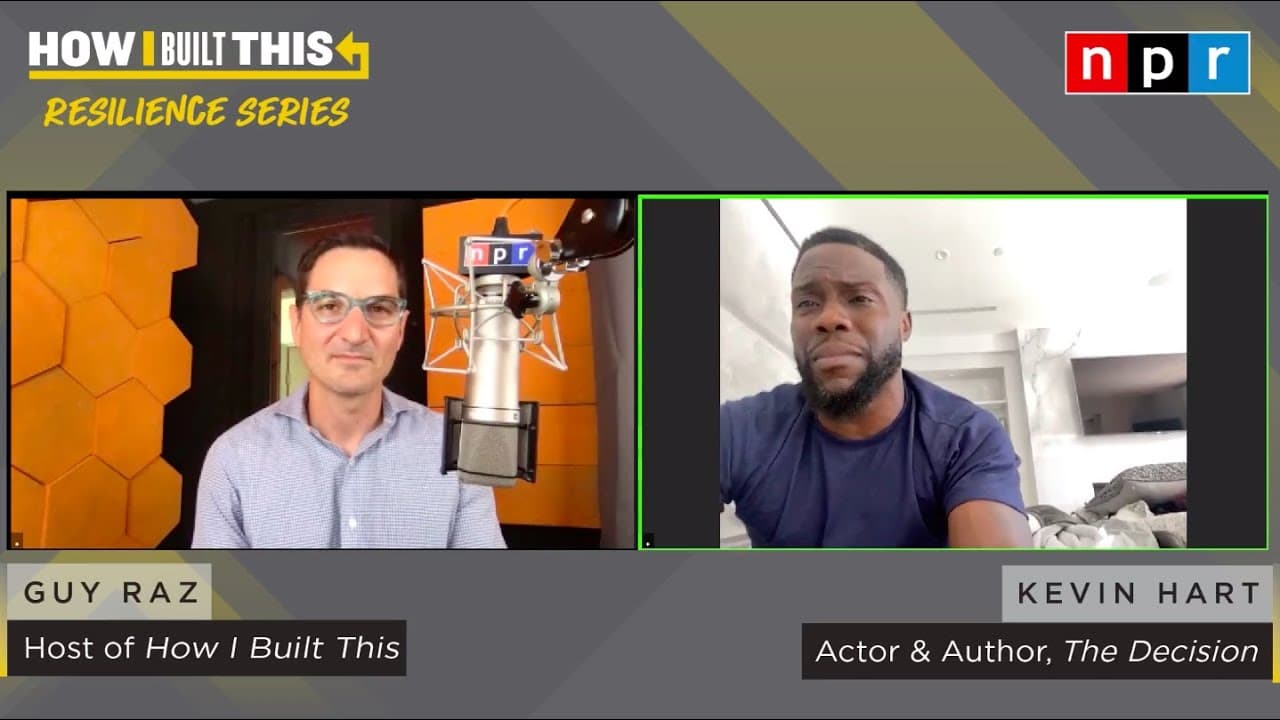
Kevin Hart on COVID-19 and Nationwide Protests with Guy Raz | How I Built This | NPR
TL;DR
Meaningful change requires mainstream America and powerful white individuals to join Black voices in opposing racism and social injustice. Kevin Hart also argues that resilience comes from accepting responsibility for decisions, learning from failure, protecting mental energy, and remaining open to new directions when an expected path ends or a door appears closed.
Transcript
and welcome to the special evening edition of how I built this resilience Edition how how's everybody doing we are so excited to have with us on the show today Kevin Hart he is known as one of the busiest people in Hollywood he's not just an actor and a comedian he's also a dad a writer an entrepreneur an investor and of a production company and he... Read More
Key Insights
- Social change is possible when ignored problems become impossible to avoid. Hart sees the protests as an opportunity to restructure a problematic system because opposition to social injustice has grown from a limited number of voices into a broad, global demand for equality.
- Mainstream participation is a crucial part of the current movement. Hart says Black voices have been yelling for a long time, but meaningful progress also requires powerful white men and women to align themselves publicly with those demanding an end to racism.
- George Floyd's death is presented as a moment that made injustice unmistakably visible. Hart believes its immediacy caused people who had not understood the concerns to recognize the wrongdoing and join a wider call for change.
- Hart's emotional response is both hopeful and exhausted. He finds some happiness in seeing steps toward justice and broader involvement, yet he also feels angry, frustrated, tired, and worn down by having the same conversation and making the same requests repeatedly.
- Responsibility to future generations is central to Hart's argument. He credits earlier Black men and women with breaking ground for his opportunities as an entertainer, actor, and CEO, then says the present generation must create further progress for its children.
- The protests are rooted in understandable anger and frustration. Hart does not endorse every way they have unfolded, but he refuses to lose sight of why they are happening and emphasizes the unusually broad alignment of people participating.
- Shared information can make success more accessible. Hart says people who achieve success often keep the details of their journeys private, even though accounts of their failures, mindsets, and choices can give others a different lens for pursuing their own goals.
- Personal resilience is shaped by decisions and perspective. Hart encourages people to search for keys to apparently closed doors, find positives instead of focusing only on negatives, embrace unfamiliar opportunities, and take responsibility for choosing their direction.
Install to Summarize YouTube Videos and Get Transcripts
Explore YouTube Video Summarizer or Get YouTube Transcript Extractor
Questions & Answers
Q: Why did Kevin Hart believe the protests could create change?
Kevin Hart believed the protests could create change because opposition to social injustice had expanded beyond a small number of voices. He saw a global effort demanding equality and, importantly, greater participation from mainstream America. Although he remained angry and tired after repeated conversations about racism, he viewed this unusually broad alignment as a step in a better direction and an opportunity to restructure a problematic system.
Q: What role did Kevin Hart assign to white Americans?
Kevin Hart said white individuals, especially powerful white men and women, must help make the situation right by aligning themselves with Black people against racism and social injustice. He argued that Black voices had already been yelling and demanding change for a long time. Broader public support could demonstrate that racism would no longer be tolerated and give the movement the assistance Hart believed had previously been missing.
Q: Why did George Floyd's death affect public awareness?
Hart said the circumstances of George Floyd's death were so present and visible that people who had not understood the issue began recognizing what Black communities had been describing. In his account, this realization caused more people to say the treatment was wrong and join the demand for change. He connected that new awareness to the unusually broad participation he observed in the protests.
Q: How did Kevin Hart feel about the nationwide protests?
Kevin Hart expressed a mixture of hope, anger, frustration, and exhaustion. He found some happiness in the possibility of change and in seeing mainstream America become involved, but he was tired of repeating the same conversation and request for justice. He did not support every way the protests had happened, yet he understood the anger behind them and refused to overlook their underlying cause.
Q: How does Kevin Hart connect racial justice to his children?
Hart frames racial justice as a responsibility to future generations. He says his opportunities as a Black entertainer, actor, and CEO exist because earlier Black men and women broke ground before him. He therefore believes his generation must continue that work and do its absolute best to confront hate and racism, rather than leaving the same unresolved conditions for his children and new baby.
Q: What is the main idea of Kevin Hart's Audible original?
Hart's Audible original is designed to share practical information about success, failure, mindset, and personal responsibility. He believes successful people often keep their journeys to themselves, leaving others without useful accounts of how progress actually happened. His purpose is not to prescribe an identical path, but to offer his experiences as another lens through which listeners can evaluate opportunities, obstacles, and decisions.
Q: How does Kevin Hart recommend responding to failure?
Hart recommends adopting a mindset that searches for possibility instead of becoming fixed on the negative. When a door appears closed, he suggests looking for the key that could open it. His message draws on both achievement and personal failures, emphasizing that unexpected discoveries can emerge after earlier plans succeed, fail, or end, and that people can fall in love with new opportunities.
Q: Why are personal decisions important to Kevin Hart's view of success?
Hart says life offers many possible directions, including turning left or right, reversing course, following a map, or choosing an unfamiliar route. The essential point is that individuals make decisions and must accept responsibility for them. He encourages people to embrace the opportunity for something new, push themselves toward limits they believe they can reach, and consciously choose how they respond to obstacles.
Summary
In this video, Kevin Hart discusses his thoughts on the current social unrest, his new audio book, and the role of entrepreneurs in addressing issues of racial injustice. He emphasizes the need for change, the importance of not being silent, and the power of taking responsibility for creating a better future. He also touches on his own experiences with failure and overcoming fear.
Questions & Answers
Q: How does Kevin Hart feel about the current state of the world?
Kevin Hart believes that the current time is a pivotal moment in history where there is an opportunity for restructuring a problematic system. He sees a global effort for equality and an alignment of voices demanding change.
Q: Does Kevin Hart think this time will be different in terms of social response?
Kevin Hart acknowledges that the names may change, but the color of their skin remains the same. He believes it is past the point of shame on America and emphasizes the need for the white community to align with the Black community in order to make a significant change.
Q: What is Kevin Hart's new audio book about?
Kevin Hart's new audio book, "The Decision: Overcoming Today's BS for Tomorrow's Success," aims to share his journey and provide valuable information to help others find success. He shares his mindset and the keys to finding success, even in the face of failure.
Q: How has failure shaped Kevin Hart's career?
Kevin Hart emphasizes that failure is a crucial part of his journey. He recounts numerous instances where he faced failure, such as not getting certain roles or shows, but he believes that those failures have led him to where he is today. He sees failure as a blessing in disguise, providing knowledge and preparation for future opportunities.
Q: How can young men of color navigate white spaces in the entertainment industry?
Kevin Hart advises young men of color to understand what they can do and fight for opportunities. He shares his own experience of pushing studios to market his movies internationally, proving that success is not limited by race. He encourages individuals to grind and be a part of the conversation for change.
Q: What role do entrepreneurs and the business community play in addressing racial injustice?
Kevin Hart believes that being silent is not an option for entrepreneurs and the business community. He emphasizes the need to work together, listen to one another, and hold hands to create change. He urges entrepreneurs to use their position to be a part of the conversation and advocate for a better future.
Q: How does Kevin Hart overcome the fear of failure?
Kevin Hart believes that experiencing failure helps to realize that it is not as bad as it seems. Through his own experiences, he learned that failure is not the end, but a starting point to figure things out. He emphasizes the importance of not being afraid to seek knowledge and find a way forward.
Takeaways
Kevin Hart's insights highlight the importance of not being silent and taking responsibility for creating change. He emphasizes that failure is not an obstacle, but an opportunity for growth. Entrepreneurs and the business community have a role to play in addressing racial injustice by working together and advocating for change. It is crucial to be informed, listen to one another, and take action towards a better future.
Summary & Key Takeaways
-
Kevin Hart describes the nationwide protests as a possible turning point because frustration with racism and social injustice has expanded from some voices to a global effort. He sees hope in mainstream America joining the demand for equality, while emphasizing that repeated injustice has left him angry, frustrated, and tired.
-
Hart argues that Black communities have protested and demanded change for a long time, so powerful white individuals must now help confront racism. He says the visible circumstances of George Floyd's death made more people recognize the problem, producing a broad alignment among protesters that Hart had never witnessed at that level.
-
Hart presents his Audible original as an effort to share information about success, failure, mindset, and personal responsibility. He believes successful people often keep their journeys private, even though those stories could give others a useful perspective. His central message is to embrace new possibilities and consciously choose a direction.
-
Key Insights forward. Each must begin with a standalone factual statement (e.g. 'X is...', 'The key to Y is...', 'Z works by...') so it can be cited independently. 25-50 words each.
Read in Other Languages (beta)
Share This Summary 📚
Summarize YouTube Videos and Get Video Transcripts with 1-Click
Try YouTube Summary with ChatGPT & Claude or YouTube Transcript Generator
Explore More Summaries from NPR 📚



Summarize YouTube Videos and Get Video Transcripts with 1-Click
Try YouTube Summary with ChatGPT & Claude or YouTube Transcript Generator