Which AI Mobile App Builder Works Best?
TL;DR
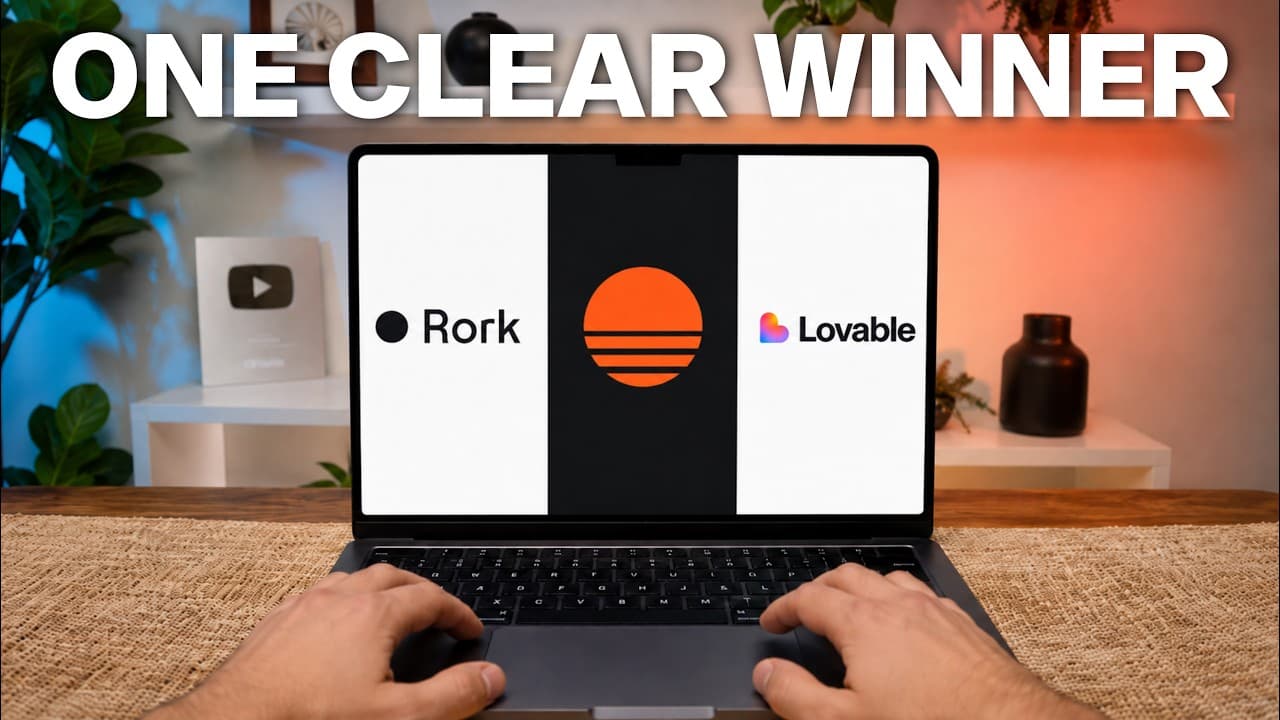
Rork delivered the strongest functional prototype in the recorded tests, with mobile-first presentation, real email confirmation, working matching, and functional chat. Base44 also produced a polished, working flow, while Lovable created a usable interface but failed to provide a working messaging experience, showing why core workflows matter more than surface design when comparing AI app builders.
Transcript
What is the best AI tool to build a mobile apps for the iOS and Android store? Well, today I'm going to be building the exact same app in the three most popular AI coding platforms so that you can figure out which one fits your needs. Now, the rules for this challenge are pretty simple. Number one, I'm going to use the exact same starting prompt fo... Read More
Key Insights
- Rork produced the most complete tested workflow, including account creation, real email confirmation, onboarding, matching, and working chat. Its preview was also presented as a mobile app, making it easier to judge the experience in the form users would encounter on iOS or Android.
- Lovable generated a simple and usable interface with onboarding, profile editing, discovery cards, swiping, and matches. However, opening a match did not provide a functioning messaging experience, even after the creator had previously prompted the platform to address that central feature.
- Base44 created an attractive mobile layout with onboarding, discovery, matching, profile editing, and message sending. Its main usability weakness was the discovery selection interface, which did not clearly communicate where the user should click before an additional request added explicit match and reject buttons.
- The comparison controlled the starting conditions by giving all three platforms the exact same detailed prompt. Each initial build was followed by exactly 10 minutes of adaptation, allowing the creator to compare how effectively the builders interpreted requests and improved their generated applications under the same constraint.
- The test application was designed as a co-founder matching service with a Tinder-like interaction model. Users needed to discover candidates, swipe according to fit, receive a match when interest was mutual, and begin messaging, so incomplete chat behavior represented a significant failure rather than a minor omission.
- Mobile-first presentation was a clear strength of Rork because the generated product appeared inside an app-style preview, supported scrolling and keyboard interaction, and could also be tested through Rork's own app. These details made the prototype feel closer to a dedicated mobile application during testing.
- Production readiness requires more than an attractive generated interface. The creator asked each platform to recommend and implement launch essentials, then evaluated practical details such as password recovery, onboarding quality, navigation, matching accuracy, profile editing, and whether messages could actually be sent.
- Lovable received a design score of 7 out of 10 in the portion of the final evaluation included in the transcript. The creator considered its appearance simplistic but acceptable, while noting that missing forgot-password support and nonfunctional messaging would substantially reduce its functionality assessment.
Install to Summarize YouTube Videos and Get Transcripts
Explore YouTube Video Summarizer or Get YouTube Transcript Extractor
Questions & Answers
Q: Which AI builder produced the best mobile app prototype?
Rork produced the strongest prototype among the workflows shown in the transcript. It created a mobile-style interface, supported account registration with a real confirmation email, completed onboarding, generated matches, and allowed chat messages to work. Base44 also handled matching and messaging, but its discovery controls were initially unclear. Lovable's core messaging experience did not function during the final review.
Q: How were Lovable, Rork, and Base44 compared fairly?
All three builders received the exact same detailed starting prompt for a co-founder matching application. After reviewing each initial result, the creator allowed exactly 10 minutes for changes and generally asked the AI to recommend and execute the next steps. This method standardized the requested features, starting instructions, and improvement window, making differences in design and functionality easier to observe.
Q: What app was built to test the three AI platforms?
The test product was a mobile service for finding a startup co-founder through a Tinder-like matching flow. Users created profiles, reviewed potential partners, swiped left or right according to fit, received mutual-match notifications, and attempted to message matches. The concept tested multiple connected workflows rather than only a landing page, exposing whether each builder could support meaningful application behavior.
Q: What worked well in the Rork app build?
Rork created an app-like preview with a generated icon, mobile scrolling, keyboard interaction, registration, and onboarding. It sent a real confirmation email when the creator signed up, then supported profile completion, candidate discovery, matching, and functional chat. When asked to add a back button within a conversation, it implemented navigation back to the list of chats successfully.
Q: What problems appeared in the Lovable app build?
Lovable produced working onboarding, profile editing, swiping, matching, and logout behavior, but its messaging flow was the major problem. Selecting a match did not open a usable chat experience, despite an earlier request to fix it. The sign-in screen also lacked a forgot-password option, and the discovery results sometimes recommended people whose roles did not match the stated preference.
Q: What were the strengths and weaknesses of Base44?
Base44 generated a visually appealing mobile view and supported onboarding, discovery, matches, profile editing, and message sending. The creator said the first test looked good. However, the selection interface on discovery cards was initially unclear because it did not make the clickable actions obvious. The creator therefore requested dedicated buttons for accepting or rejecting each candidate while swiping.
Q: Why is working chat important in an AI-built matching app?
Working chat is essential because the requested product does not end when two users match. Its stated flow requires both people to receive the match and then begin messaging about a potential startup partnership. A builder can reproduce onboarding and swipe cards convincingly, but if matched users cannot communicate, the central user journey remains incomplete and the prototype is not ready for launch.
Q: What should be checked before launching an AI-generated mobile app?
The test suggests checking the entire user journey, including account creation, email confirmation, password recovery, onboarding, discovery, matching logic, navigation, profile editing, and messaging. The interface should also make actions obvious in mobile view. Asking the builder for recommended next steps can reveal missing launch requirements, but every implemented feature still needs direct testing because a generated screen may not function as expected.
Summary & Key Takeaways
-
The comparison used one detailed prompt to build the same co-founder matching app in Lovable, Rork, and Base44. Each platform generated an initial version, after which the creator spent exactly 10 minutes requesting improvements and generally followed the platform's recommendations for moving the prototype closer to launch readiness.
-
The requested product combined discovery, profile cards, left and right swiping, mutual matches, notifications, and direct messaging. This common specification made functional differences visible. Rork supported real email confirmation and working chat, Base44 handled matching and messages, while Lovable's messaging flow remained unavailable during the final review.
-
Rork stood out as a mobile-focused builder because its preview behaved like an app, included a generated icon, and supported the tested user journey. Base44 offered an attractive mobile view and functional messaging but had an unclear selection interface. Lovable looked clean and familiar, yet missing chat and password recovery reduced its readiness.
Read in Other Languages (beta)
Share This Summary 📚
Summarize YouTube Videos and Get Video Transcripts with 1-Click
Try YouTube Summary with ChatGPT & Claude or YouTube Transcript Generator
Explore More Summaries from Christian Peverelli 📚


Summarize YouTube Videos and Get Video Transcripts with 1-Click
Try YouTube Summary with ChatGPT & Claude or YouTube Transcript Generator