How Does India's National Logistics Policy Work?
TL;DR
India's National Logistics Policy and the Unified Logistics Interface Platform aim to cut freight costs by shifting road transport from a point-to-point model to a hub-and-spoke model and by putting every stakeholder on one digital interface. Success depends on cutting-edge coordination algorithms, multimodal logistics parks, and digitalization simple enough for truck drivers to actually use.
Transcript
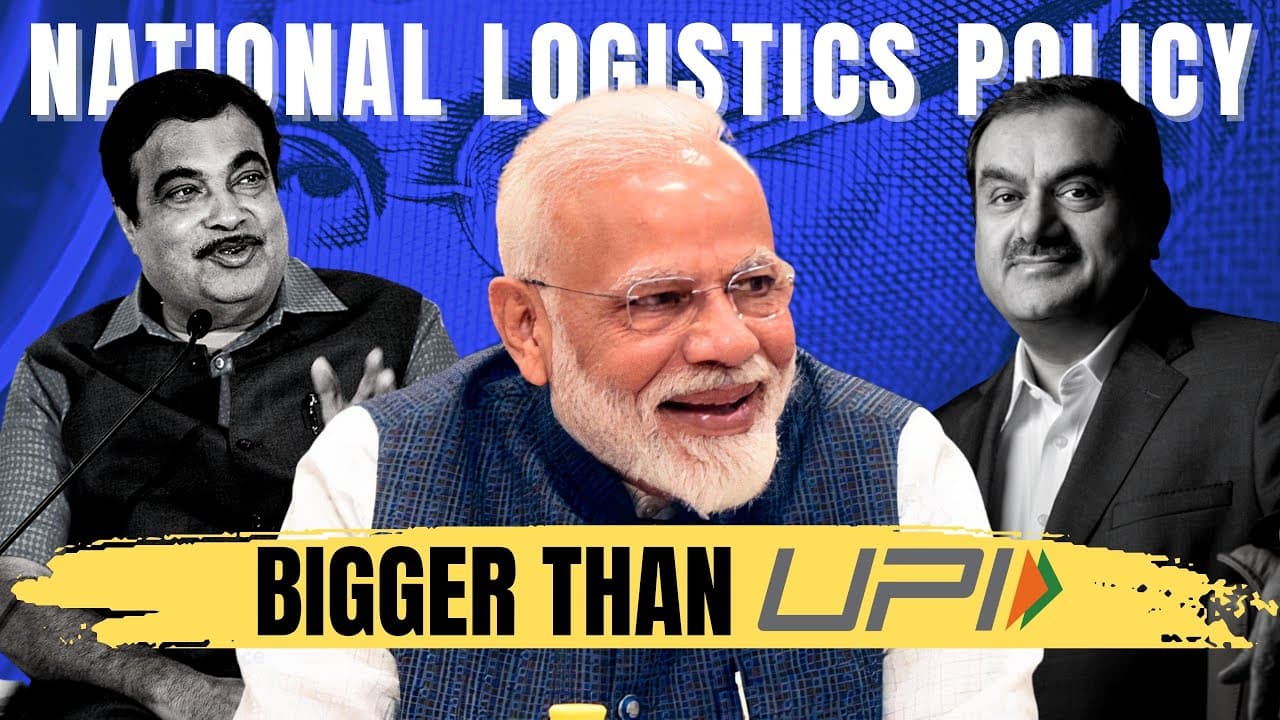
prime minister Narendra Modi has unveiled the government's National Logistics policy 2022. National logistic policy is a logistics foreign on 17th of September 2022 the prime minister of India made the Grand announcement of the national Logistics policy and the unified Logistics interface and just like UPI revolutionized the payment industry of Ind... Read More
Key Insights
- Rail is the cheapest way to move a metric ton of goods a kilometer in India and air is the most expensive, yet road carries the overwhelming majority of freight, meaning the country systematically uses a costlier mode than economics would suggest.
- The reason rail is underused is capacity and priority: there are not enough trains to meet demand, and passenger trains share tracks with goods trains while getting preference, which builds delay directly into rail freight.
- Rail freight requires multimodal handoffs for first-mile and last-mile connectivity, so a shipment goes factory to truck to train to truck to warehouse, and India lacks the infrastructure to move goods seamlessly between truck and train.
- Rail security is a deterrent independent of speed. Theft, rough handling, and the absence of any tracking facility mean safe arrival is not guaranteed, which pushes shippers toward road even when rail would be cheaper.
- Inland waterways are throttled by paperwork rather than physics. Approvals and certifications come from government segments that are neither connected to each other nor modernized, so time is lost to certification rather than to shipping or producing.
- Truck utilization is the biggest road inefficiency. Out of a month's billable days, most trucks run only about half, because after delivering to a distant city it takes one to three days to find a return load, producing delays, underutilization, or empty running.
- The hub-and-spoke model reduces the number of trucks needed to connect a set of cities, raises the likelihood each truck runs full, and makes larger trucks viable, since larger vehicles are more economical per ton per kilometer.
- The system's fragility is its coordination requirement. One truck breaking down or arriving late degrades the entire network, and because origin cities sit at different distances, arrivals are staggered and need algorithmic matching or warehouse buffering.
Install to Summarize YouTube Videos and Get Transcripts
Explore YouTube Video Summarizer or Get YouTube Transcript Extractor
Questions & Answers
Q: What is India's National Logistics Policy?
The National Logistics Policy was announced by Prime Minister Narendra Modi on 17 September 2022, alongside the Unified Logistics Interface Platform. It is intended to transform the entire logistics industry of India, covering road, rail, waterways, and air logistics. The comparison drawn is to UPI: just as UPI reshaped India's payment industry, this policy is expected to reshape logistics and make India a fierce competitor not only in Asia but globally. Its practical goals are lowering transport cost, raising efficiency, and unifying a fragmented sector under a single digital interface.
Q: Why do most goods in India move by road instead of rail?
Rail is the cheapest mode per metric ton per kilometer, yet the overwhelming majority of freight moves by road for several reasons. India does not have enough rails or trains to serve the quantity of goods being transported. Passenger and goods trains run on the same tracks with passenger trains given preference, which causes delays. Rail also requires multimodal transport for first-mile and last-mile connectivity, and the infrastructure to move goods seamlessly from truck to train is missing. On top of that, rail security is weak, with theft, rough handling, and no tracking facility.
Q: How does the hub-and-spoke model work in logistics?
In the point-to-point model, every city sends a separate truck to every other city, so connecting a handful of cities requires a large number of trucks. In the hub-and-spoke model, one city is designated the hub. Each city sends a single truck carrying all goods bound for every other city to the hub. At the hub, loads are redistributed onto the trucks heading back to their home cities, so every truck returns fully loaded with goods from multiple origins without ever visiting those destinations. Fewer trucks are needed and each runs fuller.
Q: What are the main problems with truck transport in India?
Trucks run only about half the billable days in a month because finding a return load after a long haul can take one to three days, leading to delays, underutilization, or empty return trips. Indian trucks cover far fewer kilometers per day than the global average, and the empty running rate is high. There are also multiple intermediaries between the truck operator and the shipper, and truckers lose a meaningful share of their earnings to these agents before final payment arrives. Most truckers also remain far from digitalization.
Q: What is the Unified Logistics Interface Platform?
The Unified Logistics Interface Platform, or ULIP, is the digital layer of the policy, part of an integrated digital system for logistics services. It brings all stakeholders in the logistics chain onto a single unified interface where they can manage shipments, track movements, and offer their services. This matters because the sector is fragmented across many government agencies, export promotion councils, certifications, and commodities, none of which were connected. The interface must be simple enough for truck drivers to use and transparent enough for businesses to track their shipping movements.
Q: Why is the hub-and-spoke model hard to execute in practice?
The model demands an extraordinary level of coordination, management, and cutting-edge logistics solutions. If a single truck breaks down or is delayed by even an hour, inefficiencies cascade through the entire network. Because origin cities sit at different distances from the hub, arrival times are naturally staggered, so goods must either sit in a warehouse or be matched to outbound trucks by a sophisticated algorithm that minimizes storage time. In a true multimodal setting, with ships, trucks, and trains all arriving, delays, permissions, passing time, and breakdowns multiply the variables.
Q: How does the policy reduce logistics costs for businesses?
Cost falls through better asset utilization rather than cheaper fuel or tolls. Consolidating shipments at a hub means far fewer trucks are needed to connect the same set of cities, and each truck is far more likely to travel full instead of empty. Because volumes are aggregated, larger capacity trucks become viable, and larger trucks are more economical on a per ton per kilometer basis. Combined with digital tracking that reduces reliance on intermediaries and manual coordination, the total cost of moving goods is expected to drop substantially.
Q: What role do multimodal logistics parks play in the policy?
Multimodal logistics parks are the physical infrastructure that makes the hub-and-spoke and multimodal vision workable. Several dozen such parks are coming up in various parts of the country. They serve as the hubs where goods arriving by ship, truck, and train can be transferred between modes efficiently and accurately. Without them, the first-mile and last-mile connectivity gap remains, since India currently lacks the infrastructure to move goods seamlessly from a truck to a train. The parks pair with the digital interface so physical transfer and digital coordination work together.
Summary & Key Takeaways
-
India's logistics sector has long been a bottleneck for business. Rail is the cheapest mode per metric ton per kilometer and air the costliest, yet the overwhelming majority of goods move by road. The reason is a shortage of rail capacity, passenger trains getting priority on shared tracks, and weak first-mile and last-mile connectivity between trucks and trains.
-
Road transport carries its own inefficiencies. Trucks in India run only about half the billable days in a month because a returning load is hard to find quickly, they cover far fewer kilometers per day than the global average, and a large share of running is empty. Multiple intermediaries sit between shipper and trucker, skimming a meaningful slice of earnings.
-
The policy's core fix is the hub-and-spoke model. Instead of every city sending a separate truck to every other city, one city becomes a hub where consolidated loads are redistributed. Fewer trucks are needed, each is far more likely to run full, and larger trucks become viable, which lowers cost per ton per kilometer substantially.
-
Execution is the hard part. A single breakdown or delay ripples through the whole network, arrival times differ because distances differ, and goods must either wait in a warehouse or be matched by a sophisticated algorithm. Extending this to ships, trains, and trucks together multiplies the variables that must be optimized.
-
The Unified Logistics Interface Platform and an integrated digital system are meant to bring all stakeholders onto a single interface where they can manage, track, and offer services. Multimodal logistics parks are being built across the country to physically support the model, and the digital layer must stay simple for drivers and transparent for businesses.
Read in Other Languages (beta)
Share This Summary 📚
Summarize YouTube Videos and Get Video Transcripts with 1-Click
Try YouTube Summary with ChatGPT & Claude or YouTube Transcript Generator
Explore More Summaries from Think School 📚





Summarize YouTube Videos and Get Video Transcripts with 1-Click
Try YouTube Summary with ChatGPT & Claude or YouTube Transcript Generator