How Does Inspiration Increase Thoracic Volume?
TL;DR
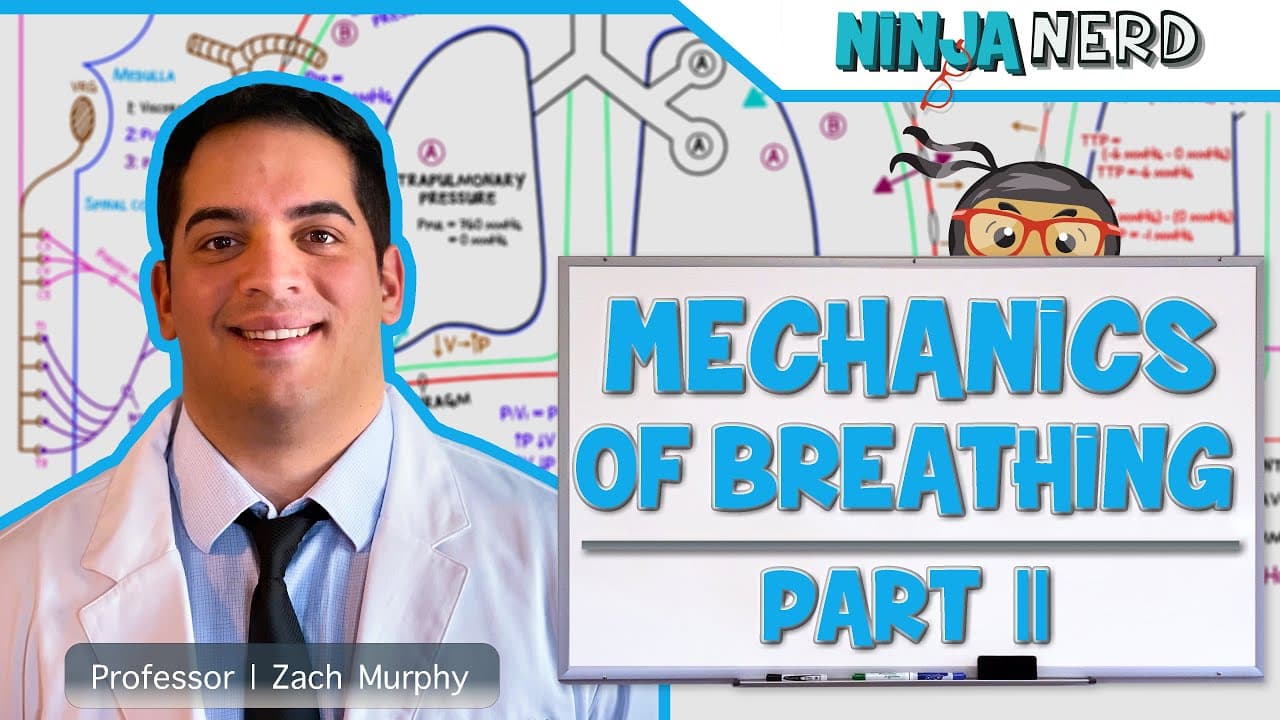
Inspiration begins when the diaphragm and external intercostal muscles contract, increasing thoracic cavity volume. The diaphragm depresses, while the external intercostals elevate and move the ribs outward and push the sternum outward. These skeletal muscles receive motor input through the phrenic and intercostal nerves, with signals originating from cortical control or the ventral respiratory group in the medulla.
Transcript
all right ners so if you guys here for Part Two for the mechanics of breathing appreciate it what we're going to do now is we're going to go over exactly how this actual inspiratory process can produce these changes in these pressures okay so let's go ahead and get started so where does this all start okay let's say that we have here our actual cen... Read More
Key Insights
- The diaphragm and external intercostals are the two major skeletal muscles emphasized in the inspiratory process. Their contraction enlarges the thoracic cavity through complementary movements of the diaphragm, ribs, and sternum.
- The diaphragm is a large muscle positioned beneath the thoracic cavity. It separates the thoracic cavity from the abdominal cavity and depresses when it contracts, increasing the available volume within the chest.
- The external intercostals are muscles located between the ribs. When they contract, they pull the lower ribs upward and outward, expanding the horizontal dimensions of the thoracic cavity.
- The phrenic nerve innervates the diaphragm and arises from the C3, C4, and C5 nerve roots. Signals traveling through this motor pathway stimulate the diaphragm to contract during inspiration.
- The intercostal nerves extend from T1 through T11 and innervate the external intercostal muscles. Their stimulation causes these muscles to contract and move the rib cage during inspiration.
- Inspiratory muscles can receive signals from the cerebral cortex. This cortical control is possible because the diaphragm and external intercostals are skeletal muscles that can be placed under voluntary control.
- The ventral respiratory group is a set of nuclei located within the medulla. It has connections that can stimulate neurons supplying both the diaphragm and the external intercostal muscles.
- Thoracic cavity volume increases through three coordinated movements: the diaphragm depresses, the ribs move upward and outward in a bucket-handle pattern, and the sternum moves outward to enlarge the chest anteriorly.
Install to Summarize YouTube Videos and Get Transcripts
Explore YouTube Video Summarizer or Get YouTube Transcript Extractor
Questions & Answers
Q: How does the diaphragm increase thoracic cavity volume?
The diaphragm increases thoracic cavity volume by contracting and depressing downward. Before contraction, it has a domed position beneath the thoracic cavity and above the abdominal cavity. As the muscle moves downward, additional space becomes available inside the chest. This downward expansion works together with movements of the ribs and sternum to produce the overall increase in thoracic cavity volume during inspiration.
Q: How do the external intercostal muscles support inspiration?
The external intercostal muscles support inspiration by contracting between the ribs and pulling the lower ribs upward and outward. This outward rib movement resembles the movement of a bucket handle and increases the horizontal volume of the thoracic cavity. Their contraction also pushes the sternum outward, enlarging the chest in another dimension. Both effects contribute to the overall increase in thoracic cavity volume.
Q: What nerve controls the diaphragm during inspiration?
The phrenic nerve innervates and stimulates the diaphragm during inspiration. It is formed from the C3, C4, and C5 nerve roots within the cervical region of the spinal cord. Motor signals travel through this pathway to the diaphragm, causing it to contract and depress. That downward movement enlarges the thoracic cavity and contributes to the mechanical process of drawing a breath.
Q: What nerves stimulate the external intercostal muscles?
The intercostal nerves stimulate the external intercostal muscles. The lecture identifies these nerves as extending from T1 through T11 in the thoracic region. When motor signals travel through them, they activate the external intercostals between the ribs. The resulting contraction elevates and moves the ribs outward while also moving the sternum outward, thereby increasing the volume of the thoracic cavity.
Q: What is the bucket-handle movement of the ribs?
The bucket-handle movement describes how the ribs move upward and outward when the external intercostal muscles contract. It is compared with lifting the handles of a bucket away from its sides. This movement expands the rib cage horizontally and increases thoracic cavity volume. It occurs alongside outward movement of the sternum and downward movement of the diaphragm during the inspiratory process.
Q: What is the role of the ventral respiratory group in inspiration?
The ventral respiratory group is a set of nuclei located within the medulla. It sends connections that can stimulate spinal neurons supplying the diaphragm and external intercostal muscles. Through these pathways, it contributes motor input to the phrenic and intercostal nerve systems. Activation of those inspiratory muscles then produces the coordinated chest movements that increase thoracic cavity volume.
Q: Can inspiration be controlled voluntarily?
Inspiration can receive voluntary input from the cerebral cortex because the diaphragm and external intercostals are skeletal muscles. Cortical signals can descend toward motor neurons in the spinal cord, including those associated with the phrenic and intercostal nerves. These nerves then stimulate the diaphragm and external intercostals, allowing voluntary control to initiate the muscle contractions that enlarge the thoracic cavity.
Q: What movements increase thoracic cavity volume during inspiration?
Thoracic cavity volume increases through several coordinated movements. The diaphragm contracts and moves downward, expanding the cavity vertically. The external intercostals contract and pull the ribs upward and outward in a bucket-handle movement, increasing horizontal volume. They also push the sternum outward, enlarging the cavity anteriorly. Together, these actions produce the overall expansion associated with inspiration.
Summary & Key Takeaways
-
Inspiration depends heavily on the diaphragm and external intercostal muscles. The diaphragm separates the thoracic cavity from the abdominal cavity, while the external intercostals lie between the ribs. Contraction of these skeletal muscles changes the dimensions of the thoracic cavity, producing the volume increase required during the inspiratory process.
-
Motor signals reach the diaphragm through the phrenic nerve, which arises from the C3, C4, and C5 nerve roots. Intercostal nerves extending from T1 through T11 provide stimulation to the external intercostal muscles. These pathways can receive input from the cerebral cortex and the ventral respiratory group within the medulla.
-
External intercostal contraction elevates and moves the ribs outward in a bucket-handle movement while pushing the sternum outward. Diaphragm contraction causes the muscle to dome downward or depress. Together, these movements enlarge the thoracic cavity horizontally, anteriorly, posteriorly, and downward, creating the central mechanical change associated with inspiration.
Read in Other Languages (beta)
Share This Summary 📚
Summarize YouTube Videos and Get Video Transcripts with 1-Click
Try YouTube Summary with ChatGPT & Claude or YouTube Transcript Generator
Explore More Summaries from Ninja Nerd 📚




Summarize YouTube Videos and Get Video Transcripts with 1-Click
Try YouTube Summary with ChatGPT & Claude or YouTube Transcript Generator