How Do Python Expressions Evaluate to Values?
TL;DR
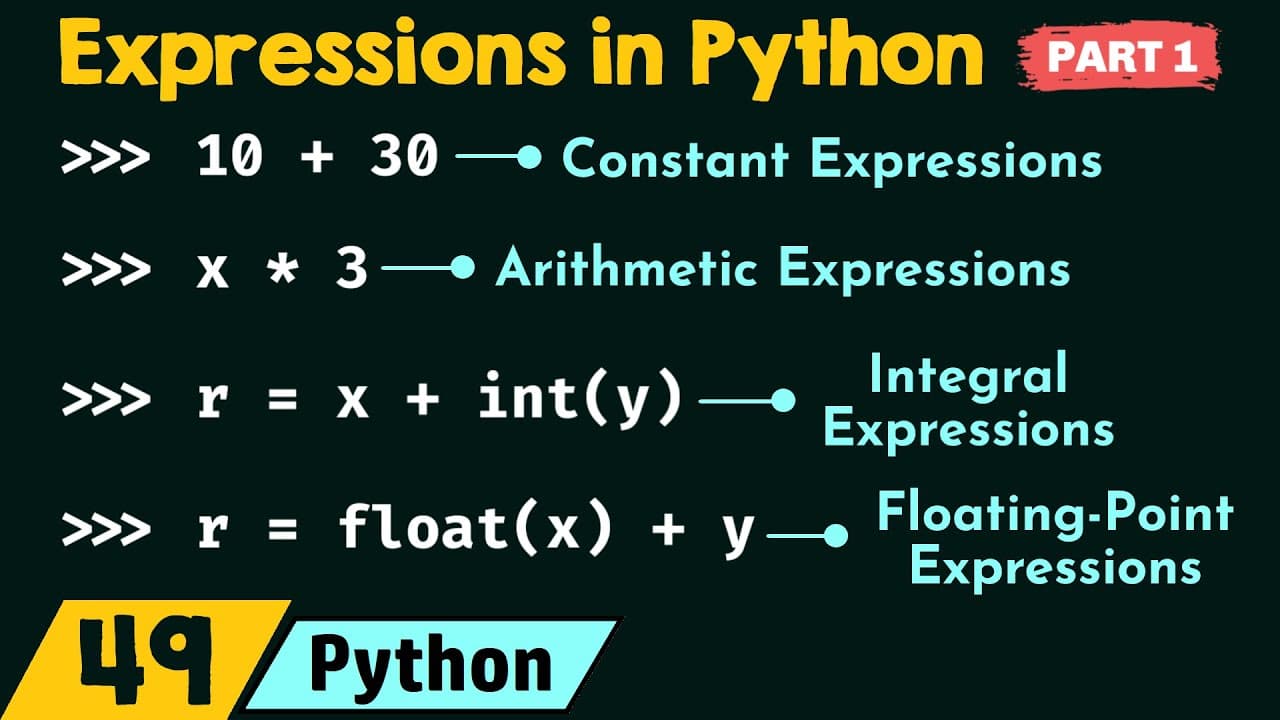
A Python expression combines operands and operators and always evaluates to a value. Constant expressions use only constant operands, while arithmetic expressions use numeric values or strings with arithmetic operators. Integral and floating-point expressions are classified by their resulting value after any required type conversion, and the division operator produces a floating-point result.
Transcript
from this presentation onwards we will understand expressions in Python in details this is part one of expressions in Python so without any further delay let's get started the first topic of this presentation is expressions in Python the second topic is constant Expressions the third topic is arithmetic expressions the fourth topic is integral expr... Read More
Key Insights
- A Python expression is a combination of operators and operands that always evaluates to a value. It may contain more than one operator or operand, but producing a resulting value is an essential characteristic of every expression.
- The expression x + 3 evaluates to 13 when x points to 10. It contains two operands, x and 3, along with one addition operator, and Python replaces x with its associated value at runtime.
- A constant expression is an expression whose operands are all constants. The operators used do not determine this classification, so 10 + 30 is a constant expression because both operands are constants, and it evaluates to 40.
- An arithmetic expression contains numeric values or strings as operands and at least one arithmetic operator. Parentheses may also appear, particularly when multiple operators are present and the order of operations needs to be controlled.
- String multiplication is an arithmetic expression when a string and numeric value are joined by the multiplication operator. If x contains neso, the expression x * 3 evaluates by repeating the string three times.
- An integral expression produces an integer after any necessary type conversions. With x equal to 5 and y equal to 7.5, x + int(y) converts y to 7 and produces the integer result 12.
- The int function converts supported data into an integer for an integral expression. Converting the string value '5' with int allows it to be added to the integer 5, producing an integer result of 10.
- A floating-point expression produces a floating-point value after any necessary conversion. Adding 10 to 15.0 produces 25.0 through implicit conversion, while 10 / 5 produces 2.0 because the division operator returns a floating-point result.
Install to Summarize YouTube Videos and Get Transcripts
Explore YouTube Video Summarizer or Get YouTube Transcript Extractor
Questions & Answers
Q: What is an expression in Python?
A Python expression is a combination of operators and operands that evaluates to a value. An expression may include one or several operators and one or several operands. For example, x + 3 is an expression because it combines the operands x and 3 with the addition operator and produces 13 when x points to 10.
Q: What is a constant expression in Python?
A constant expression is an expression containing only constants as its operands. The particular operator or number of operators does not change that requirement. For example, 10 + 30 is a constant expression because both 10 and 30 are constants rather than variables. Evaluating the expression produces the value 40.
Q: What makes an expression an arithmetic expression?
An arithmetic expression contains numeric values or strings as operands and includes at least one arithmetic operator. It can contain multiple arithmetic operators and may also use parentheses. Parentheses are especially useful when several operators appear and the programmer needs to determine which operation should be performed first.
Q: How does Python multiply a string by an integer?
Python evaluates string multiplication by repeating the string the specified number of times. If x points to the string neso, then x * 3 combines the string operand with the numeric operand 3 through the multiplication operator. The resulting value contains neso repeated three times, so the statement qualifies as an arithmetic expression.
Q: What is an integral expression in Python?
An integral expression is an expression that produces an integer value after any necessary type conversions. For example, if x is 5 and y is 7.5, the expression x + int(y) converts y from 7.5 to 7. Adding 5 and 7 then produces 12, which makes the expression integral.
Q: How does int convert floating-point and string values?
The int function converts a supplied value into integer data for the examples presented. Passing the floating-point value 7.5 to int produces 7, while passing the string value '5' produces the integer 5. These conversions allow the resulting integers to participate in addition expressions that produce integer results such as 12 or 10.
Q: What is a floating-point expression in Python?
A floating-point expression is an expression that produces a floating-point value after any required conversions. If x is 10 and y is 15.0, float(x) + y converts x to 10.0 and produces 25.0. Python can also convert x implicitly when evaluating x + y, resulting in the same floating-point value.
Q: Why does dividing 10 by 5 produce 2.0 in Python?
The division operator produces a floating-point result in the example, even when both operands are integers and the mathematical result appears whole. When x is 10 and y is 5, x / y evaluates to 2.0 rather than 2. Because its result is floating-point data, x / y is classified as a floating-point expression.
Summary & Key Takeaways
-
Python expressions are combinations of operators and operands that evaluate to values. For example, when x points to 10, the expression x + 3 contains two operands and one addition operator. At runtime, x is replaced by 10, so the complete expression evaluates to the value 13.
-
Constant expressions contain only constants as operands, while arithmetic expressions contain numeric values or strings and at least one arithmetic operator. The expression 10 + 30 is constant and evaluates to 40. Multiplying the string stored in x by 3 repeats that string three times, producing neso neso neso.
-
Integral expressions produce integer values after necessary conversions, while floating-point expressions produce floating-point values. Converting 7.5 with int gives 7, allowing 5 + 7 to produce 12. Converting 10 with float gives 10.0, and adding 15.0 produces 25.0. Division of 10 by 5 produces 2.0.
Read in Other Languages (beta)
Share This Summary 📚
Summarize YouTube Videos and Get Video Transcripts with 1-Click
Try YouTube Summary with ChatGPT & Claude or YouTube Transcript Generator
Explore More Summaries from Neso Academy 📚




Summarize YouTube Videos and Get Video Transcripts with 1-Click
Try YouTube Summary with ChatGPT & Claude or YouTube Transcript Generator