How to Build AI Agents for ROI and Secure Scale
TL;DR
Start with tedious back-office workflows whose inputs, outputs, and results are easy to verify, then use the gains to support more advanced agent systems. As deployments expand, orchestration becomes essential because it controls context, tools, data access, costs, stopping conditions, escalation, and human involvement while providing stronger safeguards than relying on model-layer security alone.
Transcript
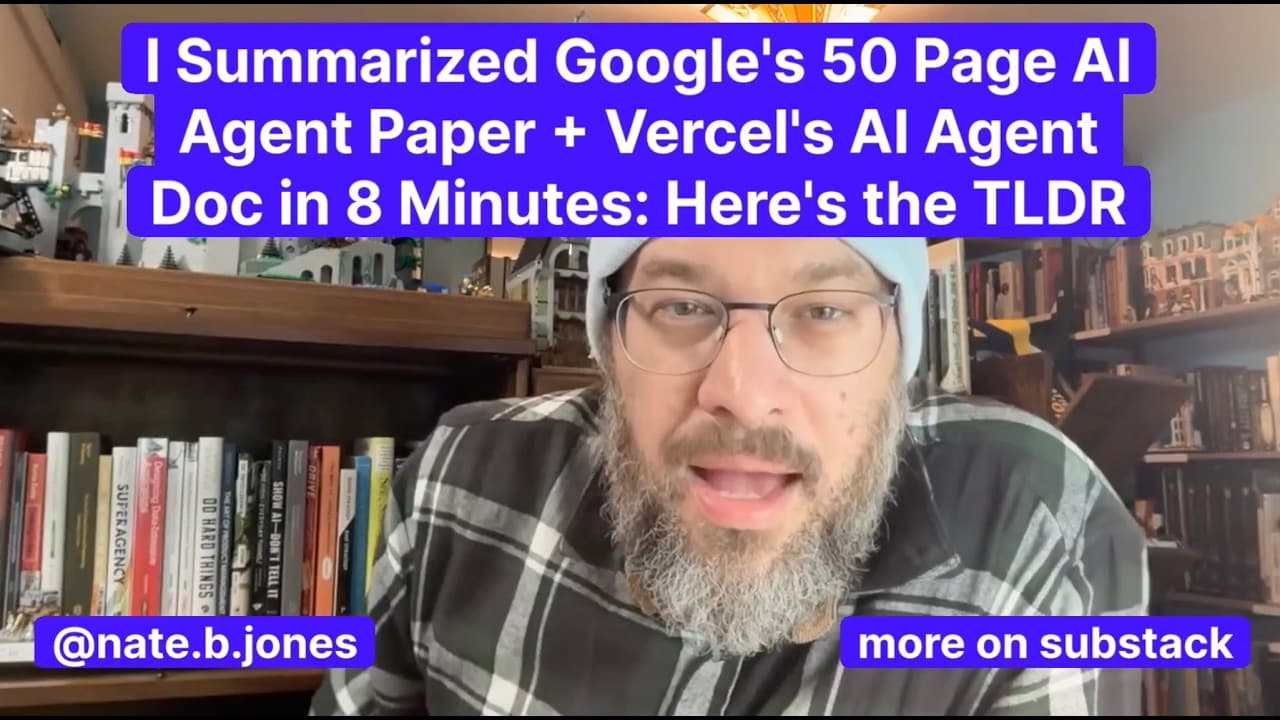
I spent time this week with three dramatically different documents about agents and I want to bring you the synthesis that matters for you. So number one was Google's 50page introduction to agents white paper. I have seen that traded around a lot. I have not seen it read a lot because if you read it you would know there's a lot in there to unpack a... Read More
Key Insights
- Verifiable back-office work is the strongest starting point for practical agents because its inputs, outputs, steps, and success conditions are already understood. Vercel identifies these opportunities by speaking with the people doing the work and targeting repetitive tasks that create avoidable toil.
- Agent automation is most valuable when it redirects people toward higher-value responsibilities. Vercel’s customer-service ticket triage example removes an unpleasant routine task while preserving human involvement for work that benefits from accumulated understanding, long context, judgment, and each employee’s strongest contributions.
- An agent is a loop that repeatedly thinks, acts, and observes. Google’s model reduces the agent’s central responsibility to context-window curation, meaning it must preserve and pass along the information required for the model, subsequent agents, and participating humans to act effectively.
- The orchestration platform is the operational environment surrounding the model. It determines which tools an agent may call, which data it may access, how long plans may run, when execution must stop, and when the system should escalate, ask a human, or transfer context.
- Agentic operations is the practice of making agent activity observable and manageable. It includes tracking what agents do, measuring the costs they incur, examining execution traces, and detecting problems that emerge during runs, rather than treating the model as an independently trustworthy system.
- Multi-agent systems are decentralized because a single all-purpose agent would require too much context and could break. Google’s vision distributes loop patterns across specialized agents, with humans placing and connecting those loops so that each participant receives the appropriate curated context.
- Agents are first-class technical identities that require roles, budgets, personas, policies, and explicit privilege levels. They should be governed like semi-autonomous workers because they can perform consequential actions and cause damage, making model-layer security alone insufficient for safe deployment.
- The practical path to Google’s large-scale vision begins with Vercel’s simpler approach. Organizations can earn value today by automating low-friction, verifiable operations, then prepare orchestration platforms and control panes for a future in which hundreds of agents require coordinated governance.
Install to Summarize YouTube Videos and Get Transcripts
Explore YouTube Video Summarizer or Get YouTube Transcript Extractor
Questions & Answers
Q: How should a business get started with AI agents?
A business should begin by reviewing back-office operations with the people who actually perform them. The best initial targets are tedious workflows made of clear, repeatable steps, with known inputs, outputs, and objectively verifiable results. Automating this low-hanging work can reduce employee toil, demonstrate practical return on investment, and create a foundation for more sophisticated agent deployments later.
Q: What kinds of tasks are best for AI agents today?
The strongest current candidates are repetitive back-office tasks that employees dislike and that follow an obvious sequence of actions. Their outcomes should be easy to verify, and both the starting information and expected output should be known. Customer-service ticket triage is one example because an agent can handle routine classification while employees shift their attention toward more valuable and human-centered responsibilities.
Q: What is the primary job of an AI agent?
The agent’s primary job is context-window curation within a repeating loop of thinking, acting, and observing. It must gather, preserve, and pass forward the information needed for each next action. This framing shifts attention away from viewing the model as a complete autonomous worker and toward designing the surrounding system that supplies useful context and governs its behavior.
Q: Why is orchestration important for AI agents?
Orchestration controls the operating conditions around an agent. The platform decides what tools the model can call, which data it can see, how long its plans may continue, when it must stop, and when it should escalate or ask a human for help. It also enables cost tracking, run tracing, and issue detection, making agent activity safer and more manageable.
Q: How should organizations secure autonomous AI agents?
Organizations should treat agents as first-class identities within their technical systems. Each agent needs defined roles, budgets, personas, policies, and privilege levels, along with appropriate role-based access controls. Because a semi-autonomous agent can cause damage, security cannot depend only on the model layer. The orchestration system must restrict access, supervise execution, and define conditions for stopping or human escalation.
Q: Why should multi-agent systems be decentralized?
Multi-agent systems should be decentralized because one all-purpose agent would need to hold too much context and could break under that burden. A distributed design assigns focused loops to separate agents and routes curated context among them. Humans can be inserted where their judgment matters, while each subsequent agent receives only the information required for its particular role and task.
Q: What is the role of humans in agent-based workflows?
Humans should remain connected to work where long-term understanding, judgment, and accumulated context add value. Agents can remove repetitive toil and handle clearly verifiable operations, but the goal is to let people spend more time on higher-value responsibilities. Effective systems weave agents around employees, route useful context to them, and define when an automated process must request human involvement.
Q: How do Google’s and Vercel’s AI agent strategies differ?
Google describes a future centered on large-scale orchestration, decentralized multi-agent systems, control panes, contextual coordination, and security-first governance. Vercel focuses on immediate business value by automating simple, tedious, and verifiable back-office workflows. The approaches are complementary across time: Vercel offers a practical starting point today, while Google outlines the infrastructure needed as organizations eventually manage hundreds of agents.
Summary & Key Takeaways
-
Vercel’s practical approach begins with interviewing the people who perform back-office work and identifying tedious, repeatable tasks with known inputs and outputs. Automating verifiable operations such as customer-service ticket triage can reduce toil while allowing experienced employees to concentrate on higher-value work that benefits from human understanding and long-term context.
-
Google presents an agent as a repeated loop of thinking, acting, and observing whose central responsibility is curating the context window. The surrounding orchestration platform determines available tools and data, limits plans, tracks costs and traces, applies stopping conditions, and decides when the agent should escalate or involve a human.
-
The combined strategy is to pursue measurable value through simple agent workflows now while preparing for decentralized systems containing many specialized agents. Security requires treating every agent as a first-class identity with defined roles, budgets, policies, personas, and privileges, supported by an orchestration control plane that makes behavior observable and governable.
Read in Other Languages (beta)
Share This Summary 📚
Summarize YouTube Videos and Get Video Transcripts with 1-Click
Try YouTube Summary with ChatGPT & Claude or YouTube Transcript Generator
Explore More Summaries from AI News & Strategy Daily | Nate B Jones 📚






Summarize YouTube Videos and Get Video Transcripts with 1-Click
Try YouTube Summary with ChatGPT & Claude or YouTube Transcript Generator