How to Structure Facebook Ads for BFCM Sales
TL;DR
Use separate sales campaigns for Black Friday and Cyber Monday, allocating about 40% of daily spend to Advantage+ Shopping and another 40% to a manual prospecting CBO campaign. Optimize for purchases with highest-volume bidding, seven-day click and one-day view attribution, broad targeting, and only the strongest interests proven by substantial annual spend and high return on ad spend.
Transcript
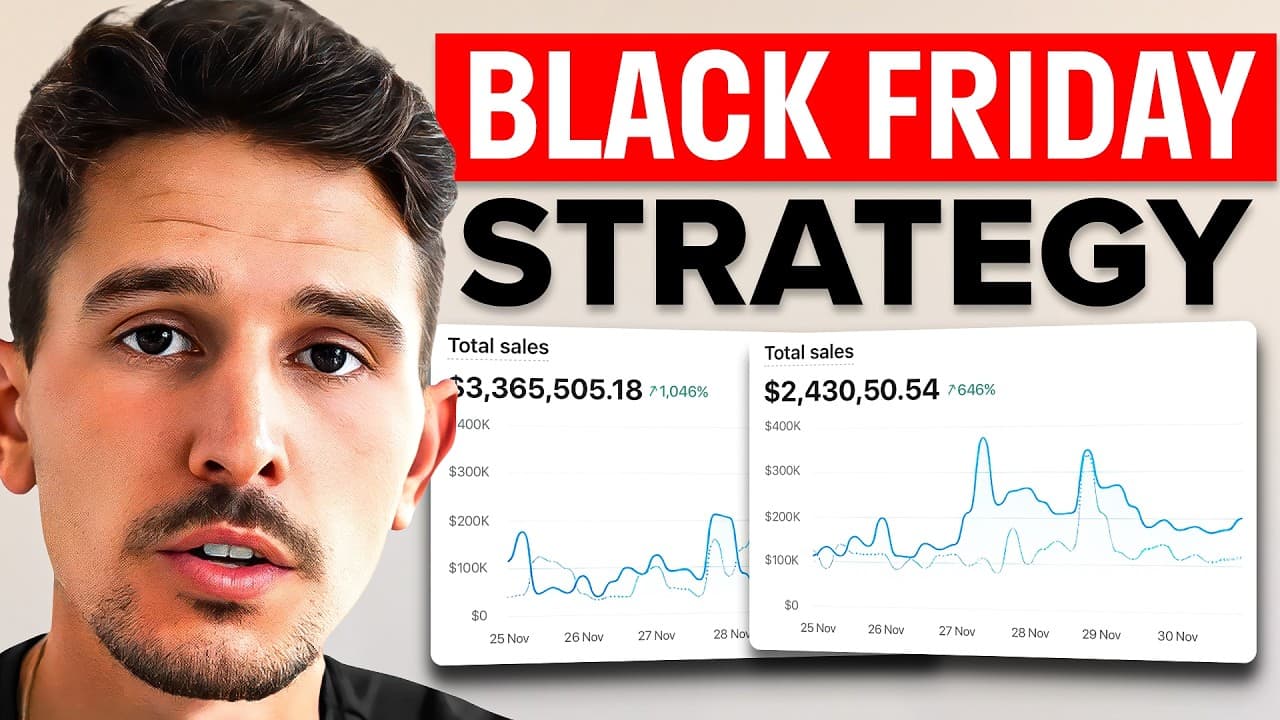
Black Friday and Cyber Monday is literally a few weeks away in fact some brands are promoting already in this video I'm going to show you three steps for exactly how we're setting up our Facebook accounts for Black Friday and Cyber Monday across all the clients that we manage now I'm going to break down exactly the strategy structure creative and a... Read More
Key Insights
- The Black Friday and Cyber Monday campaign structure is separate from evergreen campaigns, allowing holiday spending, creative, audiences, and performance decisions to be managed independently from the brand's normal advertising activity.
- The sales objective is used across the holiday setup because the stated priorities are purchases, higher return on ad spend, and scalable revenue throughout Black Friday, Cyber Monday, and the broader holiday period.
- The Advantage+ Shopping campaign receives about 40% of the total daily budget, which equals $400 in the video's $1,000-per-day example, and it runs without a cost-per-result goal, cost cap, or bid cap.
- The manual prospecting CBO campaign receives another 40% of the account budget and uses the highest-volume bid strategy, with no campaign spending limit or budget scheduling applied during the initial setup.
- The broad prospecting ad set uses original audience options and generally leaves targeting unrestricted, although age and gender may be constrained when the product clearly requires those limitations.
- The conversion optimization choice depends on the product range: stores with many products can maximize conversion value, while stores selling one product or only a few products can maximize the number of conversions.
- The attribution setting is seven-day click and one-day view for both the Advantage+ Shopping and prospecting setups, while the purchase event serves as the conversion event in the manual prospecting ad set.
- The interest ad sets use only the top two or three proven interests from historical account data, prioritizing audiences with substantial spending and strong return on ad spend or another chosen KPI instead of small, exceptional results.
Install to Summarize YouTube Videos and Get Transcripts
Explore YouTube Video Summarizer or Get YouTube Transcript Extractor
Questions & Answers
Q: How should Facebook ads be structured for BFCM sales?
The holiday setup should be separated from evergreen advertising and built around the sales objective. Start with an Advantage+ Shopping campaign using about 40% of the total daily budget. Then create a manual prospecting CBO campaign with another 40%, using a broad ad set plus duplicated ad sets containing the top two or three interests proven during the year.
Q: How much budget should go to an Advantage+ Shopping campaign for BFCM?
The general starting rule presented is to allocate around 40% of the total daily advertising budget to the Advantage+ Shopping campaign. In the example account spending $1,000 per day, that campaign receives $400 per day. The exact amount depends on the brand's current budget, but the percentage provides the initial allocation used in the demonstrated structure.
Q: What settings should an Advantage+ Shopping campaign use for BFCM?
The Advantage+ Shopping campaign should use the sales objective, website and Shop when that integration is available, the correct pixel, and seven-day click plus one-day view attribution. The campaign should target the complete country where the brand needs to scale. It should not use a cost-per-result goal, cost caps, or bid caps in the demonstrated setup.
Q: How should a prospecting CBO campaign be configured for BFCM?
The prospecting campaign should be a manual sales campaign using auction buying and campaign budget optimization. It receives about 40% of the total daily account budget and uses the highest-volume bid strategy. The setup does not apply catalog ads at the campaign level, a campaign spending limit, cost-per-result goals, or initial budget scheduling, because the focus is aggressive holiday scaling.
Q: Should BFCM prospecting use broad or interest targeting?
The prospecting CBO campaign should include both approaches. Its first ad set is completely broad, with no interest targeting and only necessary age or gender restrictions. That ad set is then duplicated to create interest-based versions using the strongest interests from historical account data. The interest selections should be proven performers rather than new ideas introduced during the holiday period.
Q: How do you choose the best Facebook ad interests for BFCM?
Review the account's advertising data from the year and select the top two or three interests. A strong interest is defined by substantial spending combined with high return on ad spend or the account's chosen KPI. The recommendation explicitly favors interests responsible for thousands in spend over small audiences that produced an unusually high return from only $500 of spending.
Q: When should Facebook ads maximize conversion value instead of conversions?
An e-commerce store with many products should select maximize value of conversions because the platform can optimize around differences in purchase value across the product range. A store with one product or only a few products can select maximize number of conversions, which is described as easier for Facebook to optimize when the available product selection is limited.
Q: Should brands test new audiences and dynamic creative during BFCM?
The strategy says Black Friday and Cyber Monday should focus on scaling proven winners rather than testing new interests. Dynamic creative is also left off in the demonstrated ad-set configuration. Instead, brands should use their strongest existing audiences and interests, retain Advantage+ placements, and make data-driven decisions based on meaningful historical spending and return on ad spend or another established KPI.
Summary & Key Takeaways
-
The recommended Black Friday and Cyber Monday setup is separate from evergreen advertising and uses the sales objective throughout. An Advantage+ Shopping campaign receives roughly 40% of the total daily budget, uses website and Shop when integrated, optimizes without cost caps, and applies seven-day click and one-day view attribution.
-
A manual prospecting campaign uses campaign budget optimization, highest-volume bidding, and about another 40% of daily spending. Its first ad set targets a broad audience, optimizes for purchases, uses Advantage+ placements, avoids spending limits and budget scheduling, and applies only necessary age or gender restrictions through original audience options.
-
The broad ad set is duplicated to create interest-based ad sets using the top two or three interests from the year. Strong interests are identified by substantial spend combined with high return on ad spend or the brand's chosen KPI. Black Friday is presented as a scaling period, not a testing period.
Read in Other Languages (beta)
Share This Summary 📚
Summarize YouTube Videos and Get Video Transcripts with 1-Click
Try YouTube Summary with ChatGPT & Claude or YouTube Transcript Generator
Explore More Summaries from Sam Piliero 📚

Summarize YouTube Videos and Get Video Transcripts with 1-Click
Try YouTube Summary with ChatGPT & Claude or YouTube Transcript Generator