How to Succeed as a Student in an AI-Driven World
TL;DR
To excel in an AI-driven world, students must adapt quickly to AI technologies and integrate them into their work. Key strategies include mastering AI co-pilot modes, automating tasks, and continuously updating AI knowledge. Understanding AI's current capabilities and limitations can give students a competitive edge in the workforce.
Transcript
hello and welcome to the cognitive Revolution where we interview Visionary researchers entrepreneurs and Builders working on the frontier of artificial intelligence each week we'll explore their revolutionary ideas and together we'll build a picture of how AI technology will transform work life and Society in the coming years I'm Nathan lens joined... Read More
Key Insights
- AI is approaching human expert performance on routine tasks but lacks breakthrough insights.
- AI's speed and availability offer significant advantages over human workers.
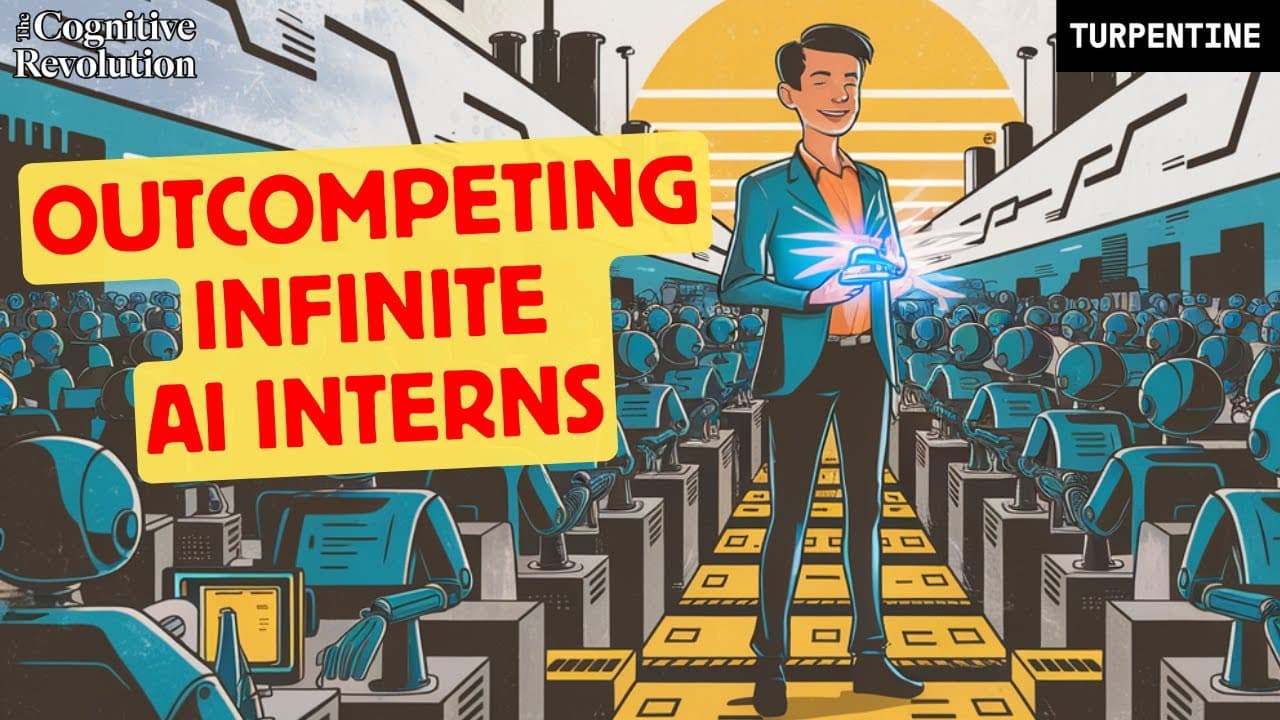
- AI tools can serve as infinite entry-level employees, changing workforce dynamics.
- Mastering AI co-pilot mode is essential for effectively integrating AI into workflows.
- Delegation mode allows AI to handle repetitive tasks, increasing efficiency.
- AI tools are constantly evolving, requiring continuous learning and adaptation.
- Understanding AI's strengths and weaknesses helps in leveraging them effectively.
- AI can automate processes, providing a significant advantage in business contexts.
Install to Summarize YouTube Videos and Get Transcripts
Explore YouTube Video Summarizer or Get YouTube Transcript Extractor
Questions & Answers
Q: How can students prepare for an AI-driven job market?
Students can prepare for an AI-driven job market by mastering AI co-pilot modes and automating repetitive tasks. They should continuously update their knowledge of AI advancements and understand the strengths and limitations of AI tools. This preparation will help them effectively integrate AI into their work, offering a competitive edge.
Q: What are the three modes of AI production?
The three modes of AI production are co-pilot, delegation, and agent mode. Co-pilot mode involves real-time interaction with AI to assist in tasks. Delegation mode automates repetitive tasks for efficiency, while agent mode promises real-time task delegation with reliable results, though it is not yet fully realized.
Q: What are the limitations of current AI technologies?
Current AI technologies are approaching human expert performance in routine tasks but lack the ability to generate breakthrough insights, often referred to as 'Eureka moments.' AI systems can make mistakes, especially in adversarial contexts, and require clear instructions to function effectively.
Q: How can AI be used to automate business processes?
AI can automate business processes by identifying repetitive tasks and setting up systems for AI to handle them consistently. This involves mapping out implicit processes, setting up input-output frameworks, and using no-code platforms to integrate AI into existing workflows, significantly increasing efficiency.
Q: Why is it important to use the best available AI tools?
Using the best available AI tools is crucial because they offer the most advanced capabilities, ensuring higher accuracy and efficiency in tasks. Top-tier models like GPT-4 and Claude 3 provide superior performance compared to free or outdated versions, making them invaluable for maintaining a competitive edge.
Q: What is the role of AI in coding and software development?
AI plays a significant role in coding and software development by acting as a co-pilot, assisting with code generation, debugging, and optimization. Tools like GitHub Copilot and Codium enhance productivity by providing real-time suggestions and automating routine coding tasks, allowing developers to focus on complex problem-solving.
Q: How can AI tools enhance learning and education?
AI tools can enhance learning and education by providing personalized learning experiences, automating administrative tasks, and offering real-time feedback. They can assist in content creation, data analysis, and resource management, allowing educators to focus more on teaching and less on routine tasks.
Q: What strategies can help students integrate AI into their work?
Students can integrate AI into their work by mastering AI co-pilot and delegation modes, continuously learning about AI advancements, and automating repetitive tasks. They should focus on understanding AI's strengths and limitations, using top-tier AI tools, and applying AI-driven insights to enhance productivity and efficiency.
Summary & Key Takeaways
-
AI is advancing rapidly, closing in on human expert performance in routine tasks, but it still struggles with generating breakthrough insights. Students should focus on mastering AI tools to enhance productivity and efficiency in their work. Understanding AI's strengths and limitations is crucial to leveraging its capabilities effectively.
-
Three modes of AI production are identified: co-pilot, delegation, and agent mode. Co-pilot mode involves real-time interaction with AI, while delegation mode automates repetitive tasks. Agent mode, though not fully realized, promises real-time task delegation with reliable results. Mastering these modes can offer a competitive edge.
-
AI's role in the workforce is expanding, with tools acting as infinite entry-level employees. To succeed, students should embrace AI technologies, automate processes, and continuously update their understanding of AI advancements. This proactive approach will help them stand out in an AI-dominated job market.
Read in Other Languages (beta)
Share This Summary 📚
Summarize YouTube Videos and Get Video Transcripts with 1-Click
Try YouTube Summary with ChatGPT & Claude or YouTube Transcript Generator
Explore More Summaries from Cognitive Revolution "How AI Changes Everything" 📚





Summarize YouTube Videos and Get Video Transcripts with 1-Click
Try YouTube Summary with ChatGPT & Claude or YouTube Transcript Generator