How to Build Strength Without Adding Muscle Size
TL;DR
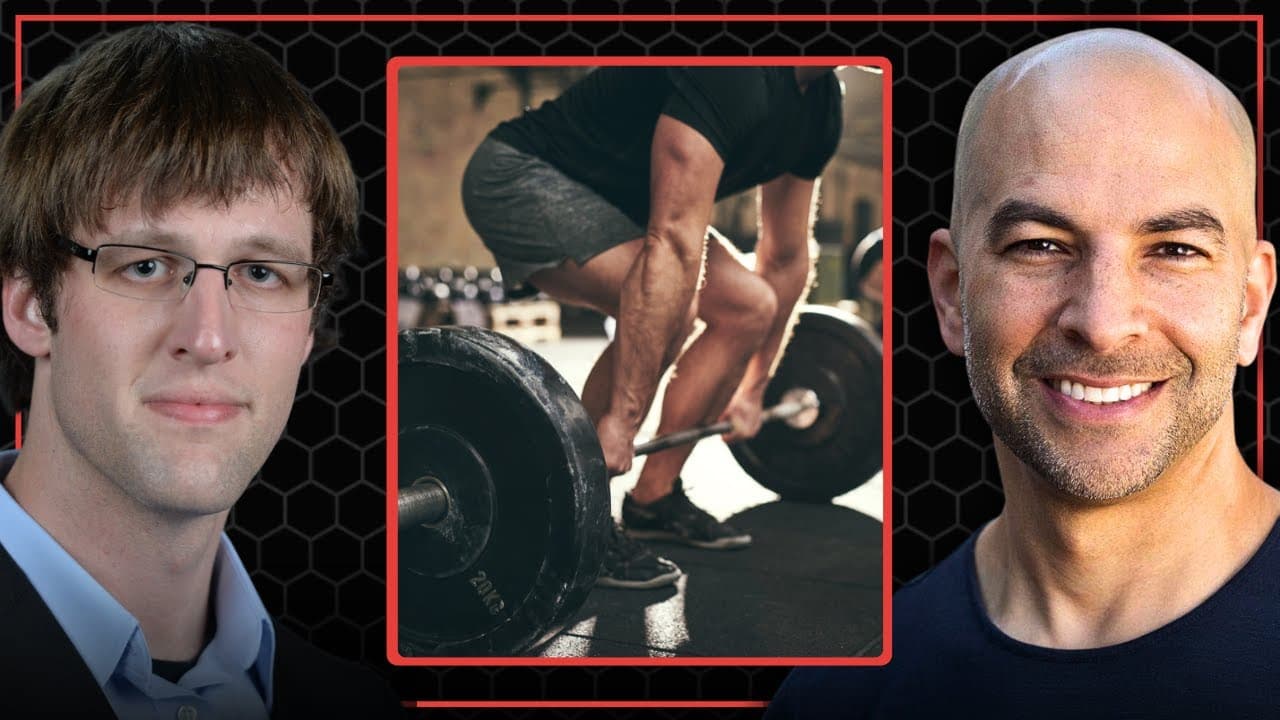
Strength can increase without measurable muscle growth when training emphasizes very heavy, low-repetition efforts near a one-repetition maximum. Evidence discussed here suggests strength gains depend strongly on practicing the specific movement and may arise predominantly from neural adaptations, along with possible local muscular changes unrelated to size. Muscle growth has not been conclusively excluded, but any causal contribution may be too small to detect.
Transcript
even outside of bfr which seems to provide a very elegant tool to test the hypothesis as as you've explained and we'll get into in a little bit more detail um it seems that you could do other experiments to test this even without blood flow restriction for example couldn't you you know have somebody do workouts where they only do one to five reps o... Read More
Key Insights
- Strength gains are possible without measurable muscle growth, as shown by an experimental group that practiced one-repetition maximum efforts and became as strong as a traditional 8–12 repetition group despite showing no growth.
- Training specificity is a major determinant of maximal strength, so someone seeking a stronger squat or deadlift for one repetition should spend at least part of their training at or near a one-repetition maximum.
- Very low-repetition training can emphasize strength while limiting hypertrophy, particularly when athletes perform no more than five repetitions and focus on maximal or near-maximal loads rather than bodybuilding-style volume.
- Exercise-induced muscle growth is not currently established as a mechanism that causes strength gains, according to the experiments discussed, although the available evidence does not conclusively rule out a small contribution.
- Causal mediation analysis tests whether adding muscle growth to a statistical model partially or completely removes the relationship between exercise and increased strength, which would indicate that growth helps drive the observed improvement.
- Muscle growth showed no detectable mediation in either training group when each was compared with a non-exercising control, meaning changes in muscle size did not statistically explain their gains in strength.
- Neural adaptation is considered a major potential explanation for strength development, but the discussion stops short of claiming that neurological changes account for the entirety of exercise-induced improvement.
- Local muscular adaptations may improve forceful contractions without increasing size, potentially through qualitative changes involving calcium handling or myosin-head binding, although the precise mechanisms remain unidentified and are presented only as possibilities.
Install to Summarize YouTube Videos and Get Transcripts
Explore YouTube Video Summarizer or Get YouTube Transcript Extractor
Questions & Answers
Q: Can strength increase without increasing muscle size?
Strength can increase without measurable growth in muscle size. In the experiment discussed, one group worked up to a one-repetition maximum, completed about five total repetitions, and then went home. Another group performed 8–12 repetitions and experienced muscle growth. Both groups achieved the same change in strength, suggesting that hypertrophy was not necessary for the observed improvement.
Q: How should someone train for maximal one-repetition strength?
Someone seeking maximal one-repetition strength should train at or close to a one-repetition maximum for at least a meaningful portion of their program. Strength has a large specificity component, so becoming highly proficient at a heavy squat or deadlift requires practicing that exact type of effort. Hypertrophy work may receive less time if its contribution to maximal strength is small.
Q: Why can low-repetition training increase strength without hypertrophy?
Low-repetition training can deliver a strong maximal-strength stimulus without accumulating the volume commonly used to produce muscle growth. The example discussed involves working at or near a one-repetition maximum for about five total repetitions. Strength may then improve through movement-specific practice, neural adaptations, and possible qualitative changes within the muscle that do not increase its measured size.
Q: What did the biceps curl training experiment find?
The biceps curl experiment compared a group training through one-repetition maximum testing with a traditional group performing 8–12 repetitions. The traditional group showed both muscle growth and increased strength, while the maximal-effort group showed no growth but achieved the same strength improvement. Because the movement was simple, the researchers thought a more complex exercise might produce a larger separation.
Q: What is causal mediation analysis in strength research?
Causal mediation analysis examines whether an additional variable explains part or all of a relationship. Here, researchers first measured the direct relationship between exercise and improved strength relative to a non-exercising control. They then added muscle growth to the model. If the exercise-strength relationship weakened or disappeared, growth would partially or completely mediate the strength gain, but no such effect appeared.
Q: Does muscle growth cause strength gains?
The experiments discussed provide no detected evidence that exercise-induced muscle growth caused the measured strength gains. Muscle size did not mediate the relationship between training and strength in either exercise group. However, the researchers do not claim that hypertrophy has been completely ruled out. Measurement error, biological variability, and a potentially very small effect prevent such a definitive conclusion.
Q: Are neural adaptations the complete explanation for strength gains?
Neural adaptations are presented as a major possible driver of strength gains, and some people believe exercise-induced improvements are predominantly neural. The discussion does not conclude that neural changes explain everything. Local muscular changes independent of size may also help a muscle respond more effectively to forceful contractions, but those mechanisms have not yet been clearly identified.
Q: What local muscle changes might improve strength without growth?
Possible local adaptations include qualitative changes in how muscle responds to forceful contractions without becoming larger. The discussion mentions calcium handling and changes in how the myosin head binds as potential examples. These suggestions are hypotheses rather than established explanations. The researchers acknowledge that they do not yet know which local mechanisms, if any, account for strength gains independent of size.
Summary & Key Takeaways
-
Experiments compared participants who performed only about five total repetitions while working toward a one-repetition maximum with participants who performed traditional sets of 8–12 biceps curls. Both groups gained similar strength, although measurable muscle growth occurred only in the traditional training group, indicating that increased size was unnecessary for the observed strength improvement.
-
Researchers used causal mediation analysis to examine each exercise group against a non-exercising control group. Adding muscle growth as a potential mediating variable did not partially or completely explain the relationship between exercise and increased strength. Measurement noise and biological variability remain limitations, so the results cannot definitively prove that hypertrophy has no role.
-
For athletes seeking maximal one-repetition strength, training must include substantial practice at or near the one-repetition maximum because strength has a large specificity component. Lower-volume maximal training may also reduce the recovery demands associated with hypertrophy-oriented volume. Strength gains may reflect neural adaptations and unidentified qualitative changes within the muscle itself.
Read in Other Languages (beta)
Share This Summary 📚
Summarize YouTube Videos and Get Video Transcripts with 1-Click
Try YouTube Summary with ChatGPT & Claude or YouTube Transcript Generator
Explore More Summaries from Peter Attia MD 📚


Summarize YouTube Videos and Get Video Transcripts with 1-Click
Try YouTube Summary with ChatGPT & Claude or YouTube Transcript Generator