What Is Tiny Grad and How Does It Improve AI Development?
TL;DR
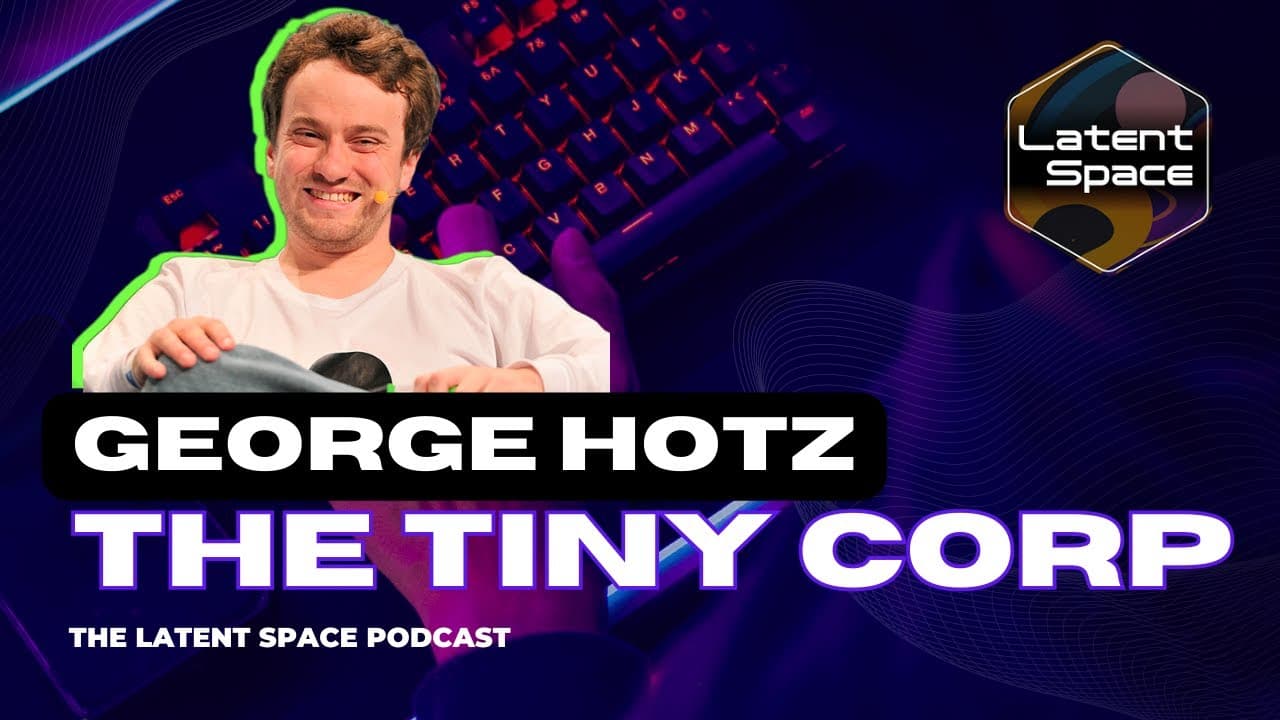
Tiny Grad is an AI framework developed by Geohot that focuses on creating accessible, customizable, and efficient ML compute devices. By minimizing complexity and optimizing performance, Tiny Grad aims to democratize machine learning and empower developers. The framework emphasizes simplicity and allows users to efficiently manage resources while avoiding the pitfalls of traditional, complex architectures.
Transcript
hey everyone welcome to delete and space podcast this is swix write an editor of latent space and Alessio is taking over uh with the intros unless his partner and CTO on residents and decimal Partners hey everyone today we have geohot on the podcast AKA George hotz um for the the human name everybody knows George so I'm not going to do a big intro ... Read More
Key Insights
- 🍝 Geohot's past experiences have shaped his focus on developing customizable ML compute devices like Tiny Grad.
- 🏛️ Tiny Grad is built with the goal of providing accessible, powerful, and customizable AI solutions.
- 👻 Geohot believes in empowering individuals by allowing easy access to ML compute devices, avoiding gatekeeping.
- ❓ The development of Tiny Grad focuses on principles of simplicity, efficiency, and customization while managing complexity.
- 🎙️ More videos with George Hotz:
Install to Summarize YouTube Videos and Get Transcripts
Explore YouTube Video Summarizer or Get YouTube Transcript Extractor
Questions & Answers
Q: How did Geohot's past experiences influence his decision to develop Tiny Grad?
Geohot's experiences of unlocking the iPhone, breaking into the PS3, and facing legal issues from companies like Sony pushed him towards developing a customizable AI framework like Tiny Grad. He values accessibility and believes in empowering individuals through easy access to ML compute devices.
Q: What is the difference between a dev kit and Tiny Grad?
Geohot explains that a dev kit is typically associated with hardware that is limited to research or development purposes. In contrast, Tiny Grad focuses on providing a consumer product that allows anyone to experiment and utilize ML compute devices. He believes that if you think a dev kit is for you, then Tiny Grad is the right choice.
Q: What is Geohot's motivation behind developing Tiny Grad?
Geohot's main motivation is to ensure that access to ML compute devices remains open and unrestricted. He aims to build a platform that prevents gatekeeping and provides individuals and organizations with the tools they need to develop and customize AI solutions. He is collaborating with Nvidia and Qualcomm to make high-quality chips accessible to everyone.
Q: What are the key principles of Tiny Grad?
Tiny Grad focuses on being a lightweight and efficient AI framework. It aims to simplify complex instruction sets, provide a clear analogy to processor development, and optimize the use of caches and memory to reduce complexity. Geohot emphasizes the importance of managing complexity without sacrificing performance.
Summary & Key Takeaways
-
Geohot, also known as George Hotz, is a hacker and entrepreneur known for unlocking the iPhone and breaking into the PS3.
-
His past experiences have shaped his current focus on developing Tiny Grad, an AI framework that aims to provide accessible and customizable ML compute devices.
-
Geohot discusses the difference between dev kits and Tiny Grad, emphasizing the importance of making ML compute devices available to anyone and avoiding gatekeeping.
-
He shares insights on the development of Tiny Grad, its core principles of simplicity and efficiency, and its potential impact on the future of AI.
Read in Other Languages (beta)
Share This Summary 📚
Summarize YouTube Videos and Get Video Transcripts with 1-Click
Try YouTube Summary with ChatGPT & Claude or YouTube Transcript Generator
Explore More Summaries from Latent Space - The AI Engineer Podcast (Video Podcast) 📚




Summarize YouTube Videos and Get Video Transcripts with 1-Click
Try YouTube Summary with ChatGPT & Claude or YouTube Transcript Generator