Why Did Hindenburg Target Icahn Enterprises?
TL;DR
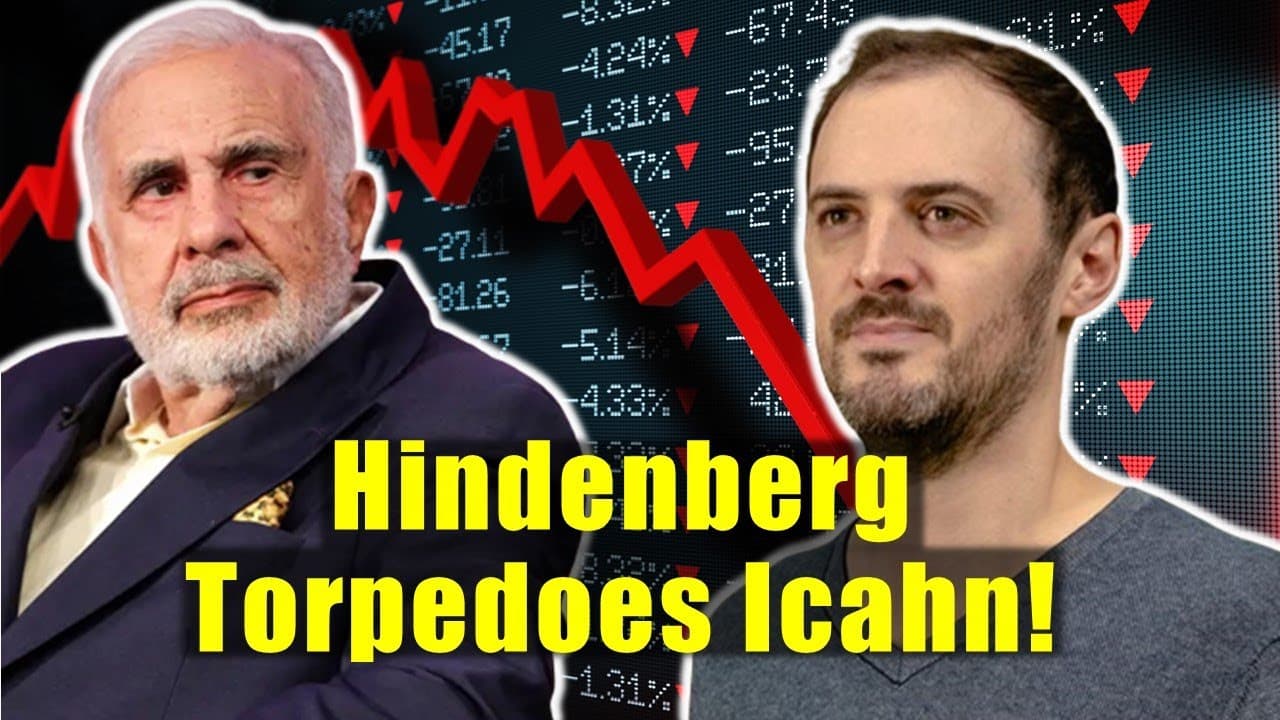
Hindenburg Research alleged that Icahn Enterprises was drastically overvalued, marked some assets above observable values, and financed its unusually large dividend through repeated stock sales rather than investment cash flow. The resulting share-price decline increased the dividend yield above 25%, reduced Carl Icahn’s net worth by billions, and raised concerns about debt, margin loans, and forced selling.
Transcript
Carl Icahn has had a long career in markets, starting out as a stockbroker in 1961, later becoming a risk arb and options trader. In the 70’s and 80’s he was a notorious corporate raider. He was accused of being an asset stripper (the worst kind of stripper) in his dealings with TWA. Today he is a notorious activist investor known for forcing even ... Read More
Key Insights
- Icahn Enterprises was valued by the market at $18 billion while reporting year-end net assets of $5.6 billion. Hindenburg argued that this unusually large premium reflected investor enthusiasm for the distribution rather than the underlying value and performance of the company’s collection of businesses.
- The dividend was allegedly funded through continuous sales of new units rather than cash flow generated by investments. Hindenburg described that arrangement as Ponzi-like because money from new investors appeared to support distributions benefiting existing holders, although Icahn Enterprises rejected the short seller’s characterization.
- Carl Icahn and his son Brett held approximately 88% of Icahn Enterprises units and typically accepted distributions in additional units rather than cash. Consequently, cash distributions were primarily required for the roughly 12% held by outside investors, reducing the immediate cash cost of the headline dividend.
- Hindenburg estimated current net asset value at approximately $4.4 billion, which was 22% below the disclosed year-end indicative value of $5.6 billion. On that estimate, the units had traded at a 310% premium to net asset value, with annual distributions equal to 64% of net asset value.
- Some asset marks were allegedly far above observable or subsequently supportable values. Icahn Enterprises valued its 90% interest in a listed meat-packaging business at $243 million when that company’s total market value was $89 million, while a key automotive-parts subsidiary entered bankruptcy one month after year-end.
- Carl Icahn had allegedly pledged around 60% of his Icahn Enterprises holdings as collateral for personal margin loans. Because maintenance thresholds and loan-to-value terms were not disclosed, investors could not determine the price at which lenders might require additional collateral or force unit sales.
- Icahn Enterprises carried $5.3 billion in debt, with stated maturities of $1.1 billion in 2024, $1.36 billion in 2025, and $1.35 billion in 2026. Hindenburg presented this leverage schedule as another source of pressure on a company whose investments allegedly produced negative operating cash flow.
- Holding companies and closed-end investment vehicles commonly trade near or below net asset value because investors discount management costs, poor capital allocation, uncertain asset-sale timing, taxes, and delayed shareholder returns. Hindenburg found Icahn Enterprises’ premium exceeded every one of the 526 U.S. closed-end funds in Bloomberg’s database.
Install to Summarize YouTube Videos and Get Transcripts
Explore YouTube Video Summarizer or Get YouTube Transcript Extractor
Questions & Answers
Q: Why did Hindenburg target Icahn Enterprises?
Hindenburg targeted Icahn Enterprises because it believed the publicly traded units were substantially overvalued relative to the company’s assets. Its report alleged that the high dividend attracted retail investors, new unit sales helped finance cash distributions, certain less liquid investments carried inflated values, and weak investment performance further reduced the company’s ability to sustain its distributions.
Q: Why did Hindenburg call Icahn Enterprises Ponzi-like?
Hindenburg used the term Ponzi-like because it alleged that Icahn Enterprises supported distributions by continually selling new units rather than relying on cash generated by its investments. Under this interpretation, money supplied by new investors helped pay cash distributions to existing outside investors. The description was an allegation from a short seller, and Icahn Enterprises said it stood by its disclosures.
Q: How was the Icahn Enterprises dividend structured?
Before the report, Icahn Enterprises offered a dividend yield of about 15%. Carl Icahn and his son Brett controlled approximately 88% of the units and typically received their distributions in additional units instead of cash. Cash therefore went mainly to the roughly 12% of units owned by outside investors. After the price fell, the indicated yield rose above 25%.
Q: Was Icahn Enterprises trading above net asset value?
Icahn Enterprises reported year-end net asset value of $5.6 billion while its market value stood at $18 billion. Hindenburg adjusted the estimated net asset value downward to approximately $4.4 billion, citing allegedly inflated marks. Based on that lower estimate, the short seller calculated that the units had traded at a 310% premium to net asset value.
Q: What evidence suggested that some IEP assets were overvalued?
Hindenburg cited Icahn Enterprises’ 90% interest in a publicly traded meat-packaging business. The stake was valued at $243 million at year-end even though the listed company’s total market value was only $89 million at that time. It also cited an automotive-parts division valued at $381 million in December 2022, one month before its key subsidiary declared bankruptcy.
Q: How could Carl Icahn’s margin loans affect IEP units?
Hindenburg reported that Carl Icahn had pledged around 60% of his Icahn Enterprises holdings as collateral for personal margin loans. If the unit price continued falling, lenders could potentially demand additional collateral or repayment. Forced unit sales could then place further downward pressure on the price. The report noted that maintenance thresholds and other important loan terms were not disclosed.
Q: What role did Jefferies play in the Hindenburg allegations?
Jefferies was identified as the only major investment bank publishing research on Icahn Enterprises while also helping the company sell units. Hindenburg said Jefferies managed all $1.7 billion of the company’s at-the-market offerings since 2019. It alleged that favorable research attracted retail investors while the investment-banking operation facilitated unit sales that helped support the dividend.
Q: Why do holding companies often trade below net asset value?
Holding companies often trade below the combined value of their underlying assets because investors account for management expenses, possible capital misallocation, uncertain timing of asset sales, taxes on future dispositions, and delays in returning capital. The transcript explains that comparable vehicles managed by Dan Loeb and Bill Ackman traded at discounts of 14% and 35%, respectively, making Icahn Enterprises’ premium particularly unusual.
Summary & Key Takeaways
-
Hindenburg Research targeted Icahn Enterprises with allegations that its units traded at an extraordinary premium to net asset value. The short seller argued that retail investors were attracted by a 15% dividend yield, even though the holding company’s investments allegedly failed to generate enough cash to support that distribution.
-
The report estimated Icahn Enterprises’ adjusted net asset value at about $4.4 billion, compared with its disclosed year-end indicative value of $5.6 billion. It cited questionable marks on less liquid holdings, including a meat-packaging stake valued substantially above its observable public market value and an automotive-parts division facing bankruptcy.
-
Carl Icahn’s financial exposure amplified the risks identified in the report. Hindenburg said about 60% of his Icahn Enterprises holdings had been pledged for personal margin loans, while the company carried $5.3 billion in debt. A continued unit-price decline could therefore create margin pressure and potentially accelerate further selling.
Read in Other Languages (beta)
Share This Summary 📚
Summarize YouTube Videos and Get Video Transcripts with 1-Click
Try YouTube Summary with ChatGPT & Claude or YouTube Transcript Generator
Explore More Summaries from Patrick Boyle 📚





Summarize YouTube Videos and Get Video Transcripts with 1-Click
Try YouTube Summary with ChatGPT & Claude or YouTube Transcript Generator