Why European Automakers Are Losing to China
TL;DR
European automakers are losing ground because China has stopped being a major buyer of German vehicles and has become a faster, lower-cost competitor in electric vehicles. High energy costs and bureaucracy contribute to Germany’s weakness, but lost export markets, rapid Chinese development cycles, surplus production, and an undervalued renminbi create a deeper structural challenge that layoffs alone cannot resolve.
Transcript
If you look at Volkswagen stock chart over the last five years, it doesn't really look like a 90-year-old industrial titan. It looks more like an altcoin that got rugpulled by its own founding team. The stock is down more than 65% trading at its lowest level since 2010. Which means, and I want you to sit with this, it's now cheaper than it was duri... Read More
Key Insights
- Germany’s automotive crisis is rooted primarily in lost export demand, not bureaucracy alone. Bloomberg research attributes about 40% of Germany’s recent GDP shortfall to lost export markets, another 40% to the energy shock, and the remaining 20% to weak domestic demand and bureaucracy.
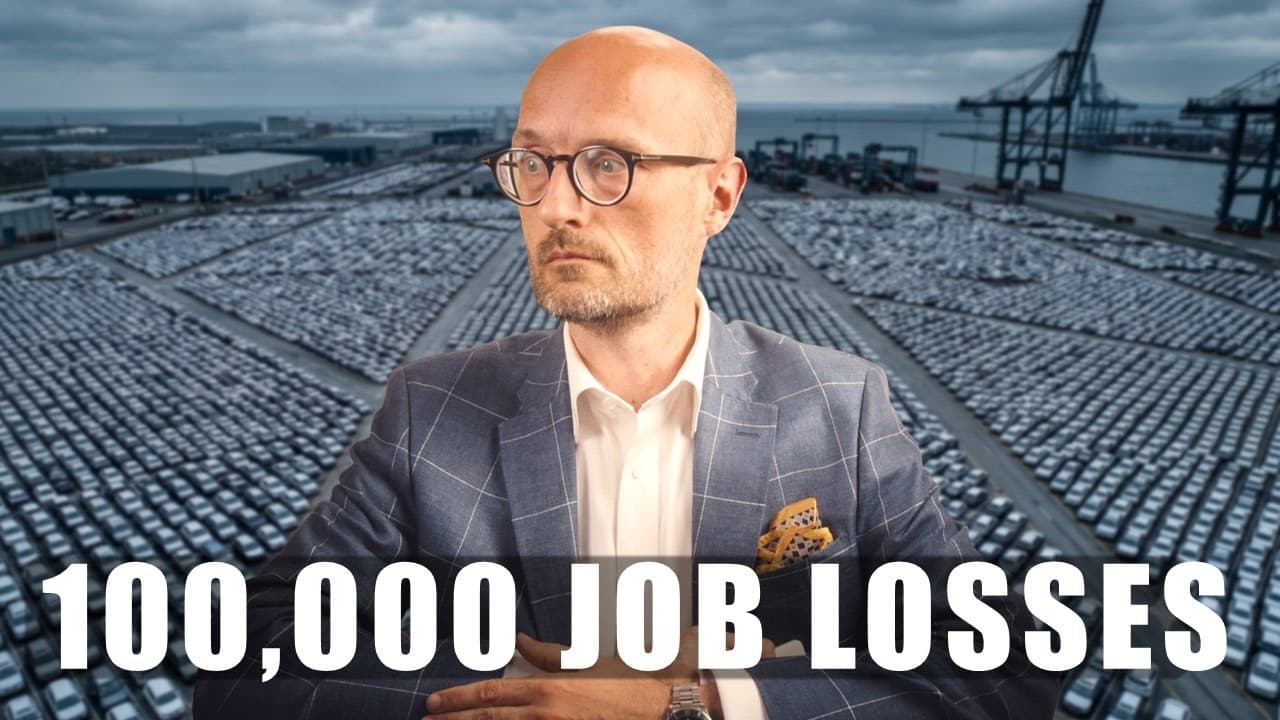
- Volkswagen is considering changes that would break longstanding corporate precedents. Reported proposals include cutting up to 100,000 jobs and closing four German factories, despite a late-2024 written promise to unions that plant closures would not occur before 2030.
- European automakers are facing pressure across multiple brands and markets. BMW expects to spend up to a billion euros on restructuring, Mercedes-Benz has postponed a worker bonus and requested longer hours without corresponding pay, and Peugeot sold only 373 Australian cars during the year’s first five months.
- Germany’s traditional economic model is dependent on exporting complex, expensive manufactured goods. That model weakens when major customers stop buying German machinery and vehicles, especially when China develops domestic alternatives and begins exporting competing capital goods and cars.
- Electric vehicles changed the basis of automotive competition from combustion-engine excellence toward battery chemistry and software. German manufacturers treated their engineering advantage as durable, but Chinese companies developed capabilities that undermined the competitive value of Europe’s century-long strength in combustion technology.
- China speed is based on development cycles of under 24 months, compared with 40–80 months for typical European and American automakers. Chinese companies achieve this through flatter management, demanding work schedules, and a software-style approach that can address some problems later through over-the-air updates.
- China Shock 2.0 targets capital-intensive and technology-intensive sectors that Europe historically dominated. Unlike the first China shock after the country’s 2001 WTO entry, the current export expansion directly challenges European vehicles, machinery, chemicals, and other industries important to long-term economic strength.
- China’s export imbalance is not correcting through stronger consumption or currency appreciation. The inflation-adjusted renminbi depreciated by around 15% over roughly five years, while state banks reportedly bought dollars to restrain its value, making Chinese exports more competitive in foreign markets.
Install to Summarize YouTube Videos and Get Transcripts
Explore YouTube Video Summarizer or Get YouTube Transcript Extractor
Questions & Answers
Q: Why are European automakers losing to Chinese competitors?
European automakers are losing ground because China has shifted from buying German vehicles and machinery to producing competing electric cars and capital goods. Chinese manufacturers combine development cycles of under 24 months with strong battery and software capabilities. Weak domestic Chinese sales and a severe price war also encourage manufacturers to send surplus vehicles abroad, increasing pressure on European producers in their home and export markets.
Q: What is China Shock 2.0 in the automotive industry?
China Shock 2.0 describes export growth from a Chinese economy representing about 18% of global GDP, concentrated in capital-intensive and technology-intensive industries that Europe once dominated. Unlike the first shock, which mainly affected low-wage production such as toys, furniture, and basic electronics, the new wave directly challenges European vehicles, machinery, chemicals, and other strategically important manufactured products.
Q: How does China speed help Chinese car manufacturers?
China speed allows Chinese manufacturers to bring a new model to market in under 24 months, while European and American companies typically require 40–80 months. The faster process relies on flat management structures, demanding working hours, and software-industry quality practices. Some problems can be addressed after delivery through over-the-air updates, enabling rapid launches and quicker responses to shifting customer preferences.
Q: Why does bureaucracy not fully explain Germany’s economic weakness?
Bureaucracy cannot fully explain Germany’s weakness because neighboring countries such as the Netherlands and Denmark operate under the same European Union paperwork while continuing to grow. Bloomberg research attributes about 40% of Germany’s recent GDP shortfall to the energy shock and another 40% to lost export markets. Weak domestic demand and bureaucracy together account for the remaining 20%, according to the figures presented.
Q: Why did electric vehicles weaken Germany’s automotive advantage?
Electric vehicles changed which capabilities determine automotive competitiveness. German manufacturers had spent decades refining combustion engines and assumed that engineering advantage would remain durable. The transition placed greater emphasis on battery chemistry and software, fields in which Chinese manufacturers moved ahead. As a result, expertise accumulated over a century became less decisive while faster development and digital capabilities became more important.
Q: Why are Chinese automakers exporting more vehicles?
Chinese automakers are exporting more vehicles partly because demand at home has weakened. Domestic car sales in China fell 22.3% year on year in May, while manufacturers were engaged in a severe domestic price war. Companies with surplus production therefore sought buyers abroad. China’s auto exports were expected to approach 10 million vehicles during the year discussed, greatly increasing competitive pressure on overseas manufacturers.
Q: How does China’s currency policy affect European carmakers?
China’s currency policy helps keep exports competitively priced. Adjusted for inflation, the renminbi depreciated by around 15% over roughly five years instead of appreciating in response to the trade surplus. Chinese state banks reportedly intervened by buying dollars to restrain the currency’s value. The IMF estimated undervaluation at around 16%, while other analysts cited in the discussion believed the true figure was higher.
Q: Why might job cuts fail to solve Volkswagen’s problem?
Job cuts can reduce payroll expenses, but the crisis described is a structural challenge involving lost export demand, electric-vehicle competition, faster Chinese product development, and an automotive cost gap. Volkswagen’s reported plan could affect up to 100,000 jobs and four German factories, yet reducing headcount does not restore Chinese demand, rebuild technological leadership, or correct the international trade and currency imbalances supporting lower-priced imports.
Summary & Key Takeaways
-
Germany’s automotive crisis is visible in falling valuations, potential plant closures, and restructuring proposals. Volkswagen is considering up to 100,000 job cuts and four German factory closures, while BMW and Mercedes-Benz are also seeking savings. Peugeot’s extremely weak Australian sales further illustrate the pressure facing established European brands abroad.
-
High energy costs, demographic pressures, and bureaucracy contribute to Europe’s difficulties, but the central problem is weakening demand for German exports. Bloomberg research attributes about 40% of Germany’s recent GDP shortfall to the energy shock and another 40% to lost export markets, leaving only 20% for domestic weakness and bureaucracy.
-
China has transformed from a customer for German machinery and vehicles into a major competitor in capital goods and electric cars. Faster product cycles, advanced battery and software capabilities, weak Chinese domestic sales, surplus production, and currency intervention are pushing more Chinese vehicles abroad, threatening Europe’s export-based automotive business model.
Read in Other Languages (beta)
Share This Summary 📚
Summarize YouTube Videos and Get Video Transcripts with 1-Click
Try YouTube Summary with ChatGPT & Claude or YouTube Transcript Generator
Explore More Summaries from Patrick Boyle 📚






Summarize YouTube Videos and Get Video Transcripts with 1-Click
Try YouTube Summary with ChatGPT & Claude or YouTube Transcript Generator