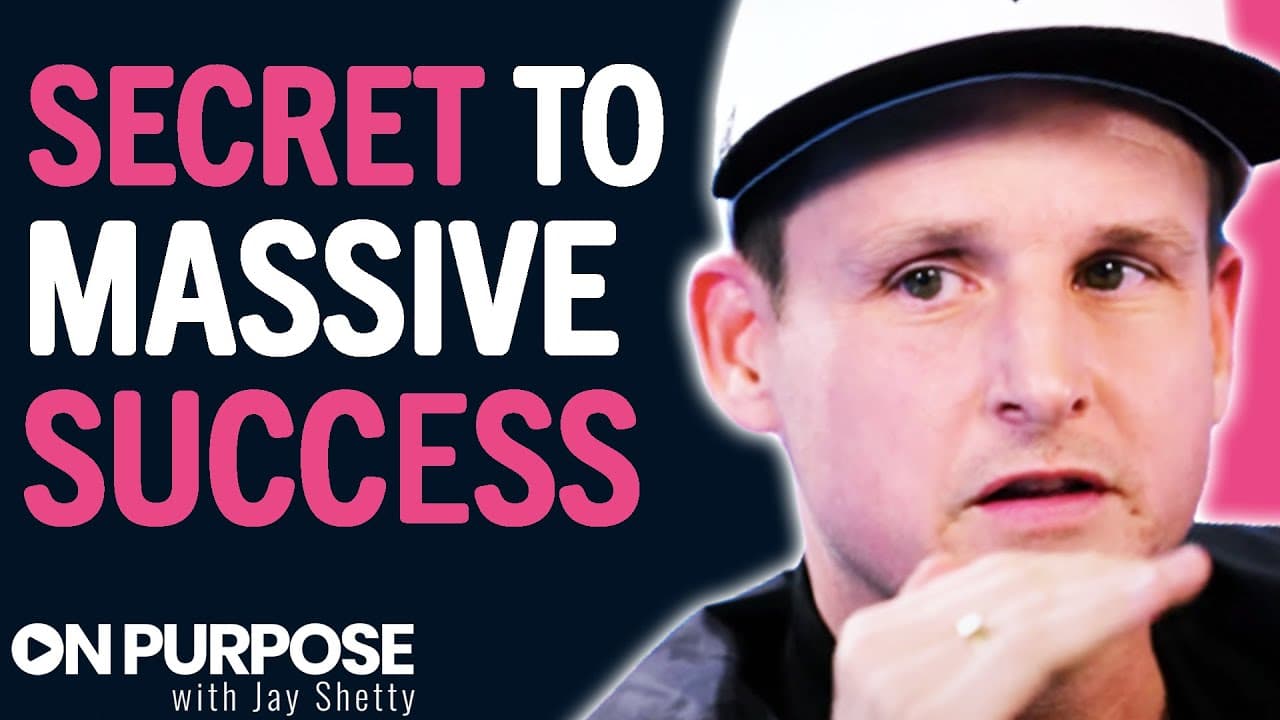
How To Build Your BRAND, THINK BIGGER & Find CLARITY In Life | Rob Dyrdek & Jay Shetty
TL;DR
Design your life so every commitment supports your legacy, lifestyle, or happiness, then use that clarity to filter decisions. In business, Rob Dyrdek favors deeply involved creation over passive investing, evaluating opportunities through founder commitment, leadership, market white space, liquidity potential, financial modeling, and unfair advantages while building systems that let others operate what he helps shape.
Transcript
designing a life uh in such a way that everything that you do and every decision you make is either leading towards uh your legacy uh your lifestyle or or your happiness and then making sure that you don't ever do anything other than what supports that hey everyone thank you so much for coming back to the show today's guest is a school dropout turn... Read More
Key Insights
- Life design is the practice of ensuring that every action and decision supports legacy, lifestyle, or happiness. Dyrdek presents these three outcomes as a practical filter for avoiding commitments that conflict with the life a person intends to build.
- Personal evolution is easier to recognize when progress has visible markers. Dyrdek treats substantial podcast conversations held every six to eight months as records of his changing ideas, allowing him to compare his current thinking with earlier stages of development.
- A promising investment is evaluated through founder commitment, leadership quality, market white space, a clear path to liquidity, and unfair advantages. Dyrdek uses these principles as a repeatable filter rather than relying solely on excitement about a product.
- Financial modeling is a central method for validating a business opportunity. Dyrdek praised a model that mapped growth door by door, product by product, and margin by margin because it translated an attractive concept into a detailed operational and financial plan.
- Strong founders can combine creative, operational, and financial thinking. Dyrdek considered that combination rare and especially valuable because it connects product imagination with execution discipline and a realistic understanding of how the business can grow.
- Distinctive branding can help a product occupy a clearer position in a crowded category. The change from Fresh Soul to Pig Out gave the mushroom-based bacon product a more memorable, aggressive identity and supported packaging, character, and messaging ideas.
- Consumer criticism can reveal risks before branding becomes permanent. After people strongly rejected a joke about a pig eating bacon-flavored chips, Dyrdek removed the message before production because packaging on retail shelves would be harder to reverse than a social post.
- Dyrdek's preferred entrepreneurial role is creating and shaping businesses rather than operating them. He wants to influence the idea, brand, and route to market, then establish systems that allow the venture to continue without requiring him to manage daily operations.
- Related book: Think Like a Monk
- Export your Kindle highlights to Glasp: How to Download Highlights and Notes from Kindle
Install to Summarize YouTube Videos and Get Transcripts
Explore YouTube Video Summarizer or Get YouTube Transcript Extractor
Questions & Answers
Q: How can you design a life around clear priorities?
Design a life by testing every action and decision against three priorities: legacy, lifestyle, and happiness. A commitment should contribute to at least one of those outcomes rather than pull attention away from them. This filter creates clarity because it connects daily choices to a larger purpose and reduces involvement in activities that do not support the life being built.
Q: How does Rob Dyrdek evaluate a business opportunity?
Rob Dyrdek evaluates opportunities through a repeatable set of principles. He looks for a fully committed founder, an effective leadership team, open space in the market, a clear path to liquidity, and unfair advantages. He also examines whether the business has a rigorous financial model and whether he can contribute meaningfully to shaping the concept, brand, and growth strategy.
Q: Why is a detailed financial model important for a startup?
A detailed financial model turns a creative idea into a testable plan for growth. In the Pig Out example, the model described expansion door by door, product by product, and margin by margin. Dyrdek viewed that precision as evidence that the founder understood how distribution, assortment, economics, and execution would work together, rather than depending only on enthusiasm for the product.
Q: What qualities does Rob Dyrdek value in a founder?
Dyrdek values a founder who is deeply committed and capable of thinking creatively, operationally, and financially. He praised Bill Glaser for understanding the business clearly, creating a precise tactical model, developing relationships, and continually finding manufacturing, financial, and creative support. Dyrdek considers this combination rare because it joins imaginative brand building with the discipline required to execute and grow.
Q: How was the Pig Out brand name developed?
The product was originally called Fresh Soul, but Dyrdek believed its unusual mushroom-based bacon concept needed a louder and more distinctive identity. After considering several directions, Bill Glaser proposed Pig Out. Dyrdek initially thought it might be too aggressive, then recognized that it was memorable and closely connected to the product, which led to packaging, character, and visual branding ideas.
Q: What branding lesson came from the Pig Out controversy?
The Pig Out team learned that an amusing internal concept can create a very different reaction among consumers. A joke showing a pig pleased to eat bacon-flavored chips drew intense criticism when posted online. Dyrdek decided to remove the related message before package production because printed retail packaging would make the controversy more permanent and difficult to correct than a deletable social media post.
Q: Why does Rob Dyrdek prefer creating businesses to operating them?
Dyrdek receives his greatest satisfaction from moving an idea through creation, shaping, market introduction, and eventual sale to a customer. He enjoys contributing to naming, branding, positioning, and strategic development, but does not enjoy running daily operations. His preferred approach is to build systems that support continued execution, allowing him to remain focused on the creative stage where he contributes most.
Q: How can interviews help measure personal growth?
Long-form interviews can serve as periodic records of a person's beliefs, priorities, and reasoning. Dyrdek compares conversations recorded every six to eight months and notices significant changes in how he thinks and communicates. Because podcast discussions allow deeper reflection than short promotional television appearances, they provide useful markers for observing personal evolution across different stages of work and life.
Summary
In this video, Rob Dyrdek, a school dropout turned pro skateboarder turned TV host turned entrepreneur, talks about his journey of constantly evolving and transitioning from one passion to another. He shares his experiences in creating successful businesses and finding clarity in life. Rob emphasizes the importance of designing a life that aligns with your legacy, lifestyle, and happiness. He also discusses his involvement in Pig Out Chips and the process of investing in businesses. Rob's core principles revolve around defending and pursuing happiness, clarity, and the art of constantly evolving.
Questions & Answers
Q: How did Rob get involved in Pig Out Chips?
Rob got involved in Pig Out Chips through his evolved way of creating and investing in businesses. He saw the potential in the vegan market and was fascinated by the taste of the product. As he invested in the company, he realized the need for a unique brand name and eventually came up with the name "Pig Out." The collaboration between Rob and the founder of Pig Out Chips resulted in a successful partnership.
Q: How did Rob evolve and recreate himself over time?
Rob's journey of constant evolution and recreation stems from his deep belief, relentless drive, and self-reflection. He mentions how he grew over two years by engaging in podcast interviews every six to eight months. Rob's constant pursuit of growth and self-improvement has allowed him to reinvent himself in various industries, from skateboarding to television hosting to entrepreneurship.
Q: Why does Rob choose to have deep conversations in podcasts rather than traditional interviews?
Rob believes that podcasts provide a platform for real, deep conversations. Unlike traditional interviews, podcasts allow him to share a different side of himself and engage in discussions that go beyond surface-level topics. Rob values authenticity and believes that podcasts offer a space for genuine conversations about beliefs, philosophies, ideas, motivations, and happiness.
Q: What are Rob's core principles in life and business?
Rob's core principles revolve around designing a life that leads to legacy, lifestyle, and happiness. He created a system where every decision he makes aligns with these three aspects. His principles include being tuned in with energy, feeling light in existence, defending happiness, and having clarity in what he wants to achieve in life. Rob's ultimate goal is to live an extraordinary life filled with success, balance, and happiness.
Q: How does Rob find clarity despite living in an unclear and uncertain world?
Rob finds clarity by looking at his life holistically and breaking it down into different aspects, such as relationships, work, and free time. He tracks his daily feelings about each aspect and identifies the things that make his life problematic. By addressing these challenges, learning, and refining his approach, Rob gradually gains more clarity. He emphasizes the importance of defining what life you want and making decisions that support that vision.
Q: How does Rob approach the transition and evolution process?
Rob sees the transition and evolution process as a continuous refinement of his vision and goals. He believes in constantly evolving, breaking things down into smaller steps, and continuously learning from each step. By staying committed to mastering life, he aims to live a life of clarity, bliss, and fulfillment. Rob acknowledges that the transition can be challenging, but he embraces the process as it leads to personal growth and self-mastery.
Q: Why does Rob place so much importance on clarity?
Clarity is vital to Rob because it allows him to align his actions with his intentions and goals. He believes that clarity is a key element in designing a life that brings happiness and fulfillment. Rob's obsession with clarity stems from his desire to make sense of his life and his commitment to constant improvement and evolution. He considers clarity as a fundamental aspect of living an extraordinary life.
Q: How does Rob balance the paradox of hosting ridiculousness and pursuing meaningful depth?
Rob acknowledges the paradox he embodies, from hosting a lighthearted show like Ridiculousness to pursuing meaningful depth in his life and business endeavors. He explains that Ridiculousness was created as a business opportunity but does not define him entirely. Rob is currently transitioning towards showcasing his true way of thinking and focusing on living a life aligned with his principles. He aims to be known for more than just hosting a clip show, and his future content will reflect his evolved thinking.
Q: How did Rob navigate the process of dropping out of school and pursuing entrepreneurship at a young age?
When Rob dropped out of school at 16, it wasn't a decision that came with fear or uncertainty. He grew up around entrepreneurs and was gifted with deep self-belief. For him, starting a company and becoming a professional skateboarder felt natural and aligned with his upbringing. Rob's strong belief in himself and the support of those around him allowed him to pursue his passions without second-guessing himself.
Q: How did Rob find the self-belief and clarity to pursue his passions?
Rob found self-belief and clarity through deep introspection, commitment to growth, and continuous learning. He emphasizes the importance of understanding oneself and identifying what brings lightness and fulfillment in life. Rob's journey involved a profound commitment to mastering himself, designing a life plan that aligns with his values, and constantly evolving his mindset and approach. He considers self-belief and clarity as powerful tools for pursuing happiness and achieving success.
Takeaways
Rob Dyrdek's journey is a testament to the power of self-belief, constant evolution, and designing a life that aligns with legacy, lifestyle, and happiness. He emphasizes the importance of clarity and the art of continuously refining one's vision and goals. Rob's core principles revolve around defending and pursuing happiness, which he sees as the ultimate purpose of life. His determination to create businesses that bring joy and meaning to himself and others is inspiring. Rob's perspective challenges the notion that demystifying everything is the only path to success, reminding us of the beauty in the process of exploration and intellectual curiosity. Overall, his story serves as a reminder that personal growth and self-mastery are lifelong journeys worth embracing.
Summary & Key Takeaways
-
Rob Dyrdek describes life design as aligning every action and decision with legacy, lifestyle, or happiness. His career, from leaving school to professional skateboarding, television, and entrepreneurship, reflects relentless evolution. He also uses periodic interviews as markers that reveal how his thinking and personal development change over time.
-
Dyrdek evaluates business opportunities using a structured filter: a fully committed founder, a capable leadership team, market white space, a clear path to liquidity, and unfair advantages. He also values detailed financial models that map growth through distribution, product assortment, and margins, treating disciplined validation as essential to creative entrepreneurship.
-
The Pig Out brand illustrates Dyrdek's preferred creative process. He helped reshape the original Fresh Soul concept through naming, positioning, packaging, and character development. After a provocative marketing joke attracted criticism, he removed it before production, showing that memorable branding must still account for consumer reactions and permanent retail exposure.
Read in Other Languages (beta)
Share This Summary 📚
Summarize YouTube Videos and Get Video Transcripts with 1-Click
Try YouTube Summary with ChatGPT & Claude or YouTube Transcript Generator
Explore More Summaries from Success Habits 📚



Summarize YouTube Videos and Get Video Transcripts with 1-Click
Try YouTube Summary with ChatGPT & Claude or YouTube Transcript Generator