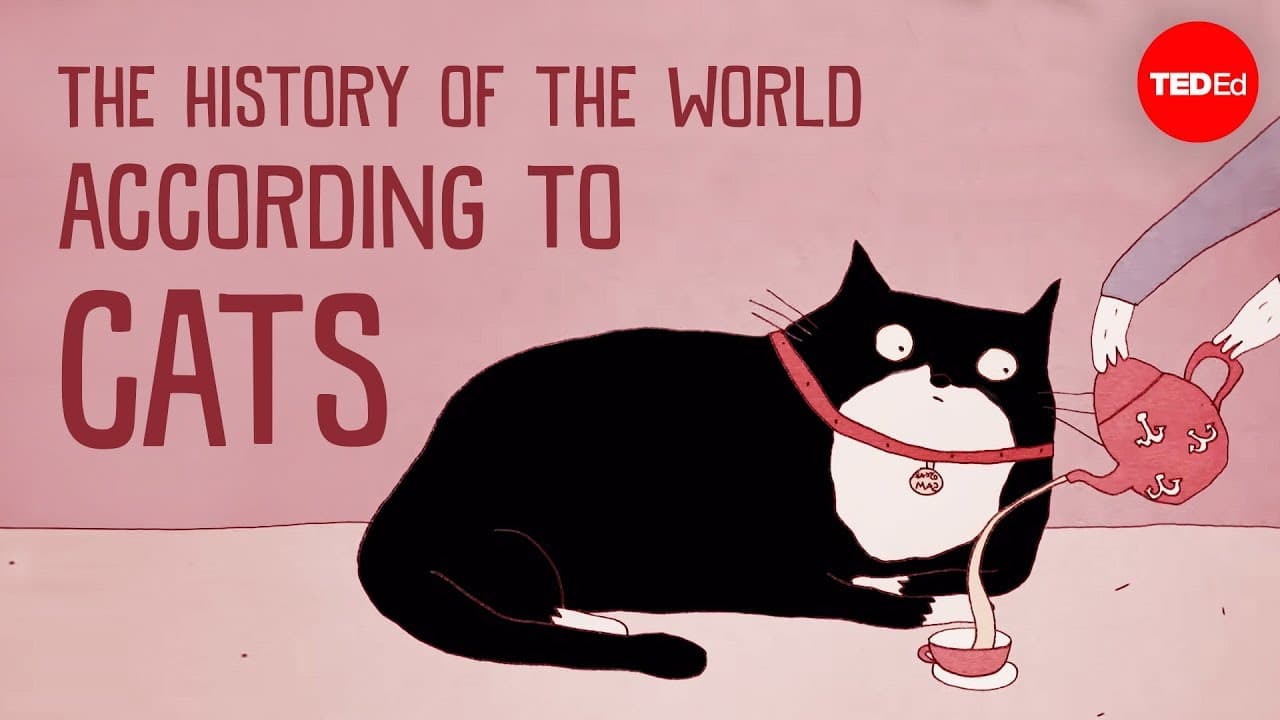
The history of the world according to cats - Eva-Maria Geigl
TL;DR
Cats transitioned from wild predators to cherished companions through a mutually beneficial relationship with humans, starting over 10,000 years ago. They helped Neolithic farmers control vermin, eventually becoming vital sailing companions and revered figures in cultures like Ancient Egypt. Despite domestication, modern cats remain genetically similar to their wild ancestors and retain much of their natural behaviors.
Transcript
On May 27th, 1941, the German battleship Bismarck sank in a fierce firefight, leaving only 118 of her 2,200 crew members alive. But when a British destroyer came to collect the prisoners, they found an unexpected survivor - a black and white cat clinging to a floating plank. For the next several months this cat hunted rats and raised British moral... Read More
Key Insights
- 😺 Cats started as wild predators aiding humans by controlling vermin.
- 🥺 Neolithic farmers tolerated cats for pest control, leading to their domestication.
- 😺 Cats were crucial on ships for rodent control, making them essential sailing companions.
- 😺 Egyptian cats were revered for their hunting skills and immortalized in religious culture.
- 😺 Domestic cats descended from ancient lineages and their genomes show little alteration from ancient cats.
- 😺 Cats have retained their natural behaviors over millennia, remaining essentially wild animals.
- 😺 Despite centuries of association, cats don't see humans as keepers due to their long history of independence.
Install to Summarize YouTube Videos and Get Transcripts
Explore YouTube Video Summarizer or Get YouTube Transcript Extractor
Questions & Answers
Q: How did the relationship between humans and cats start?
The relationship was likely born out of mutual benefit with farmers tolerating cats for pest control, leading to domestication and widespread cooperation.
Q: Why were cats considered essential sailing companions?
Cats were crucial on ships as they controlled vermin that damaged provisions and ropes, making them indispensable to sailors for centuries.
Q: What role did cats play in Egyptian religious culture?
Cats were revered for their hunting abilities, key in dispatching venomous snakes and catching rats, and were immortalized in various art forms, mummified alongside owners.
Q: How have modern cats retained their natural behaviors?
Unlike dogs that underwent selective breeding, modern cats are genetically similar to ancient cats, maintaining their wild nature and independence even after millennia of human association.
Summary
This video explores the domestication of cats and their journey from wild predators to naval officers and beloved companions. It highlights the historical significance of cats in different civilizations and their role in controlling vermin on ships.
Questions & Answers
Q: How did the domestication of house cats begin?
The domestication of house cats can be traced back over 10,000 years ago in the Fertile Crescent during the Neolithic era. Neolithic farmers stored excess grain in pits and silos, attracting rodents and their predator, the wildcat Felis silvestris lybica. As the wildcats learned to tolerate the presence of humans and other cats during mealtime, farmers tolerated them in exchange for pest control.
Q: How did cats migrate with Neolithic farmers?
The cats migrated with Neolithic farmers from Anatolia into Europe and the Mediterranean due to the mutually beneficial relationship of rodent control. They became essential sailing companions as vermin were a major problem on ships, eating provisions and gnawing at rope lines.
Q: How were cats revered in Egyptian culture?
In Egyptian culture, cats were revered for their abilities to kill venomous snakes, catch birds, and kill rats. They gained immortality in various forms of art and were even mummified alongside their owners. Egyptian ship cats served as protectors against poisonous river snakes on the Nile and continued to travel across Europe with their owners.
Q: What lineage do most house cats descend from?
Most house cats today descend from either the Near Eastern or the Egyptian lineage of Felis silvestris lybica. Genetic analysis and coat patterns indicate that modern cats are genetically similar to ancient cats, with little alteration to their natural behaviors.
Q: How have humans altered the behavior of cats?
Unlike dogs, which have undergone centuries of selective breeding, humans have done little to alter the natural behaviors of cats. While some cats today may be more social and docile, they are still considered wild animals and fierce hunters. Cats do not see humans as their keepers.
Q: Why were cats important on ships?
Cats were important on ships due to their role in controlling vermin. They ate the rodents that infested ships, preventing them from consuming provisions and damaging ropes. Cats have a long history of accompanying sailors and were seen as essential companions on sea journeys.
Q: How did cats reach different parts of the world?
Cats reached different parts of the world through migration and travel with humans. For example, during the time of the Roman Empire, ships traveling between India and Egypt carried the lineage of the central Asian wildcat F. s. ornata. In the Middle Ages, Egyptian cats voyaged with Viking seafarers to the Baltic Sea. Cats from both the Near Eastern and North African wildcat lineages continued to travel across Europe and eventually reached Australia and the Americas.
Q: How long have cats been working alongside humans?
Cats have been working alongside humans for thousands of years. Their cooperation and pest control abilities have made them valuable to farmers, sailors, and various civilizations throughout history.
Q: What were the main differences between ancient wildcats and domestic cats?
The main differences between ancient wildcats and domestic cats are that the wildcats were more muscular, had striped coats, and were less social towards other cats and humans. Domestication and centuries of interaction with humans have made modern cats more social and accustomed to human presence.
Q: How did a cat survive multiple ship sinkings?
The cat named Unsinkable Sam survived multiple ship sinkings through sheer luck. After the sinking of the German battleship Bismarck, Sam clung to a floating plank and was rescued by a British destroyer. He went on to serve on three more ships, one of which also sank, before retiring to the Belfast Home for Sailors.
Takeaways
The domestication of cats dates back thousands of years and is closely tied to the development of agriculture and the need for pest control. Cats have played significant roles in different civilizations, from protecting against venomous snakes in Egypt to accompanying sailors on sea voyages. Despite their long history alongside humans, cats have retained their wild nature and hunting instincts. They are cooperative companions but do not see humans as their keepers.
Summary & Key Takeaways
-
Cats have been aiding humans since ancient times by controlling vermin attracted to food stores.
-
Their domestication began around 10,000 years ago, with wildcats adapting to tolerate humans for free pest control.
-
Cats sailed with Neolithic farmers to Europe and the Mediterranean and later became important to Egyptian religious culture.
Read in Other Languages (beta)
Share This Summary 📚
Summarize YouTube Videos and Get Video Transcripts with 1-Click
Try YouTube Summary with ChatGPT & Claude or YouTube Transcript Generator
Explore More Summaries from TED-Ed 📚





Summarize YouTube Videos and Get Video Transcripts with 1-Click
Try YouTube Summary with ChatGPT & Claude or YouTube Transcript Generator