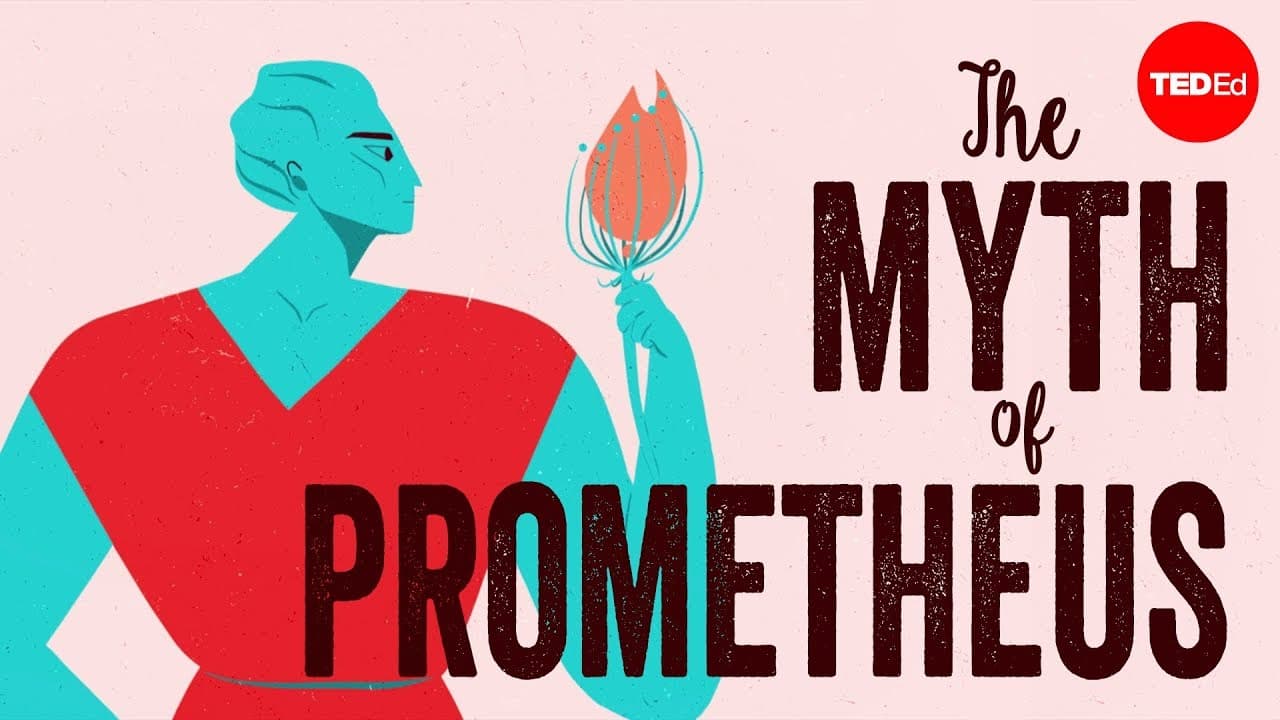
The myth of Prometheus - Iseult Gillespie
TL;DR
The myth of Prometheus tells the story of how he defied Zeus by stealing fire for humanity, which empowered civilization but led to his eternal punishment. This act symbolizes rebellion against authority and the potential for human progress through knowledge. Prometheus remains relevant today as a figure embodying individual agency and the ethical dilemmas of scientific advancement.
Transcript
Before the creation of humanity, the Greek gods won a great battle against a race of giants called the Titans. Most Titans were destroyed or driven to the eternal hell of Tartarus. But the Titan Prometheus, whose name means foresight, persuaded his brother Epimetheus to fight with him on the side of the gods. As thanks, Zeus entrusted the brothers... Read More
Key Insights
- 🥺 Prometheus, a Titan, defied Zeus by stealing fire for humans, leading to his eternal punishment.
- 🧑🏭 His act symbolizes rebellion against authority and the empowerment of humanity through knowledge and progress.
- 🤬 Prometheus's story resonates in literature, depicting him as a hero, rebel, or symbol of human potential.
- 🎮 The myth highlights the tension between individual agency and divine control in shaping human destiny.
- ❓ Prometheus's defiance and resilience make him a beloved figure, celebrated for his inquisitive spirit and contribution to human advancement.
- 🛟 The myth of Prometheus serves as a cautionary tale about the consequences of challenging natural or divine order for the pursuit of progress.
- 🫡 His story continues to inspire discussions on ethics, technology, and the balance between human ambition and the respect for tradition and authority.
Install to Summarize YouTube Videos and Get Transcripts
Explore YouTube Video Summarizer or Get YouTube Transcript Extractor
Questions & Answers
Q: How did Prometheus help humans by stealing fire from the gods?
Prometheus stole fire from Mount Olympus and gave it to humans, allowing them to harness nature for food, warmth, and technology. This act accelerated human progress and civilization.
Q: Why did Zeus punish Prometheus with eternal torment?
Zeus punished Prometheus for disobedience and trickery, chaining him to a cliff where a vulture would repeatedly eat his liver. This eternal suffering served as a warning against defying the gods.
Q: What symbolic role does Prometheus play in mythology?
Prometheus symbolizes rebellion, progress, and the potential of individual acts to ignite societal change. His actions reflect the tension between human advancement and divine authority in mythological narratives.
Q: How do literary works like "Prometheus Unbound" and "Frankenstein" portray Prometheus?
In "Prometheus Unbound," Prometheus is a romantic hero spreading empathy and knowledge. In "Frankenstein: The Modern Prometheus," Prometheus is a cautionary figure, reflecting ethical dilemmas in science and technology.
Summary
The Greek Titan Prometheus played a pivotal role in the creation of humanity and their acquisition of fire. Despite Zeus' decree that humans remain subservient and denied the use of fire, Prometheus tricked Zeus, stole fire from Mount Olympus, and gifted it to humanity. This act catalyzed civilization's progress but also angered Zeus, leading to Prometheus being punished by eternal torment. Despite his suffering, Prometheus became a beloved figure, symbolizing resilience, rebellion, knowledge, and the potential of individual acts to ignite the world.
Questions & Answers
Q: What role did Prometheus play in the creation of humans?
Prometheus shaped the first humans out of mud, forming them in the image of the gods. However, Zeus decreed that humans remain mortal, subservient, and worship the gods from below.
Q: How did Prometheus trick Zeus and obtain fire for humans?
When Zeus asked Prometheus to decide how sacrifices would be made, Prometheus devised a trick. He divided a bull into two parts, concealing the succulent flesh and skin under the unappealing belly on one side, and hiding the bones under a layer of fat on the other. When Zeus chose the seemingly better portion, Prometheus angered Zeus with his deception. As a result, Zeus forbade the use of fire on Earth. Undeterred, Prometheus climbed Mount Olympus and stole fire from the workshop of Hephaestus and Athena, hiding it in a fennel stalk.
Q: How did the acquisition of fire by humans impact civilization?
Fire empowered humans to care for themselves, providing food and warmth. Additionally, fire enabled humans to forge weapons and wage war, rapidly progressing civilization. Prometheus's act of providing fire acted as a catalyst for the advancement of knowledge, technology, and power in human hands.
Q: What punishment did Prometheus receive for his actions?
Prometheus was punished by Zeus, who chained him to a cliff for eternity. Each day, a vulture would visit Prometheus, tear out his liver, and each night his liver would regenerate, only to be attacked again the following morning. Despite enduring perpetual agony, Prometheus never expressed regret for his act of rebellion.
Q: How is Prometheus depicted in art and literature?
Prometheus is celebrated as a beloved figure in mythology, embodying resilience, rebellion, and knowledge. Percy Bysshe Shelley portrayed Prometheus as a romantic hero who escapes and continues to spread empathy and knowledge in his drama "Prometheus Unbound." Mary Shelley also depicted Prometheus in her novel "Frankenstein: The Modern Prometheus," cautioning against corrupting the natural order and addressing ethical questions surrounding science and technology.
Q: What does Prometheus symbolize?
Prometheus symbolizes humanity's capacity to harness the powers of nature and the potential of individual acts to ignite change. He represents resilience in the face of oppression, rebellion against authority, and the acquisition of knowledge and progress. Prometheus serves as a reminder of the transformative power of human actions.
Q: How has Prometheus influenced ethical questions surrounding science and technology?
Mary Shelley's novel "Frankenstein: The Modern Prometheus" alludes to the consequences of tampering with the natural order, reflecting current ethical concerns regarding the boundaries of scientific advancements. The cautionary tale of Prometheus remains relevant in contemplating the consequences of pushing the limits of science and technology.
Q: How does Prometheus embody both heroic and mischievous qualities?
As a trickster figure, Prometheus displayed mischievous and inquisitive traits by deceiving Zeus and stealing fire. However, his heroic qualities are evident in his desire to empower humanity, defy authority, and endure his eternal punishment with resilience and unwavering conviction.
Takeaways
The tale of Prometheus showcases the audacity of challenging authority, the potential of individual acts to shape the course of history, and the importance of knowledge and progress. By stealing fire from the gods and sharing it with humanity, Prometheus ignited civilization's rapid advancement. However, his actions incurred the wrath of Zeus, resulting in eternal torment. Prometheus remains a timeless symbol of resilience, rebellion, and the transformative power of humanity's endeavors. The ethical questions raised by his story continue to resonate, reminding us of the delicate balance between scientific progress and the potential consequences of disrupting the natural order.
Summary & Key Takeaways
-
Before humanity, Prometheus and Epimetheus sided with Greek gods, creating beings with gifts from gods.
-
Prometheus stole fire from Mount Olympus, empowering humans.
-
Zeus punished Prometheus with eternal suffering for rebellion, making him a symbol of human progress and potential.
Read in Other Languages (beta)
Share This Summary 📚
Summarize YouTube Videos and Get Video Transcripts with 1-Click
Try YouTube Summary with ChatGPT & Claude or YouTube Transcript Generator
Explore More Summaries from TED-Ed 📚





Summarize YouTube Videos and Get Video Transcripts with 1-Click
Try YouTube Summary with ChatGPT & Claude or YouTube Transcript Generator