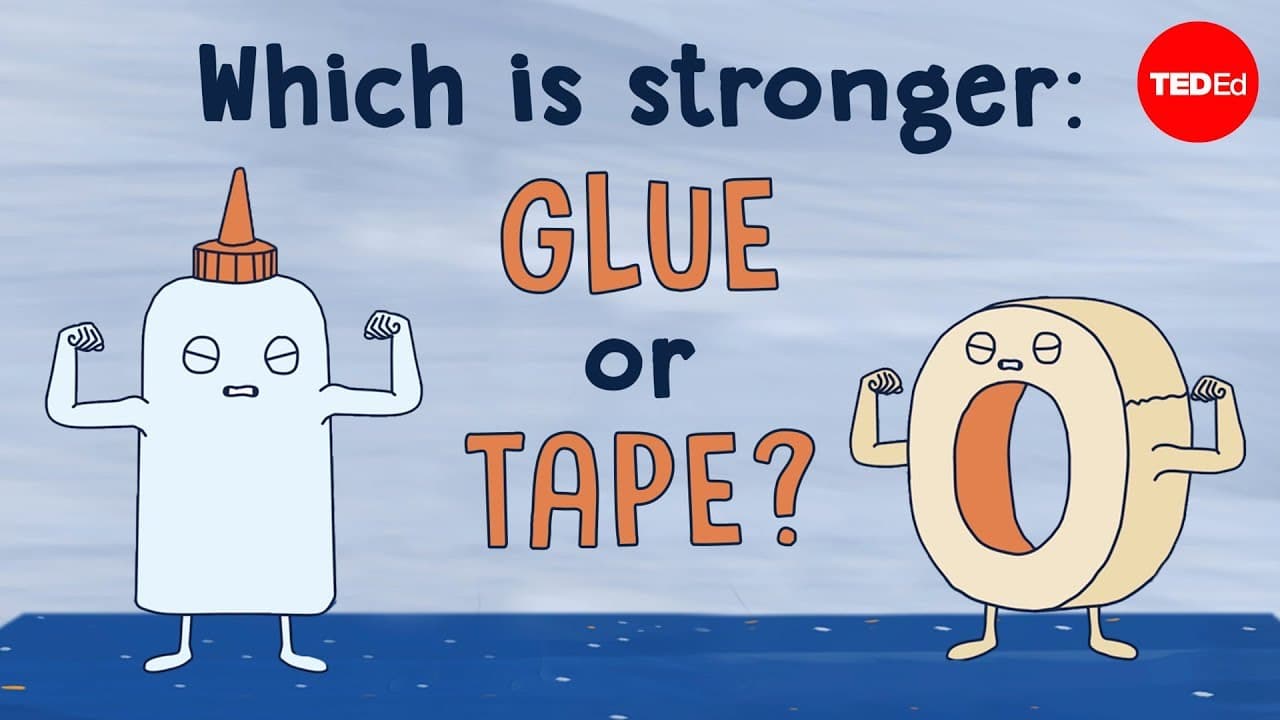
Which is stronger: Glue or tape? - Elizabeth Cox
TL;DR
Glue is stronger than tape in terms of adhesive bonds, as it forms irreversible connections that cannot be reapplied once dried. Tape, on the other hand, creates weaker, reversible bonds through Van der Waals forces, allowing it to be reused. For immediate stickiness, tape is preferable, while glue is better for permanent applications.
Transcript
The oldest glue in the world is over 8,000 years old and comes from a cave near the Dead Sea. Ancient people used this glue, made from a mixture of animal bone and plant materials, to waterproof baskets and construct utensils. And for thousands of years after, plants and animals were the glue that held human civilization together. Today, we hav... Read More
Key Insights
- ☠️ Glue dates back over 8,000 years, originating from natural materials like animal bones and plants for construction and waterproofing.
- 🩹 Adhesives rely on both adhesive and cohesive bonds, which determine their stickiness and bonding strength.
- 🥵 Super glues like cyanoacrylates may have the strongest adhesive bonds, while epoxy glues offer high resistance to heat and shearing.
- 👻 Tape forms weaker, reversible bonds due to Van der Waals forces, allowing for reuse, while glues create irreversible, strong bonds.
- 🥵 Engineers consider various factors, such as bonding strength, resistance to heat, and compatibility with surfaces, when choosing between glues and tapes.
- 💦 Duct tape offers instant stickiness in emergencies, while liquid glues may not work in zero gravity situations for extraterrestrial repairs.
- ❓ Glue requires sufficient contact area between surfaces for effective bonding, while tape can fill microscopic crevices due to viscoelasticity.
Install to Summarize YouTube Videos and Get Transcripts
Explore YouTube Video Summarizer or Get YouTube Transcript Extractor
Questions & Answers
Q: What are the main components of glues and tapes?
Glues contain adhesive polymers dissolved in solvents, while tapes have a backing coated with an elastic component and tackifier.
Q: What are the differences between adhesive and cohesive bonds in glues?
Adhesive bonds form between the glue and the surface, while cohesive bonds hold the glue's molecules together.
Q: Why can tape be reused while glue cannot?
Tape forms weaker, reversible bonds due to Van der Waals forces, allowing it to be peeled off and reused.
Q: What factors determine the stickiness of tapes?
The proportion of elastic component and tackifier, adhesive thickness, and backing material influence tape's stickiness.
Summary
The oldest glue in the world, dating back over 8,000 years, was made from animal bone and plant materials. Today, there are various types of glue and tape available for building and repairing. But what gives them their stickiness? This article explores the composition of adhesives, the difference between adhesive and cohesive bonds, and the factors that determine the strength and stickiness of glue and tape. It also discusses the strengths and weaknesses of different adhesives, including super glue and epoxy, and highlights the importance of choosing the right adhesive for specific applications.
Questions & Answers
Q: What is the oldest glue known to man made from?
The oldest glue, over 8,000 years old, was made from a mixture of animal bone and plant materials.
Q: How are adhesives made?
Adhesives can be made from synthetic molecules or natural proteins and carbohydrates, such as vegetable starch dextrin, milk protein casein, and terpenes in tree resin.
Q: What are adhesive bonds and cohesive bonds?
Adhesive bonds occur between an adhesive's molecules and the molecules of the surface it is sticking to, while cohesive bonds happen between the adhesive's own molecules, holding it together.
Q: Why do most glues have a strong smell?
The strong smell of many glues comes from the solvent used, which evaporates when exposed to air. Water and various chemicals can be used as solvents in different types of glue.
Q: What creates stronger bonds in some glues?
Glues with two or more components that chemically react, rather than just drying, can create stronger bonds.
Q: Why are adhesive bonds irreversible?
The drying process of glue makes the adhesive and cohesive bonds irreversible. If a glued surface is broken, it cannot be reattached without new glue.
Q: How are tape's bonds different from glue's bonds?
Tape forms weaker, reversible bonds called Van der Waals forces, allowing it to be peeled off a surface and used again. These forces occur when materials are extremely close together.
Q: What is tape made of?
Tape usually consists of a backing coated with a combination of a rubber or rubber-like "stretchy" component and a compound called a tackifier, which provides stickiness.
Q: How does tape stick to surfaces without a chemical reaction?
Tape does not undergo a chemical reaction when pressed onto a surface. Instead, the soft adhesive flows into the cracks and grooves of the surface, allowing it to stick through viscoelasticity.
Q: Which is stronger, glue or tape?
Glue is generally stronger than tape in terms of adhesive bonds. However, no single adhesive works well in all circumstances, and different adhesives have different strengths and compatibilities with surfaces.
Q: What are the strengths and weaknesses of super glue and epoxy glues?
Cyanoacrylates, or super glues, may form the strongest bonds, but two-component epoxy glues have higher resistance to heat and shearing, and are compatible with a wider range of surfaces.
Q: When is duct tape a better option than glue?
Duct tape is a better option when instant stickiness is required, and it can also work better in situations where large surfaces need to be joined, such as making a chain of bowling balls.
Q: Why is choosing the right glue important in engineering applications?
Choosing the right glue in engineering applications, such as withstanding heat inside an engine, is crucial for safety and performance. Different adhesives have different properties and suitability for specific situations.
Q: Why is duct tape preferred for extraterrestrial repairs?
Liquid glues do not work in zero gravity, making duct tape the preferred option for extraterrestrial repairs.
Takeaways
Glue and tape have been essential in human civilization for thousands of years, and understanding their composition and adhesive properties is crucial for choosing the right adhesive for different applications. Adhesives can be made from various natural or synthetic materials, with their stickiness resulting from adhesive and cohesive bonds. Glues typically have stronger adhesive bonds but are irreversible once dried, while tape forms weaker reversible bonds. Different adhesives, such as super glue and epoxy, have different strengths and compatibilities with surfaces, making it important to consider their properties when selecting the right adhesive for specific situations. Duct tape, although less strong than glues, has advantages such as instant stickiness and suitability for joining larger surfaces. Engineers must carefully consider the properties of adhesives for safety and performance, particularly in specialized applications. In unique situations like zero gravity, duct tape becomes the preferred choice for repairs.
Summary & Key Takeaways
-
Ancient civilizations used glue made from animal and plant materials for waterproofing and construction.
-
Glue and tape rely on adhesive and cohesive bonds for stickiness, with different properties for each.
-
While glue forms irreversible strong bonds, tape creates weaker, reversible bonds due to Van der Waals forces.
Read in Other Languages (beta)
Share This Summary 📚
Summarize YouTube Videos and Get Video Transcripts with 1-Click
Try YouTube Summary with ChatGPT & Claude or YouTube Transcript Generator
Explore More Summaries from TED-Ed 📚




Summarize YouTube Videos and Get Video Transcripts with 1-Click
Try YouTube Summary with ChatGPT & Claude or YouTube Transcript Generator