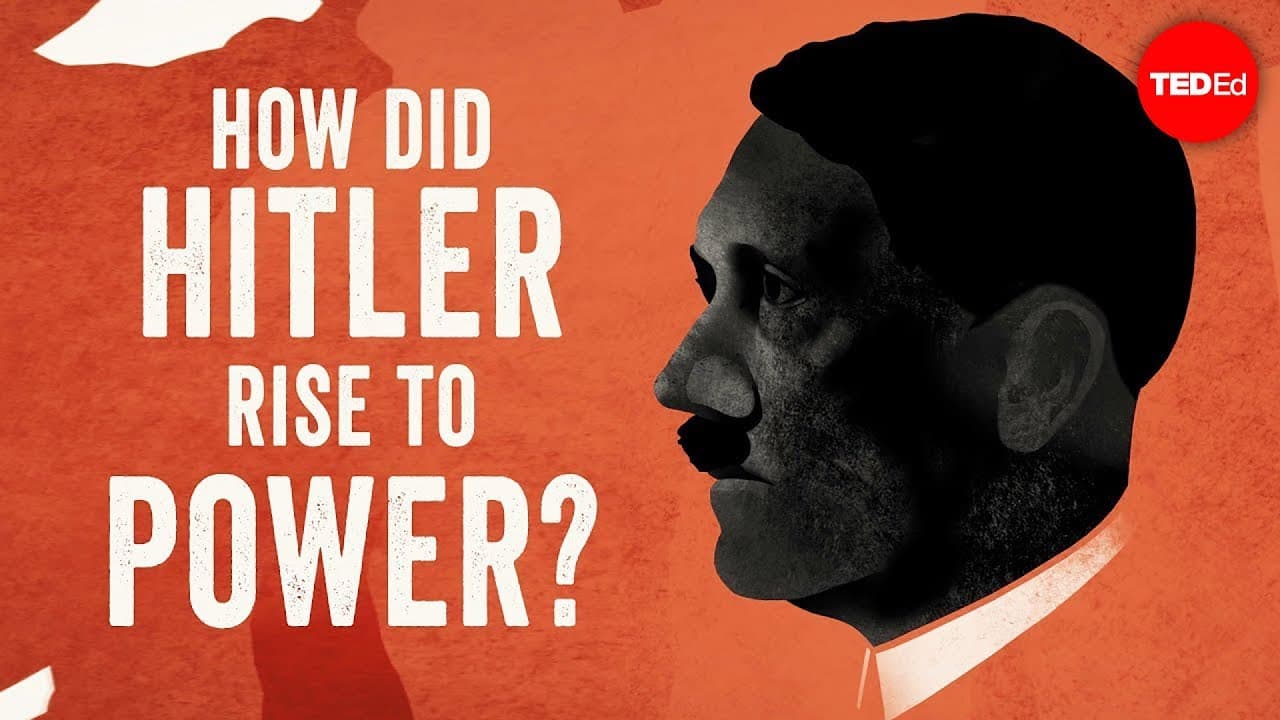
How did Hitler rise to power? - Alex Gendler and Anthony Hazard
TL;DR
Hitler rose to power by exploiting Germany's post-WWI chaos and the economic devastation of the Great Depression, using fear and anti-Semitism to garner support. His manipulation of public anger against perceived scapegoats, combined with the failure of mainstream political parties, allowed him to erode democratic institutions and ultimately establish a dictatorship.
Transcript
How did Adolf Hitler, a tyrant who orchestrated one of the largest genocides in human history, rise to power in a democratic country? The story begins at the end of World War I. With the successful Allied advance in 1918, Germany realized the war was unwinnable and signed an armistice ending the fighting. As its imperial government collapsed, civ... Read More
Key Insights
- 😮 Post-WWI turmoil and economic distress provided fertile ground for Hitler's rise to power.
- 😨 Hitler exploited fear, blaming Jews and offering simplistic solutions to complex issues during times of crisis.
- 🥳 The Great Depression further fueled Hitler's popularity, as mainstream parties failed to address economic woes effectively.
- 😮 Hitler's rise to power showcased the fragility of democratic institutions against manipulation and demagoguery.
- ✊ The alignment of public opinion, businessmen, and intellectuals with Hitler's agenda facilitated his consolidation of power.
- 😨 The erosion of democratic norms through fear-mongering and repression enabled Hitler to establish a dictatorship.
- 💀 Hitler's ability to tap into societal anger and exploit fears serves as a cautionary tale on the dangers of unchecked populism.
Install to Summarize YouTube Videos and Get Transcripts
Explore YouTube Video Summarizer or Get YouTube Transcript Extractor
Questions & Answers
Q: How did Hitler exploit post-WWI German turmoil to rise to power?
Hitler used the humiliation of defeat, economic distress, and societal unrest to blame Jews for Germany's woes, resonating with anti-Semitic sentiments prevalent in society.
Q: What role did the Great Depression play in Hitler's rise?
The economic collapse of the Great Depression allowed Hitler to capitalize on public anger, offering scapegoats and promises of restoring Germany's greatness, further bolstering his support.
Q: How did Hitler consolidate power after becoming Chancellor in 1933?
Hitler exploited a fabricated event to gain emergency powers, leading to the abolishment of press freedom, disbandment of political parties, and enactment of anti-Jewish laws, solidifying his dictatorial rule.
Q: Why were Hitler's radical measures initially accepted by many in Germany?
Hitler's manipulation of fear and anger through speeches garnered support, while businessmen and intellectuals endorsing him believed his extreme rhetoric was merely for show, showcasing the dangers of misplaced trust in a demagogue.
Summary
This video explores the rise to power of Adolf Hitler in a democratic country, despite his role in orchestrating one of the largest genocides in human history. It explains that Germany's collapse at the end of World War I, coupled with civil unrest and economic struggles, created a fertile ground for Hitler's manipulation of the public. He blamed Jews for Germany's problems and combined anti-Semitism with populist resentment to gain support. The video highlights how the Great Depression further fueled Hitler's rise, as he offered convenient scapegoats and a promise to restore Germany's former greatness. Hitler's increasing popularity and the inability of mainstream parties to handle the crisis allowed him to be appointed as Chancellor by President Hindenburg. Hitler then steadily expanded his power, abolished freedom of the press, disbanded other parties, and passed anti-Jewish laws, ultimately leading to the suppression of democratic institutions.
Questions & Answers
Q: How did Germany's defeat in World War I contribute to Hitler's rise to power?
Germany's defeat in World War I led to the collapse of its imperial government and widespread civil unrest. Faced with fears of a Communist revolution, major parties joined to suppress uprisings and establish the parliamentary Weimar Republic. However, Germany was severely weakened, both economically and territorially, due to the peace treaty imposed by the Allies. Many Germans saw these conditions as a humiliation, and Hitler capitalized on this sentiment by blaming politicians and protesters for betraying the army. His manipulation of nationalist views gained him support from those who believed the war could have been won without such betrayals.
Q: How did Hitler exploit anti-Semitism for his rise to power?
Hitler scapegoated Jews for Germany's problems, even though many Jews had integrated into German society. The success and integration of Jewish individuals led to unfounded accusations of subversion and war profiteering. Hitler tapped into existing anti-Semitic sentiments within German society, convincing many that Jews were outsiders and enemies of the nation. He used fear, anger, and bigotry to create conspiracy theories that portrayed Jews as orchestrating international plots to destroy Germany. These unfounded accusations found resonance and support among a significant portion of the population.
Q: Why did the Nazi party initially lack popularity?
The Nazi party initially lacked popularity due to its association with a small nationalist political party. After an unsuccessful attempt at overthrowing the government, the party was banned and Hitler was jailed for treason. However, upon his release about a year later, Hitler dedicated himself to rebuilding the movement. It was not until the onset of the Great Depression in 1929 that the Nazis gained significant traction. The economic collapse exacerbated public anger and frustration, providing an opportunity for Hitler to offer convenient scapegoats and a promise to restore Germany's former greatness.
Q: How did Hitler exploit the Great Depression for his rise to power?
The Great Depression profoundly impacted Germany as American banks withdrew their loans, leading to the sudden collapse of the already struggling German economy. Hitler skillfully took advantage of the people's anger and disillusionment, offering them a sense of hope through blaming others for their hardships. He provided convenient scapegoats and exploited fears and prejudices to rally support. Mainstream parties proved incapable of effectively handling the crisis, while the left-wing opposition was fragmented by internal squabbles. This combination of circumstances allowed the frustrated public to shift their support to the Nazis, increasing their parliamentary votes from under 3% to over 18% in just two years.
Q: How did Hitler expand his power once appointed as Chancellor?
Though initially appointed as Chancellor by President Hindenburg, Hitler steadily expanded the power of his position. While his supporters formed paramilitary groups and engaged in violent clashes with protestors, Hitler raised fears of a Communist uprising. He argued that only he could restore law and order, capitalizing on public anxieties. In 1933, the burning of the parliament building provided Hitler with an opportunity to manipulate the government into granting him emergency powers. Within a short period, freedom of the press was abolished, other parties were disbanded, and anti-Jewish laws were passed. Hitler also targeted potential rivals and arrested or executed many of his early radical supporters. The death of President Hindenburg solidified Hitler's control, ensuring there would be no new election.
Q: Why did some businessmen and intellectuals endorse Hitler?
Some businessmen and intellectuals endorsed Hitler because they believed his extreme rhetoric was merely for show. They wanted to align themselves with the sentiments of the angry crowds and be on the right side of public opinion. They chose to ignore or downplay Hitler's alarming ideology and the potential danger he represented. By endorsing him, they reassured themselves and each other that his actions and policies would not be as extreme as his speeches suggested. However, this endorsement and normalization of Hitler's views ultimately contributed to the erosion of democratic institutions.
Takeaways
Adolf Hitler's rise to power serves as a stark warning of how fragile democratic institutions can be in the face of an angry and manipulated populace, combined with a leader who is willing to feed their anger and exploit their fears. It underscores the danger of individuals who masterfully manipulate public sentiment for their personal gain, taking advantage of economic crises and societal anxieties. Hitler's ability to scapegoat groups and exploit existing prejudices highlights the importance of vigilance, critical thinking, and the protection of democratic values to prevent the rise of tyrants in the future.
Summary & Key Takeaways
-
After WWI, Germany's turmoil allowed Hitler to exploit fear, blaming Jews for the country's woes.
-
The Great Depression further fueled Hitler's rise by offering scapegoats and promises of greatness.
-
Hitler's ascent to power involved exploiting public anger and fears, leading to the erosion of democratic institutions.
Read in Other Languages (beta)
Share This Summary 📚
Summarize YouTube Videos and Get Video Transcripts with 1-Click
Try YouTube Summary with ChatGPT & Claude or YouTube Transcript Generator
Explore More Summaries from TED-Ed 📚



Summarize YouTube Videos and Get Video Transcripts with 1-Click
Try YouTube Summary with ChatGPT & Claude or YouTube Transcript Generator