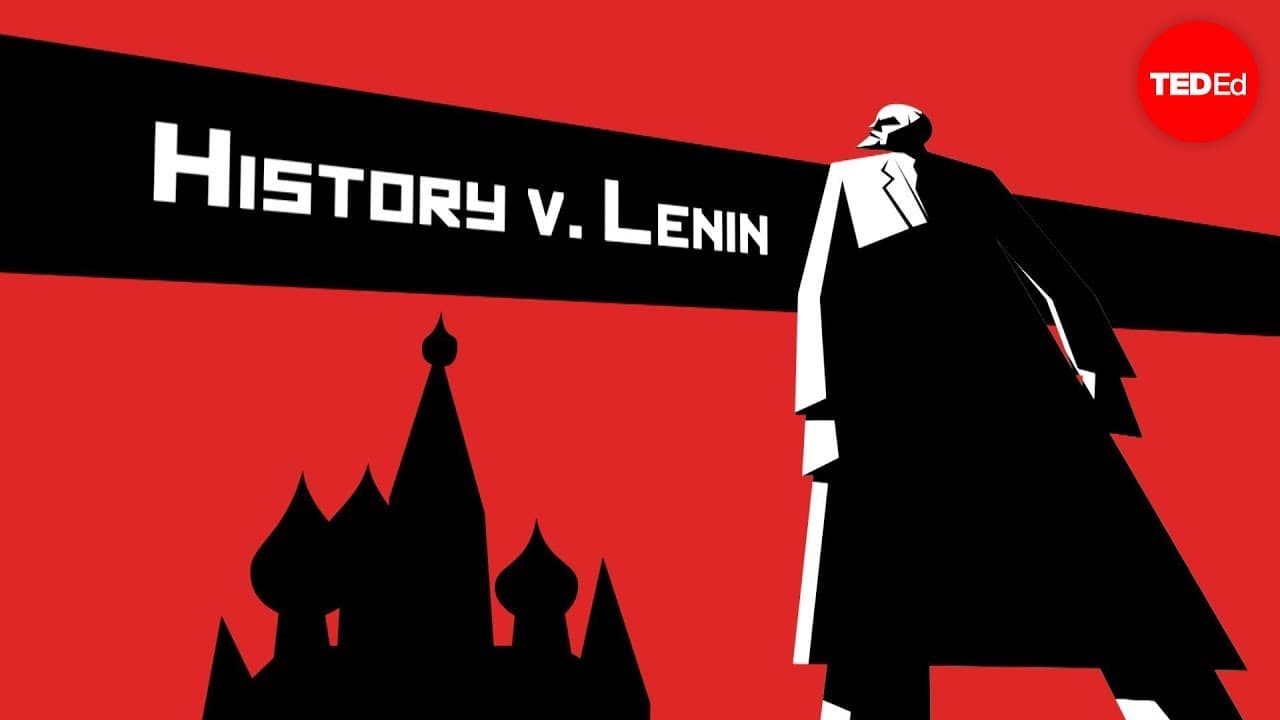
History vs. Vladimir Lenin - Alex Gendler
TL;DR
Lenin dramatically altered Russia's trajectory, toppling the oppressive Tsarist regime but establishing a repressive Soviet state. While he is credited with modernizing the country and promoting education and women's rights, his regime was marked by violence, purges, and the rise of Stalin's totalitarian rule. The debate continues on whether the advancements achieved could have occurred without his leadership.
Transcript
He was one of the most influential figures of the 20th century, forever changing the course of one of the world's largest countries. But was he a hero who toppled an oppressive tyranny or a villain who replaced it with another? It's time to put Lenin on the stand in History vs. Lenin. "Order, order, hmm. Now, wasn't it your fault that the band brok... Read More
Key Insights
- 🏛️ The Russian workers faced harsh working conditions, working long hours for low pay, under both the tsarist regime and the subsequent Soviet Union.
- ⚖️ Nicholas II, the last tsar of Russia, made minimal efforts to protect workers and suppress revolution, ultimately leading to his downfall.
- 💔 Lenin's older brother's execution and the continued repression and executions under Nicholas II motivated Lenin's revolutionary activities.
- 🌍 The provisional government led by Alexander Kerensky could have succeeded if Lenin had not returned and instigated riots, leading to the collapse of the government and the Bolsheviks taking power.
- ⚖️ The Bolsheviks resorted to violent measures to secure their position and establish their socialist order, resulting in purges, executions, and repression of other political parties and peasant uprisings.
- 👑 Lenin's successor, Stalin, abused his power and established a cult of personality, leading to decades of totalitarianism.
- 🌱 Despite the repressive regime, Lenin's efforts transformed Russia into an industrial superpower, with improved education, opportunities for women, and scientific advancements.
- ❓ The counterfactual question of whether these advancements could have occurred without Lenin and his regime remains uncertain, but studying history helps us avoid repeating past mistakes.
Install to Summarize YouTube Videos and Get Transcripts
Explore YouTube Video Summarizer or Get YouTube Transcript Extractor
Questions & Answers
Q: Was Lenin responsible for the collapse of the Russian tsar's regime?
Lenin played a significant role in the overthrow of the Russian tsar, utilizing revolutionary tactics to undermine the monarchy and mobilize the masses, but the tsar's own failures contributed to his downfall as well.
Q: Did the Russian workers benefit from Lenin's actions?
Lenin argued that the Russian workers suffered under the tsar's rule and that his actions were necessary to establish a socialist order, but critics argue that the Bolsheviks' measures, such as the purges and executions, did not align with their initial ideals.
Q: Did Lenin have a legitimate reason for ordering the execution of the tsar and his family?
Lenin's decision to execute the tsar and his family was driven by the fear of foreign imperialists using the royal heir as a figurehead to restore the monarchy, threatening the gains made by the revolution.
Q: Can the advancements made in Russia during Lenin's rule justify the means used to achieve them?
Supporters argue that Lenin's efforts transformed Russia from an undeveloped monarchy to a modern, industrial superpower with improved education and opportunities, but critics maintain that these advancements could have been achieved without the repressive regime established by Lenin.
Summary
This video discusses the controversial figure of Vladimir Ilyich Ulyanov, also known as Lenin, and whether he should be considered a hero or a villain. It explores the arguments surrounding his role in overthrowing the Russian tsar and founding the Soviet Union, as well as the consequences of his actions.
Questions & Answers
Q: Who was Lenin and what was his role in Russian history?
Lenin, whose real name was Vladimir Ilyich Ulyanov, was a prominent figure in Russian history. He played a crucial role in overthrowing the Russian tsar Nicholas II in 1917 and founded the Soviet Union, which went on to become one of the most oppressive dictatorships of the 20th century.
Q: Was the Russian tsar really a tyrant, as claimed by those who supported Lenin?
While it is true that the Russian tsar Nicholas II was not without flaws, it is important to note that serfdom had already been abolished in 1861. However, many argued that the factory bosses treated the workers even worse than the feudal landlords, with Russian workers facing long working hours and low wages compared to their European counterparts.
Q: Did the tsar make any efforts to protect the workers?
The tsar did pass some laws to protect the workers, but it was mainly in response to the threat of revolution. These measures were minimal and failed to adequately address the workers' grievances. Moreover, the tsar's troops firing on peaceful petitioners in 1905 showed his reluctance to bring about meaningful reforms.
Q: Why did Lenin and other radicals like him stir up trouble?
Lenin's older brother Aleksandr was executed by the previous tsar for revolutionary activity, and Nicholas II continued the mass repression and executions, as well as the unpopular involvement in World War I. Lenin's actions were a response to these repressive measures and the failure of the tsar to address the pressing issues facing the country.
Q: Who came to power after the Russian tsar was forced to abdicate?
After the tsar abdicated, the Duma formed a provisional government led by Alexander Kerensky. However, many considered him to be an incompetent bourgeois failure, as he made poor decisions such as launching failed offensives in the war, instead of ending it as the people desired.
Q: Wasn't the provisional government a progressive social democratic one?
While some argue that the provisional government was a progressive social democratic government, it is important to note that Lenin was sent by the Germans to undermine the Russian war effort and instigate riots. When Kerensky blamed Lenin and outlawed his Bolshevik party, it showed the government's true colors and lack of commitment to democracy.
Q: How did the Bolsheviks come to power?
The government's incompetence and greed led to their attempted military coup, which backfired and collapsed. In this situation, the Bolsheviks, with Lenin's leadership, took advantage and peacefully overthrew the government, becoming the ruling power.
Q: What were the actions of the Bolsheviks after they gained power?
The Bolsheviks' actions after gaining power were far from peaceful. They executed numerous people without trial, including the entire tsar's family, even the children. The Bolsheviks argued that Russia was under attack from foreign imperialists and that saving any royal heir would mean an end to the progress made by the people.
Q: Did the Bolsheviks only target imperialists, or were there other victims as well?
The Bolsheviks also targeted other socialist and anarchist parties, their former allies. They carried out purges and executions and used poison gas against peasants who resisted grain confiscation during the Tambov Rebellion. They also sent the army to crush workers in Kronstadt who were demanding democratic self-management.
Q: Can Lenin be credited with the advancements and progress made under the Soviet Union?
Lenin played a major role in transforming Russia from a backward and undeveloped monarchy into an industrial superpower with educated populations, opportunities for women, and significant scientific advancements. While life may not have been luxurious, the majority had shelter and food—a rare achievement for many countries.
Takeaways
This video highlights the debate surrounding Lenin's legacy and raises important questions about the consequences of his actions. It reminds us why it is essential to critically examine historical figures, their motivations, and the long-term impacts of their decisions to learn from the past and avoid repeating its mistakes.
Summary & Key Takeaways
-
The video presents arguments for and against Lenin's role in the overthrow of the Russian tsar and the founding of the Soviet Union.
-
It discusses the conditions under the tsar's rule, including serfdom and poor treatment of workers.
-
The video examines Lenin's return to Russia, the collapse of the provisional government, and the subsequent actions of the Bolsheviks.
Read in Other Languages (beta)
Share This Summary 📚
Summarize YouTube Videos and Get Video Transcripts with 1-Click
Try YouTube Summary with ChatGPT & Claude or YouTube Transcript Generator
Explore More Summaries from TED-Ed 📚

Summarize YouTube Videos and Get Video Transcripts with 1-Click
Try YouTube Summary with ChatGPT & Claude or YouTube Transcript Generator