Just How Small is an Atom?
TL;DR
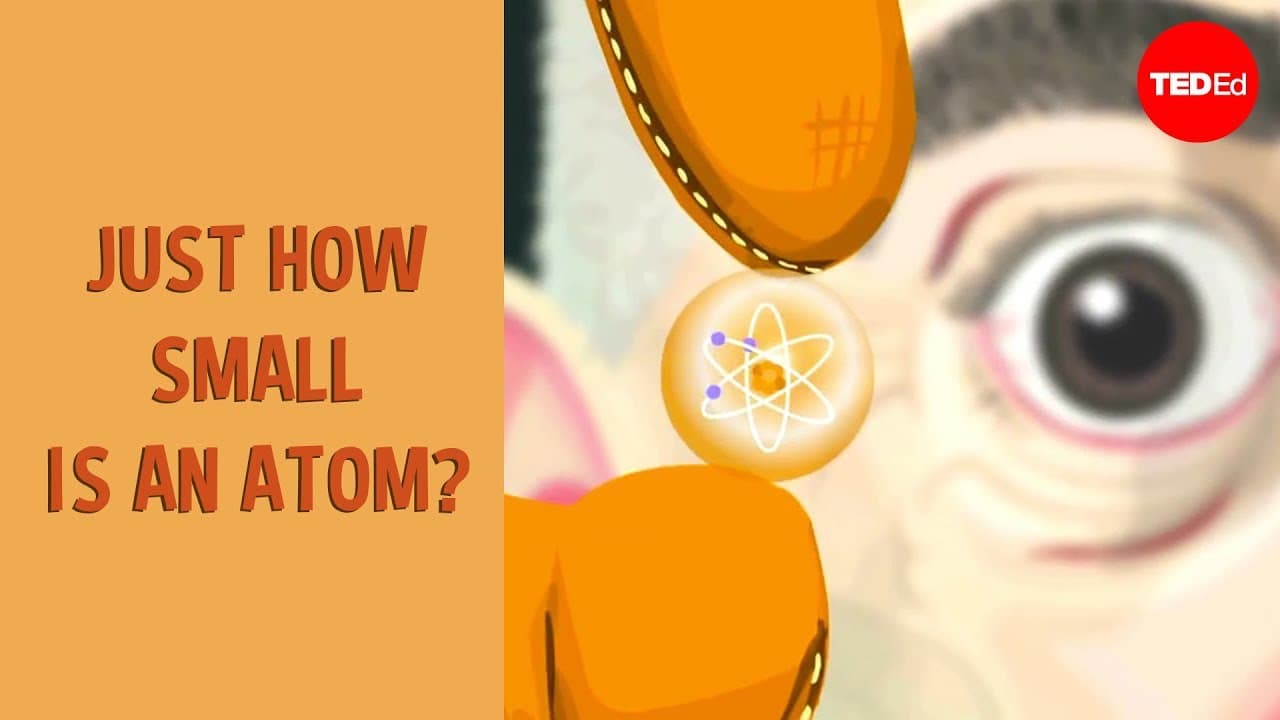
Atoms are incredibly small; for example, if atoms were the size of blueberries, a grapefruit would need to be as large as the Earth to contain the same number of them. The nucleus, where protons and neutrons reside, is even tinier and can be compared to a marble in a football stadium-sized atom, demonstrating the vast regions of empty space within.
Transcript
You probably already know everything is made up of little tiny things called atoms or even that each atom is made up of even smaller particles called protons, neutrons and electrons. And you've probably heard that atoms are small. But I bet you haven't ever thought about how small atoms really are. Well, the answer is that they are really, really s... Read More
Key Insights
- 🫀 Atoms are unimaginably small, requiring creative comparisons like blueberries on Earth.
- 🫀 The nucleus of an atom, where most of its mass resides, is incredibly dense.
- 👾 The vast regions of empty space within an atom are surprising and intriguing.
- 🗃️ The size of an atom's nucleus can be visualized using analogies like a football stadium or countless cars in a box.
- 🤯 The mind-boggling smallness and density of atoms showcase the incredible intricacies of the microscopic world.
- 🫀 The composition of atoms with protons, neutrons, and electrons highlights the complexity within their minuscule structure.
Install to Summarize YouTube Videos and Get Transcripts
Explore YouTube Video Summarizer or Get YouTube Transcript Extractor
Questions & Answers
Q: How small are atoms compared to everyday objects?
Atoms are so small that to represent their size accurately, one would need to imagine the Earth filled with blueberries.
Q: What is the composition of an atom?
An atom consists of a nucleus containing protons and neutrons, surrounded by electrons in vast regions of empty space.
Q: How dense is the nucleus of an atom?
The density of a typical atom nucleus is astounding, requiring 6.2 billion car nuclei to match its density in a one-foot box.
Q: What intriguing analogy is used to visualize the size of an atom's nucleus?
The comparison is made between a football stadium-sized atom blown up to hold a marble-sized nucleus.
Summary
This video explores the concept of how small atoms really are, using the analogy of blueberries, Earth, and a grapefruit to help visualize their size. It delves into the structure of atoms, discussing the nucleus, protons, neutrons, and electrons. It also highlights the vast regions of empty space between the nucleus and the electrons, and the density of the nucleus.
Questions & Answers
Q: How small are atoms?
Atoms are incredibly small. To put it into perspective, if we imagine blowing up each atom to the size of a blueberry, a grapefruit made up of only nitrogen atoms would be as big as the Earth.
Q: What does the nucleus of an atom contain?
The nucleus consists of protons and neutrons. These particles are tightly packed within the nucleus and contain most of the mass of the atom.
Q: How big is the nucleus of an atom?
The nucleus is remarkably small. If we were to visualize it using the analogy of blowing up a blueberry, the nucleus would be invisible, as it is too small to see. Even when blown up to the size of a two-story house, it would barely be visible.
Q: How big is the nucleus compared to the entire atom?
When we blow up the atom to the size of a football stadium, the nucleus would be located right in the center and would be the size of a small marble. It provides some insight into the relative size of the nucleus within the atom.
Q: What is present between the nucleus and the electrons in an atom?
Surprisingly, there is a vast region of empty space between the nucleus and the electrons. Although there are electromagnetic fields, in terms of tangible matter, it is mostly empty. This means that within the blueberry, which represents an atom, there is a substantial amount of empty space.
Q: How dense is the nucleus compared to other objects?
The density of a typical nucleus is incredibly high. In metric units, it is around four times 10 to the 17th kilograms per meter cubed. In English units, it is approximately 2.5 times 10 to the 16th pounds per cubic foot. Putting this into perspective, to achieve the same density as a typical nucleus, you would need to fill a one-foot box with the nuclei of approximately 6.2 billion cars.
Q: Can you provide an analogy to understand the density of a nucleus?
Imagine gathering all the nuclei from the average weight of a car, which is two tons, and placing them into a one-foot box. To have a density equivalent to that of a nucleus, you would need approximately 6.2 billion cars' nuclei. This number is nearly equal to the global population.
Q: What are the main takeaways from this video?
Atoms are incredibly small compared to our everyday perception. The nucleus, while tiny, is densely packed and contains most of the mass of an atom. The atom itself consists of vast regions of empty space between the nucleus and electrons. Lastly, the density of the nucleus is extremely high, equivalent to filling a one-foot box with billions of car nuclei.
Takeaways
This video emphasizes the magnitude of the smallness of atoms, illustrating that our everyday perception of size does not apply at the atomic level. The visual analogies employed, such as blueberries, Earth, and grapefruits, help put things into perspective. The structure of the atom, with its nucleus and electrons, is explored, highlighting the remarkable density of the nucleus and the vast empty space within the atom. Overall, it serves as a reminder of the intricate and fascinating nature of the atomic world.
Summary & Key Takeaways
-
Atoms are minuscule particles composed of protons, neutrons, and electrons.
-
The size comparison between atoms and objects like a grapefruit or the Earth is mind-blowing.
-
The nucleus of an atom, where protons and neutrons reside, is incredibly dense yet almost entirely empty.
Read in Other Languages (beta)
Share This Summary 📚
Summarize YouTube Videos and Get Video Transcripts with 1-Click
Try YouTube Summary with ChatGPT & Claude or YouTube Transcript Generator
Explore More Summaries from TED-Ed 📚

Summarize YouTube Videos and Get Video Transcripts with 1-Click
Try YouTube Summary with ChatGPT & Claude or YouTube Transcript Generator