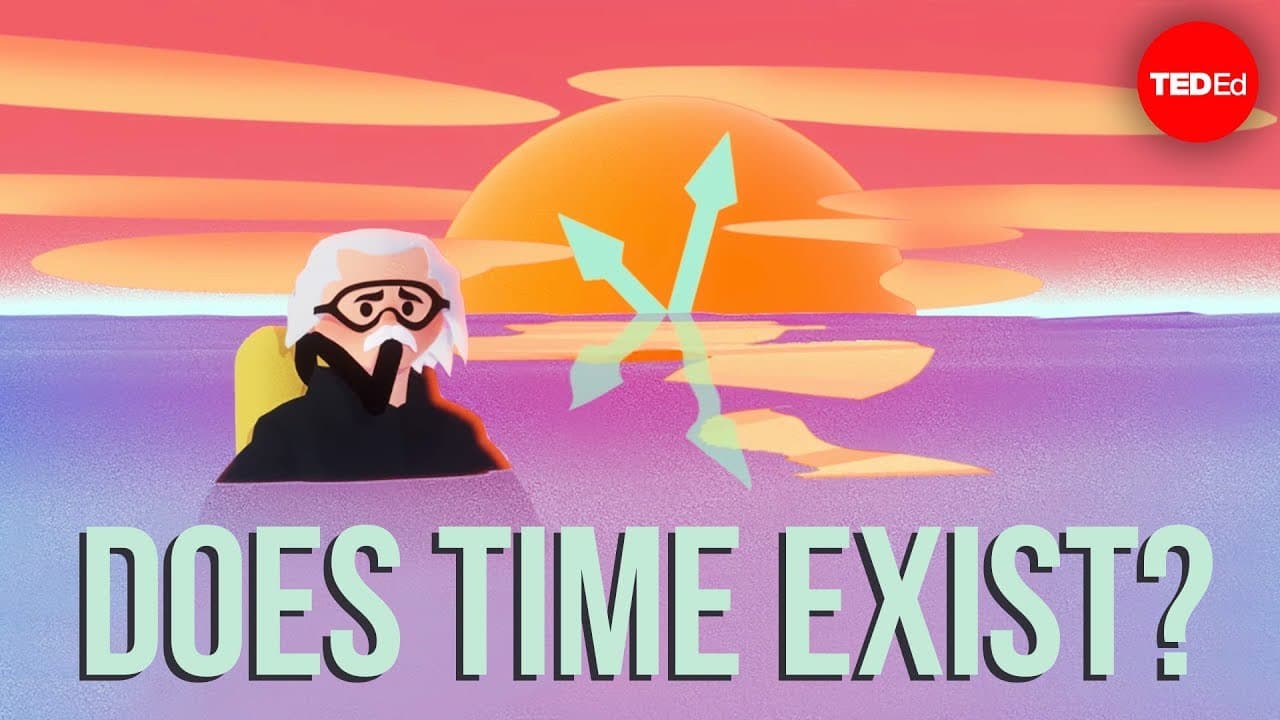
Does time exist? - Andrew Zimmerman Jones
TL;DR
Time is a complex concept; while it appears to be a fundamental property of the universe, some theories suggest it may be an emergent phenomenon or even an illusion. Einstein's relativity shows that time is malleable and linked with space, leading us to explore whether our perception of time is the result of underlying physical laws rather than a standalone entity.
Transcript
The earliest time measurements were observations of cycles of the natural world, using patterns of changes from day to night and season to season to build calendars. More precise time-keeping, like sundials and mechanical clocks, eventually came along to put time in more convenient boxes. But what exactly is it that we’re measuring? Is time somethi... Read More
Key Insights
- ⏰ Time measurement evolved from natural observations to precise clocks.
- ⌛ Einstein's theory of relativity introduced the concept of space-time and the malleability of time.
- 💘 The arrow of time is defined by the Second Law of Thermodynamics.
- ❓ Theoretical physics seeks to reconcile general relativity and quantum physics into a unified theory of everything.
- ⌛ The Wheeler-DeWitt equation, a contender for a theory of everything, does not include time.
- 🫵 Time could potentially be viewed as an emergent property of the universe.
- ⌛ Physicists are still exploring the nature of time and its role in fundamental physics.
Install to Summarize YouTube Videos and Get Transcripts
Explore YouTube Video Summarizer or Get YouTube Transcript Extractor
Questions & Answers
Q: How did time measurement evolve from natural cycles to precise clocks?
Time measurement began with observations of natural cycles and progressed to more precise methods like mechanical clocks and sundials to measure time in convenient units.
Q: How did Einstein's theory of relativity impact our understanding of time?
Einstein's theory of relativity showed that time is malleable and can pass at different rates for people in different situations, leading to the concept of space-time as a unified entity that can bend.
Q: What is the arrow of time, and how is it defined?
The arrow of time is the idea that time moves in only one direction, defined by the Second Law of Thermodynamics, which states that systems in the universe tend to gain disorder or entropy over time.
Q: Could time be considered an emergent property rather than a fundamental one?
The concept of time as an emergent property suggests that it may not exist at the most fundamental level but emerges from the interactions of the components of a system, much like how a movie creates the illusion of continuous change through still images.
Summary
This video explores the concept of time and its existence. It discusses how time is observed through natural cycles and then further measured with sundials and clocks. The video delves into Einstein's theory of relativity, which suggests that time is intertwined with space in the fabric of the universe. However, it also highlights the unresolved question of why time only moves forward and the concept of the arrow of time. The Second Law of Thermodynamics, which states that systems tend to move from order to disorder over time, is presented as an explanation for the direction of time's arrow. The video also addresses the attempts to reconcile general relativity and quantum physics into a unified theory of everything, with different theories treating time in various ways. It introduces the idea that time might be an emergent property rather than a fundamental one, drawing parallels to how a movie creates the illusion of time through a sequence of still images. The video concludes by acknowledging that many questions about time remain unanswered, leaving room for ongoing exploration and discovery.
Questions & Answers
Q: What were the earliest observations of time measurements based on?
The earliest time measurements were based on observations of cycles in the natural world, such as day to night and season to season changes.
Q: How did more precise time-keeping methods like sundials and mechanical clocks contribute?
Sundials and mechanical clocks provided more convenient ways to measure time, allowing for more precise tracking and organization of daily activities.
Q: Is time something that physically exists or is it a subjective experience?
While it may seem obvious that time physically exists, Einstein's theory of relativity introduces complexity. It suggests that time passes for everyone but doesn't always pass at the same rate for individuals in different situations.
Q: How did Einstein resolve the malleability of time?
Einstein combined time with space to define space-time, a concept that can bend but behaves consistently and predictably.
Q: What is the arrow of time?
The arrow of time refers to the phenomenon that time only moves forward, and the past is always behind us.
Q: How is the arrow of time exemplified in the Second Law of Thermodynamics?
The Second Law of Thermodynamics states that systems tend to gain disorder or entropy over time. This movement from order to disorder defines the direction of time's arrow in our universe.
Q: Are there equations that describe time as a fundamental property?
Currently, there are two sets of equations that govern physics: general relativity for large-scale phenomena and quantum physics for the very small. The desire for a "theory of everything" has led to attempts to reconcile these two sets of equations, but the treatment of time differs among the theories.
Q: Can time be considered an emergent property rather than a fundamental one?
It is possible that time could be an emergent property, meaning it doesn't exist at the level of individual system components but emerges for the system as a whole.
Q: What is an example of an emergent property?
An example of an emergent property is the tide in an ocean. While individual water molecules do not have a tide, the entire ocean as a system exhibits this phenomenon.
Q: Could the concept of time be an illusion?
It is unclear whether time is a genuine fundamental property or an illusion generated by the limitations of our perception. The idea of time being an emergent property suggests that it may be an illusion that arises from the way pieces of a system are connected.
Takeaways
The nature of time remains a subject of ongoing exploration for physicists. While time is observed and measured through natural cycles and man-made devices, its essence as a fundamental or emergent property is yet to be fully understood. Time's connection with space, its unidirectional flow, and its potential as an illusion generate fascinating questions that challenge our understanding of the universe. Further research is needed to uncover the mysteries surrounding time and provide a comprehensive explanation.
Summary & Key Takeaways
-
Time measurement began with natural cycles, evolving into precise clocks.
-
Einstein's theory of relativity complicated our understanding of time.
-
The arrow of time is defined by the Second Law of Thermodynamics.
Read in Other Languages (beta)
Share This Summary 📚
Summarize YouTube Videos and Get Video Transcripts with 1-Click
Try YouTube Summary with ChatGPT & Claude or YouTube Transcript Generator
Explore More Summaries from TED-Ed 📚





Summarize YouTube Videos and Get Video Transcripts with 1-Click
Try YouTube Summary with ChatGPT & Claude or YouTube Transcript Generator