The unexpected math behind Van Gogh's "Starry Night" - Natalya St. Clair
TL;DR
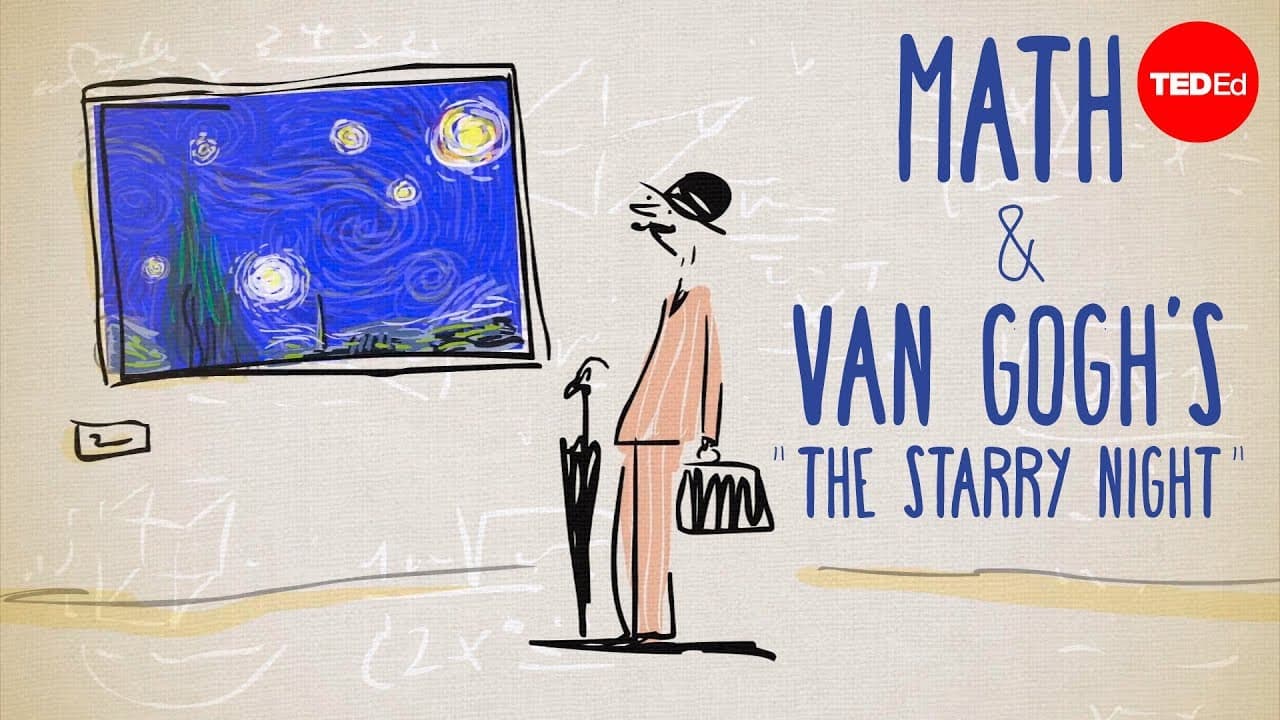
Van Gogh's 'Starry Night' illustrates the concept of turbulent flow through its swirling brushstrokes and luminance, capturing the motion of light. Recent studies found that patterns in the painting align with Kolmogorov's equation on turbulence, linking art to complex scientific principles. This connection highlights how Van Gogh represented a concept of fluid dynamics during a tumultuous period of his life.
Transcript
One of the most remarkable aspects of the human brain is its ability to recognize patterns and describe them. Among the hardest patterns we've tried to understand is the concept of turbulent flow in fluid dynamics. The German physicist Werner Heisenberg said, "When I meet God, I'm going to ask him two questions: why relativity and why turbulence? I... Read More
Key Insights
- 😒 Van Gogh's use of circular brushstrokes and luminance in "The Starry Night" captures turbulent flow like fluid dynamics.
- 🩵 Impressionist art, including Van Gogh's works, depicts light motion through contrasting colors and luminance.
- 🩵 The connection between Impressionist art and turbulent flow stems from the complex interpretations of light in our brains.
- 🥰 Scientists studied Van Gogh's paintings to find patterns resembling turbulent fluid structures, linking art to scientific concepts.
- 🥰 Kolmogorov's equation on turbulent flow closely aligns with the fluid dynamics represented in Van Gogh's art.
- 🌤️ The energy cascade in turbulent flow, from big to small eddies, mirrors natural phenomena like Jupiter's Great Red Spot and cloud formations.
- 💦 The study of luminance in Van Gogh's paintings revealed turbulent patterns, particularly in works created during periods of intense suffering.
Install to Summarize YouTube Videos and Get Transcripts
Explore YouTube Video Summarizer or Get YouTube Transcript Extractor
Questions & Answers
Q: How did Vincent van Gogh represent turbulent flow in "The Starry Night"?
Van Gogh used circular brushstrokes and luminance to convey swirling clouds and eddies of stars, capturing the essence of turbulent flow in his painting.
Q: What role does luminance play in Impressionist art?
Luminance influences how we perceive light in art, causing contrasting colors with the same luminance to blend in our visual cortex while being distinct in our primate subdivision.
Q: How did scientists connect Van Gogh's art to fluid dynamics?
By studying luminance in Van Gogh's paintings, researchers discovered patterns of turbulent fluid structures resembling Kolmogorov's equation, indicating Van Gogh's ability to subconsciously depict turbulence.
Q: Why did Van Gogh's art from different periods show varying degrees of turbulence?
Van Gogh's turbulent genius seemed to coincide with periods of intense suffering, enabling him to uniquely represent fluid turbulence in art, as seen in paintings from his psychotic agitation period.
Summary
The human brain has the remarkable ability to recognize patterns and describe them, including the concept of turbulent flow in fluid dynamics. Vincent van Gogh's paintings, such as "The Starry Night," use art to depict the way turbulent flow looks, with swirling clouds and eddies of stars. The effect is caused by luminance, the intensity of light in the colors on the canvas, which our brains interpret in different ways. Russian mathematician Andrey Kolmogorov furthered our understanding of turbulence, proposing that energy in a turbulent fluid varies in proportion to the 5/3rds power of length R. Scientists studying Van Gogh's paintings discovered a distinct pattern of turbulent fluid structures hidden in many of his works, resembling Kolmogorov's equation. Van Gogh's ability to depict turbulence in his art is a testament to his unique perception and the connection between his mind and the mysteries of movement, fluid, and light.
Questions & Answers
Q: What did Werner Heisenberg find difficult to understand mathematically?
Werner Heisenberg found the concept of turbulent flow in fluid dynamics difficult to understand mathematically.
Q: How did Vincent van Gogh represent turbulent flow in his paintings?
Vincent van Gogh represented turbulent flow in his paintings, such as "The Starry Night," by using circular brushstrokes to create a night sky filled with swirling clouds and eddies of stars.
Q: How do Impressionists represent light differently from their predecessors?
Impressionists, including Van Gogh, represent light in a different way than their predecessors. They seem to capture the motion of light, whether it's across sun-dappled waters or in the twinkling and melting of starlight through waves of blue night sky.
Q: What is the effect of luminance on our perception of colors?
Luminance, which refers to the intensity of light in the colors on the canvas, plays a role in our perception of colors. The more primitive part of our visual cortex will blend two differently colored areas together if they have the same luminance, while our primate subdivision can see the contrasting colors without blending.
Q: How did Andrey Kolmogorov contribute to our understanding of turbulence?
Andrey Kolmogorov, a Russian mathematician, proposed that energy in a turbulent fluid at length R varies in proportion to the 5/3rds power of R. His proposition was remarkably close to the way turbulent flow works, although a complete description of turbulence remains unsolved in physics.
Q: What is the self-similarity of a turbulent flow?
A turbulent flow is considered self-similar if there is an energy cascade, where big eddies transfer their energy to smaller eddies, which do likewise at other scales. Examples of self-similar turbulent flows include Jupiter's Great Red Spot, cloud formations, and interstellar dust particles.
Q: What about Van Gogh's paintings motivated scientists to study luminance?
The eddies of a distant cloud of dust and gas seen through the Hubble Space Telescope reminded scientists of Van Gogh's "Starry Night," which motivated them to study the luminance in his paintings in detail.
Q: What did the researchers discover when studying the luminance in Van Gogh's paintings?
When studying the luminance in Van Gogh's paintings, the researchers discovered a distinct pattern of turbulent fluid structures hidden in many of his works, which resembled Kolmogorov's equation for turbulent energy.
Q: Did all of Van Gogh's paintings show this pattern of turbulent fluid structures?
No, not all of Van Gogh's paintings showed the pattern of turbulent fluid structures. His self-portrait with a pipe, from a calmer period in his life, showed no sign of this correspondence. Similarly, other artists' work, like Munch's "The Scream," seemed equally turbulent at first glance but did not exhibit this correspondence.
Q: What does Van Gogh's ability to depict turbulence in his art demonstrate?
Van Gogh's ability to depict turbulence in his art demonstrates his unique perception and the ability to unite his mind's eye with the deepest mysteries of movement, fluid, and light.
Takeaways
Vincent van Gogh's paintings, particularly "The Starry Night," depict turbulent flow through swirling clouds and eddies of stars, using circular brushstrokes to capture the motion of light. The luminance in his paintings, which affects our perception of colors, showed a distinct pattern of turbulent fluid structures resembling Kolmogorov's equation. Van Gogh's ability to depict turbulence in his art showcases his unique perception and the connection between his mind and the mysteries of movement, fluid, and light.
Summary & Key Takeaways
-
Vincent van Gogh's "The Starry Night" depicts turbulent flow in a strikingly real way through swirling clouds and eddies of stars.
-
The application of luminance in Impressionist works like Van Gogh's captures the motion of light and influences our brain's visual cortex.
-
Scientists found patterns of turbulent fluid structures close to Kolmogorov's equation hidden in many of Van Gogh's paintings.
Read in Other Languages (beta)
Share This Summary 📚
Summarize YouTube Videos and Get Video Transcripts with 1-Click
Try YouTube Summary with ChatGPT & Claude or YouTube Transcript Generator
Explore More Summaries from TED-Ed 📚



Summarize YouTube Videos and Get Video Transcripts with 1-Click
Try YouTube Summary with ChatGPT & Claude or YouTube Transcript Generator