Why elephants never forget - Alex Gendler
TL;DR
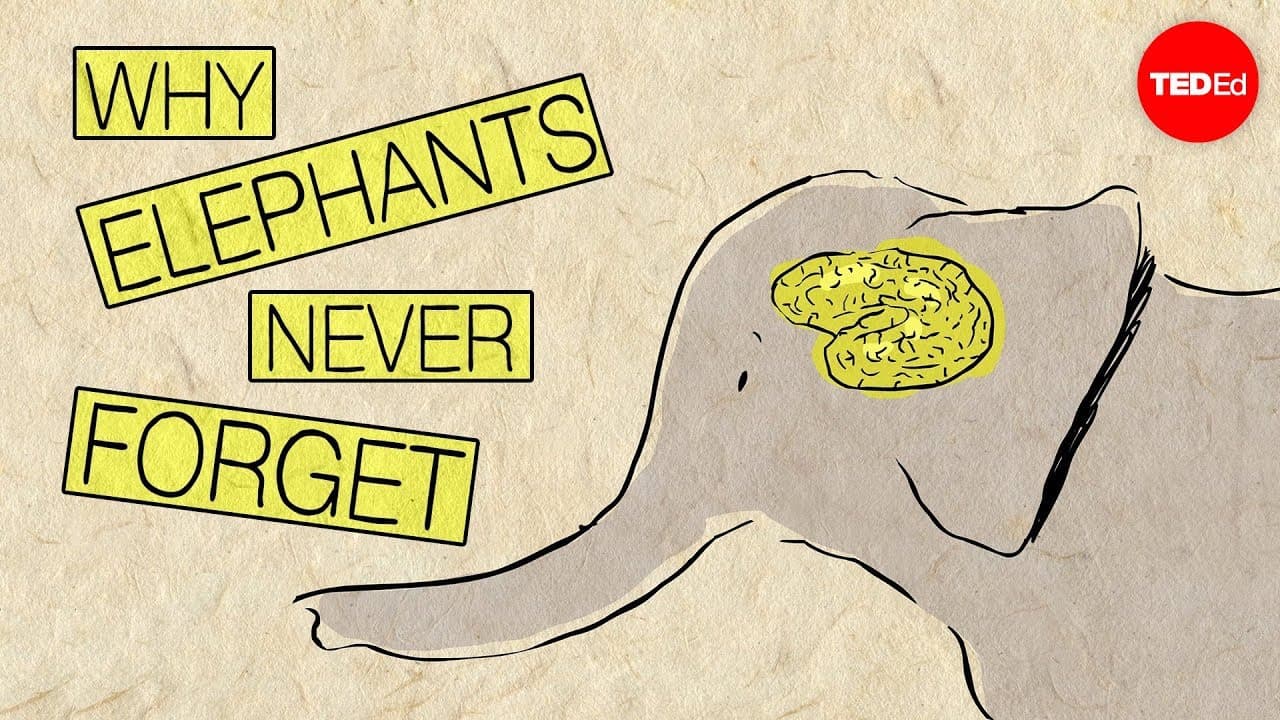
Elephants form long-term memories by encoding emotionally important experiences, helping them recognize companions, dangers, and locations after long periods. Their highly developed hippocampus and cerebral cortex also support cooperation, problem solving, communication, creativity, self-recognition, empathy, mourning, and learned survival, revealing an intelligence far more complex than simple memorization.
Transcript
It's a common saying that elephants never forget, but these magnificent animals are more than giant walking hard drives. The more we learn about elephants, the more it appears that their impressive memory is only one aspect of an incredible intelligence that makes them some of the most social, creative, and benevolent creatures on Earth. Unlike man... Read More
Key Insights
- Elephant memory is a complex, adaptable faculty that prioritizes important experiences instead of merely storing automatic responses to stimuli. This selectivity allows elephants to retain socially meaningful encounters, recognize warning signs, remember useful locations, and apply earlier experiences when circumstances change.
- Elephants can recognize as many as 30 herd companions by sight or smell. This social memory helps them during migration and when they encounter unfamiliar elephants that may be hostile, making individual recognition an important part of both group cohesion and survival.
- Long-term recognition extends beyond an elephant's own species. Two circus elephants rejoiced after meeting again 23 years after briefly performing together, while other elephants have recognized humans with whom they formed bonds after being separated for decades.
- The elephant has the largest brain of any land mammal and an encephalization quotient nearly as high as a chimpanzee's. Convergent evolution has also produced similarities to the human brain, including as many neurons and synapses and highly developed memory and reasoning regions.
- The hippocampus encodes emotionally important experiences into long-term memories. Elephants that survived drought during youth can recognize its warning signs as adults, and clans led by older matriarchs consequently have higher survival rates because accumulated experience can guide collective decisions.
- The cerebral cortex supports creative and cooperative problem solving in elephants. They can coordinate with partners, sometimes manipulate those partners or outwit researchers, and track the relative amounts of fruit in two baskets even after the quantities undergo multiple changes.
- Elephant communication uses body signals, vocalizations, and infrasound rumbles audible kilometers away. Their apparent understanding of syntax suggests a system with language and grammar, while their ability to distinguish twelve musical tones and recreate melodies indicates additional sensitivity to structured sound.
- Elephants display empathy, altruism, justice, mourning, and self-recognition. They perform burial rituals, revisit graves, protect or comfort injured humans, avoid harming other animals, and recognize themselves in mirrors, supporting the conclusion that they are conscious, intelligent, and emotional beings.
Install to Summarize YouTube Videos and Get Transcripts
Explore YouTube Video Summarizer or Get YouTube Transcript Extractor
Questions & Answers
Q: How do elephants remember companions and other individuals?
Elephants can recognize as many as 30 herd companions through sight or smell, which helps during migration and encounters with potentially hostile elephants. Their social memories can also persist for decades and extend beyond their herd. Two circus elephants recognized each other 23 years after briefly performing together, and elephants have recognized humans with whom they bonded after decades apart.
Q: Why is elephant memory more than rote memorization?
Elephant memory distinguishes experiences according to their importance, rather than operating only as a fixed response to stimuli. The hippocampus, which is strongly associated with emotion, helps encode significant experiences into long-term memories. This adaptable process lets elephants retain meaningful social bonds, danger signals, and environmental knowledge that can later guide behavior under changing conditions.
Q: How does an elephant's brain support long-term memory?
An elephant's highly developed hippocampus supports recollection by encoding emotionally important experiences into long-term memory. The elephant also has the largest brain of any land mammal, an encephalization quotient nearly as high as a chimpanzee's, as many neurons and synapses as the human brain, and a highly developed cerebral cortex that contributes to problem solving.
Q: How do older matriarchs improve elephant survival?
Older matriarchs carry memories of environmental events and their warning signs. For example, elephants that survived a drought in youth can recognize signs of another drought in adulthood. Because this accumulated knowledge can guide a clan's response to danger and scarcity, clans with older matriarchs have higher survival rates than groups lacking the same depth of experience.
Q: What problem-solving abilities do elephants demonstrate?
Elephants solve problems creatively and can work cooperatively with other elephants. During research tasks, they have sometimes outwitted researchers and manipulated their partners. They also demonstrate basic arithmetic by tracking which of two baskets contains a relatively larger amount of fruit, even after the contents have been changed multiple times.
Q: How do elephants communicate with one another?
Elephants communicate through body signals, vocalizations, and infrasound rumbles that can be heard kilometers away. Their understanding of syntax suggests that their communication may include its own language and grammar rather than consisting only of isolated signals. Their structured auditory abilities also include recognizing twelve distinct musical tones and recreating melodies.
Q: What evidence shows that elephants experience empathy and grief?
Elephants mourn their dead through burial rituals and later return to visit graves. They have also demonstrated concern for other species. One working elephant refused to place a log into a hole where a dog was sleeping, while elephants encountering injured humans have sometimes guarded them and offered gentle comfort with their trunks.
Q: Why does elephant intelligence strengthen the case for conservation?
Evidence indicates that elephants possess memory, problem-solving ability, communication, creativity, empathy, emotional bonds, and mirror self-recognition. Despite these complex mental lives, they continue to suffer from habitat destruction in Asia, ivory poaching in Africa, and mistreatment in captivity worldwide. Protecting them is therefore increasingly important as understanding of their consciousness and intelligence expands.
Summary
Elephants possess an impressive intelligence, with their memory being just one aspect of their remarkable abilities. They have the capacity to recognize and remember individual herd members, as well as distinguishing danger signals and important locations. But their memory goes beyond survival, as they can recall humans and other creatures they have bonded with even after decades apart. The elephant's large brain and highly developed hippocampus and cerebral cortex contribute to their complex memory and problem-solving skills. They communicate using various signals, understand syntax, and can create art and appreciate music. However, their most remarkable trait is their sense of empathy, altruism, and justice, as they mourn their dead, show concern for other species, and even seek revenge for harm inflicted upon their kind. Unfortunately, elephants face numerous threats, including habitat destruction, ivory poaching, and captivity mistreatment. It is crucial to protect these intelligent and emotional beings to prevent their disappearance from the world.
Questions & Answers
Q: What makes the saying "elephants never forget" scientifically accurate?
Elephants possess the ability to recognize and remember individual herd members, often up to 30 companions, by sight or smell. This recognition is not limited to their own species, as elephants have been known to recognize humans they have bonded with, even after decades apart.
Q: How does the size of an elephant's brain compare to other land mammals?
The elephant has the largest brain of any land mammal. Furthermore, when considering the size of the brain relative to the body, the elephant's brain has an impressive encephalization quotient (EQ), almost as high as a chimpanzee's.
Q: What brain structures contribute to elephant memory?
The elephant's highly developed hippocampus and cerebral cortex play important roles in their memory abilities. The hippocampus, associated with emotion, encodes significant experiences into long-term memories, aiding recollection. The cerebral cortex enables problem-solving skills.
Q: How does elephant memory extend beyond survival?
Elephants remember not only their herd companions but also other creatures who have made a strong impression on them. They can recognize humans and animals they have bonded with after years of separation. This goes beyond simple responses to stimuli and suggests a deeper form of memory.
Q: How do elephants demonstrate problem-solving skills?
Elephants display problem-solving abilities in various creative ways. They can tackle problems cooperatively and have even outwitted researchers and manipulated their partners in experiments. Additionally, elephants have shown an understanding of basic arithmetic, keeping track of the relative amounts of fruit in different baskets.
Q: How do elephants communicate?
Elephants employ a range of communication methods, including body signals, vocalizations, and infrasound rumbles that can be heard from kilometers away. Furthermore, their understanding of syntax suggests that they have their own language and grammar.
Q: Can elephants appreciate art and music?
Elephants possess a sense of aesthetics and can create art by deliberately choosing and combining different colors and elements. They can also recognize twelve distinct tones of music and recreate melodies. This suggests that elephants may have an appreciation for art and music.
Q: What sets elephants apart in terms of their emotional capacity?
Elephants exhibit a remarkable sense of empathy, altruism, and justice. They are the only non-human animals known to mourn their dead, engaging in burial rituals and revisiting graves. They have also shown concern for injured humans and even stood guard and gently comforted them with their trunks. On the other hand, they have been observed seeking revenge for harm inflicted upon their kind.
Q: How do elephants demonstrate self-awareness?
Elephants are one of the few species capable of recognizing themselves in a mirror. This ability reflects a degree of self-awareness and consciousness that sets elephants apart from many other animals.
Q: What threats do elephants currently face?
Elephants are subjected to numerous threats, including habitat destruction in Asia, ivory poaching in Africa, and mistreatment in captivity worldwide. Despite their intelligence and emotional capacities, their treatment does not reflect their true value as sentient beings.
Takeaways
Elephants possess an extraordinary intelligence that encompasses memory, problem-solving, communication, artistic appreciation, and emotional capacity. Their ability to remember individuals and locations, recognize humans and creatures they have bonded with, and solve problems creatively showcases their remarkable cognitive abilities. Moreover, their empathy, altruism, and even a sense of justice demonstrate their deep emotional lives. However, these intelligent and emotional beings face significant threats, including habitat destruction, poaching, and mistreatment in captivity. It is crucial for humanity to protect and respect elephants, considering their value as conscious and sentient creatures who contribute to the diversity of the natural world.
Summary & Key Takeaways
-
Elephants can recognize as many as 30 herd companions by sight or smell, distinguish danger cues, and recall important locations. They also remember elephants and humans who affected them strongly, even after decades apart, showing that their memory includes social and emotional experiences rather than only immediate survival information.
-
Elephant brains contain as many neurons and synapses as human brains, along with a highly developed hippocampus and cerebral cortex. The hippocampus helps encode emotionally important experiences into long-term memory, while the cerebral cortex supports creative and cooperative problem solving, partner manipulation, and basic arithmetic involving changing quantities of fruit.
-
Elephant intelligence includes long-distance communication, possible syntax, artistic choices, musical abilities, empathy, altruism, justice, mourning, and mirror self-recognition. Yet elephants continue to face habitat destruction in Asia, ivory poaching in Africa, and mistreatment in captivity, making protection increasingly important as evidence of their complex mental lives grows.
Read in Other Languages (beta)
Share This Summary 📚
Summarize YouTube Videos and Get Video Transcripts with 1-Click
Try YouTube Summary with ChatGPT & Claude or YouTube Transcript Generator
Explore More Summaries from TED-Ed 📚






Summarize YouTube Videos and Get Video Transcripts with 1-Click
Try YouTube Summary with ChatGPT & Claude or YouTube Transcript Generator