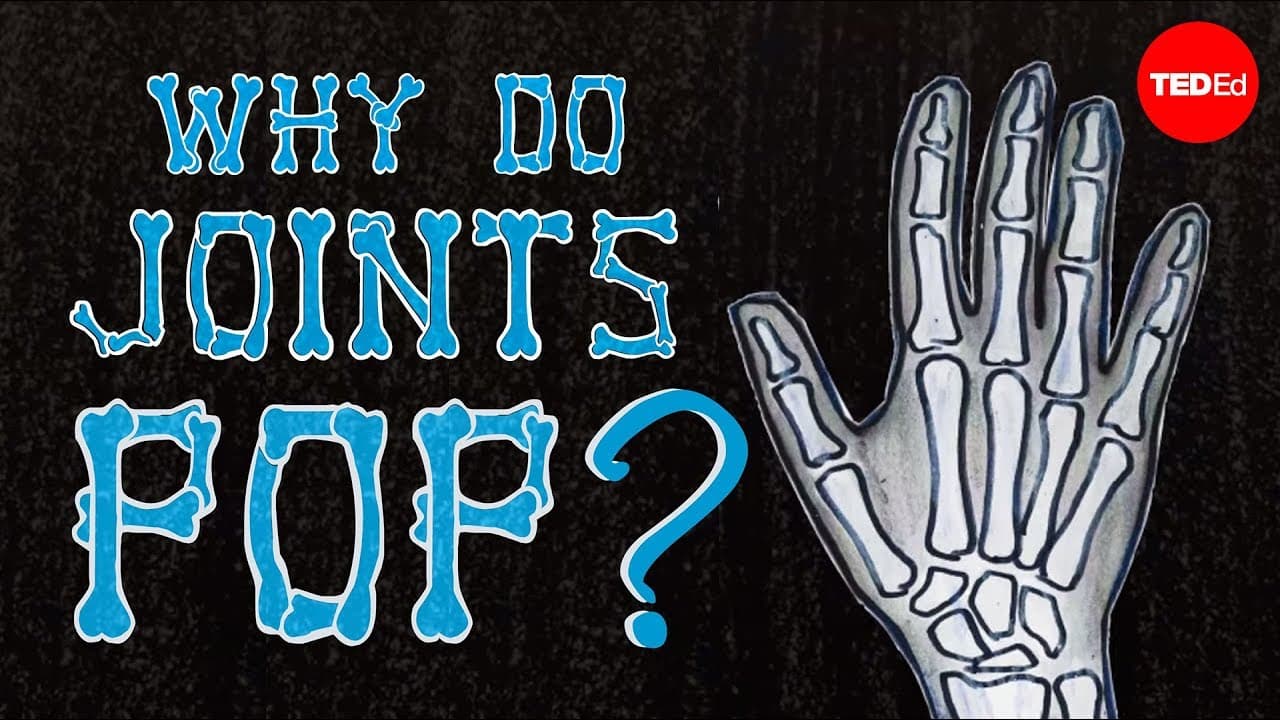
Why do your knuckles pop? - Eleanor Nelsen
TL;DR
The sound of joint popping is due to bubbles in synovial fluid; it's harmless and can even feel relieving.
Transcript
What's that sound? Depending on whom you ask, the crackle of popping joints is either the sound of sweet relief or the noxious tones of a stomach-turning habit. Really, though. What's that sound? I mean, why does bending your joints in a certain way make them pop like that? Scientists have offered several explanations, including rapidly stretchin... Read More
Key Insights
- 🫢 Joint popping is caused by gas bubbles in synovial fluid forming and collapsing during joint stretching.
- 🍾 Contrary to popular belief, joint popping does not cause arthritis and may even make joints feel more flexible.
- 🤗 A doctor's 50-year experiment cracked one hand's knuckles regularly without causing arthritis, showcasing the harmless nature of joint popping.
- 🫢 Synovial fluid serves to lubricate joints and contains gases that create the popping sound when joints are cracked.
- ❓ Joint cracking can temporarily enlarge joints, potentially giving a feeling of increased flexibility.
- 🤗 One study suggests that excessive joint popping could lead to hand swelling and weakened grip strength.
- 👨⚕️ An Ig Nobel Prize was awarded to a doctor who extensively studied joint cracking, highlighting its unusual but fascinating nature.
Install to Summarize YouTube Videos and Get Transcripts
Explore YouTube Video Summarizer or Get YouTube Transcript Extractor
Questions & Answers
Q: Why do joints make a popping sound?
Joints pop due to the formation and collapse of gas bubbles in synovial fluid when joints are stretched, creating a sound like a bubble bursting.
Q: Does joint popping cause arthritis?
No, multiple studies, including a doctor's 50-year experiment, have shown that joint cracking does not lead to arthritis as commonly believed.
Q: What are the potential risks of joint popping?
The only proven risks of joint cracking are potential hand swelling and weakened grip strength, but these are minimal compared to the perceived benefits.
Q: What is the purpose of synovial fluid?
Synovial fluid acts to cushion bones, help them glide past each other, and contain dissolved gases that create the popping sound when joints are cracked.
Summary
This video explores the reasons behind the sound that occurs when joints crack, focusing on synovial joints in particular. It explains that the sound is caused by dissolved gas bubbles forming and bursting within the synovial fluid. The video addresses common misconceptions about the potential harms of joint cracking, highlighting a study that suggests potential hand swelling and grip weakness as well as the overall annoyance it may cause to others.
Questions & Answers
Q: What are some explanations for why joints crack?
Scientists have proposed a few explanations, such as the rapid stretching of ligaments or the grinding of bones against each other in severe cases. However, the most common explanation is the presence of bubbles within the joints.
Q: Which joints are the easiest to crack?
The joints in the fingers are the easiest to crack, but people also crack joints between the vertebrae in their neck and back, as well as their hips, wrists, and shoulders. These joints are all synovial joints, known for their flexibility.
Q: What fills the space between bones in synovial joints?
The space between bones in synovial joints is filled with a viscous liquid called synovial fluid. This fluid acts as a cushion for the bones and helps them glide smoothly past each other. It also contains molecules like hyaluronic acid and lubricin, which aid in lubrication.
Q: What role does synovial fluid play in knuckle cracking?
Synovial fluid is essential for the cracking of knuckles. When a joint is stretched farther than usual, the space between bones increases, but the amount of synovial fluid stays constant. This creates a low-pressure zone that causes dissolved gas molecules in the fluid to form a bubble, resulting in a popping sound.
Q: How long does it take for the gases from the bubble to dissolve back into the synovial fluid?
After the bubble bursts, the gases slowly dissolve back into the synovial fluid over the course of approximately twenty minutes. This explains why it takes some time before the same joint can be popped again.
Q: Is there more than one popping sound when a joint cracks?
Some scientists believe that there may be two pops when a joint cracks. The first occurs when the bubble forms, and the second when it bursts. This hypothesis suggests that the cracking may temporarily enlarge the joint.
Q: Can cracking joints lead to arthritis?
Contrary to popular belief, cracking joints does not lead to arthritis. In fact, a doctor named Donald Unger conducted a 50-year experiment where he cracked the knuckles of one hand while leaving the other hand untouched. After 36,500 cracks, he found no signs of arthritis in either hand.
Q: What recognition did Dr. Unger receive for his experiment?
Dr. Unger won an Ig Nobel Prize, which celebrates peculiar and intriguing scientific achievements, for his experiment debunking the myth that cracking knuckles causes arthritis. His study suggested that other parental beliefs, like the importance of eating spinach, should also be explored.
Q: Are there any dangers associated with joint cracking?
While one study suggests that excessive joint cracking might lead to hand swelling and weakened grip, the only proven danger seems to be the annoyance it causes to those around you.
Takeaways
In summary, the sound produced when joints crack is primarily caused by dissolved gas bubbles forming and bursting within synovial fluid. Despite common misconceptions, cracking joints does not lead to arthritis. The cracking habit may temporarily enlarge joints, making them feel looser and more flexible, but any potential risks appear to be minimal, with the main drawback being the annoyance it may cause others.
Summary & Key Takeaways
-
Joint popping occurs due to bubbles in synovial fluid caused by a low-pressure zone during joint stretching.
-
Contrary to popular belief, joint popping does not lead to arthritis and can make joints feel more flexible.
-
The act of joint cracking has even won a doctor an Ig Nobel Prize for dedicating 50 years to study its effects.
Read in Other Languages (beta)
Share This Summary 📚
Summarize YouTube Videos and Get Video Transcripts with 1-Click
Try YouTube Summary with ChatGPT & Claude or YouTube Transcript Generator
Explore More Summaries from TED-Ed 📚

Summarize YouTube Videos and Get Video Transcripts with 1-Click
Try YouTube Summary with ChatGPT & Claude or YouTube Transcript Generator