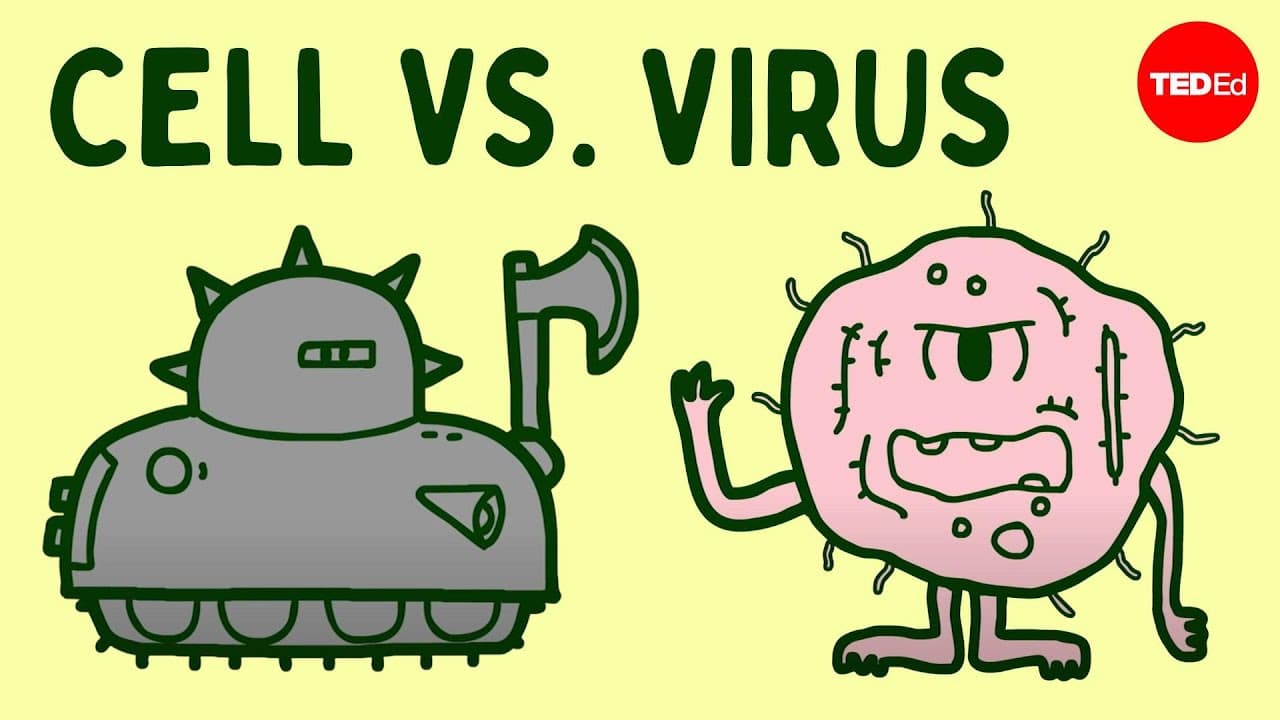
Cell vs. virus: A battle for health - Shannon Stiles
TL;DR
Cells defend against viruses by recognizing and attacking them upon entry. Once a virus infiltrates a cell, it triggers an immune response where antibodies are produced to eliminate the threat. These processes are coordinated by the cell’s DNA and involve various organelles, including ribosomes, the golgi apparatus, and mitochondria for energy.
Transcript
You're in line at the grocery store when, uh oh, someone sneezes on you. The cold virus is sucked inside your lungs and lands on a cell on your airway lining. Every living thing on Earth is made of cells, from the smallest one-celled bacteria to the giant blue whale to you. Each cell in your body is surrounded by a cell membrane, a thick flexible l... Read More
Key Insights
- 🛟 Cells are the fundamental units of life, with cell membranes protecting internal structures.
- 👻 Viruses can invade cells by tricking the cell membrane into allowing them in.
- 👾 Immune responses involve producing antibodies to defend against foreign invaders, orchestrated by DNA.
- 🥳 Various cell parts like ribosomes, golgi apparatus, and mitochondria play crucial roles in immune responses and energy production.
- 😋 Mitochondria produce ATP, the energy currency of cells, by combining oxygen and food electrons.
- 😒 Plant cells use chloroplasts to convert sunlight, carbon dioxide, and water into sugar for energy production.
- 🥳 Cell parts like lysosomes recycle waste material to maintain cell function.
Install to Summarize YouTube Videos and Get Transcripts
Explore YouTube Video Summarizer or Get YouTube Transcript Extractor
Questions & Answers
Q: How does a virus enter a cell?
A virus can attach to the cell membrane and trick the cell into bringing it inside, where it can replicate and cause harm.
Q: What role does DNA play in immune responses?
DNA contains instructions for making antibodies, proteins that attack viruses, when enzymes in the nucleus create messenger RNA to produce them.
Q: How do cells create energy to power their functions?
Mitochondria produce ATP by combining oxygen and food electrons, providing the energy needed to power cell processes like immune responses.
Q: What differentiates plant cells from animal cells in energy production?
Plant cells use chloroplasts to convert carbon dioxide, water, and sunlight into sugar, a form of energy, whereas animal cells rely on mitochondria for energy production.
Summary
This video explores the process of how a virus enters a cell, triggers the immune response, and how the cell produces antibodies to fight off the invader. It also explains the role of different cell components, such as the cell membrane, nucleus, ribosomes, golgi apparatus, lysosomes, and mitochondria, in this process. Additionally, it highlights the energy production in cells, particularly through the mitochondria and chloroplasts in animal and plant cells, respectively.
Questions & Answers
Q: What is the cell membrane?
The cell membrane is a thick flexible layer made of fats and proteins that surrounds and protects the inner components of a cell. It is semipermeable, allowing certain substances to pass through while blocking others. It is also covered in tiny projections with various functions, such as cell adhesion and nutrient binding.
Q: Do both animal and plant cells have cell membranes?
Yes, animal and plant cells both have cell membranes. However, plant cells also have an additional layer called the cell wall, which is made of rigid cellulose and provides structural support to the plant.
Q: How does a virus enter a cell?
A virus can enter a cell by attaching itself to a projection on the cell membrane and tricking the cell into bringing it inside. The cell recognizes the intruder and responds by sending enzymes to chop the virus into pieces. One of these pieces is then sent back through the cell membrane to warn neighboring cells about the invader.
Q: How does a cell produce antibodies to fight off a virus?
When a nearby cell receives the warning about the virus, it initiates the production of antibodies. This process begins in the nucleus, where enzymes locate the section of DNA that contains instructions for antibody production. They create a copy of these instructions called messenger RNA, which leaves the nucleus and travels to a ribosome. The ribosome reads the instructions and links amino acids together to create the antibody protein.
Q: What happens after the antibody is produced?
Before the antibody can fight the virus, it needs to leave the cell. It is directed to the golgi apparatus, where it is packaged for delivery outside the cell. The golgi apparatus also provides directions for the antibody to reach the cell's edge. Once there, the bubble enclosing the antibody fuses with the cell membrane, allowing the cell to eject the antibody and send it out to track down the virus. The remaining bubble is broken down by the cell's lysosomes, and its components are recycled.
Q: How does a cell obtain the energy to perform these processes?
The mitochondria play a crucial role in providing energy for the cell. By combining oxygen and electrons from the food we eat, the mitochondria produce water molecules and a high-energy molecule called ATP. ATP is then utilized by the cell to power its various functions. In plant cells, energy is generated differently through chloroplasts, which convert carbon dioxide, water, and light energy from the sun into oxygen and sugar as a form of chemical energy.
Q: How many cells are estimated in the human body?
Scientists believe that the human body contains approximately 37 trillion cells.
Takeaways
This video emphasizes the complexity and interconnectedness of cells in the human body. From the cell membrane to the nucleus, ribosomes to the golgi apparatus, lysosomes to the mitochondria, each component plays a specific role in maintaining the overall function and integrity of cells. The immune response demonstrated showcases how cells collaborate and communicate to defend the body against viruses. Moreover, the generation of energy, whether through cellular respiration or photosynthesis, is essential for cells and, subsequently, the overall functioning of the body.
Summary & Key Takeaways
-
Cells are the basic building blocks of living organisms, with cell membranes protecting inner components.
-
Viruses can trick cells into letting them in, triggering immune responses to fight them off.
-
Cells utilize various parts like ribosomes, golgi apparatus, and mitochondria to defend against invaders.
Read in Other Languages (beta)
Share This Summary 📚
Summarize YouTube Videos and Get Video Transcripts with 1-Click
Try YouTube Summary with ChatGPT & Claude or YouTube Transcript Generator
Explore More Summaries from TED-Ed 📚




Summarize YouTube Videos and Get Video Transcripts with 1-Click
Try YouTube Summary with ChatGPT & Claude or YouTube Transcript Generator