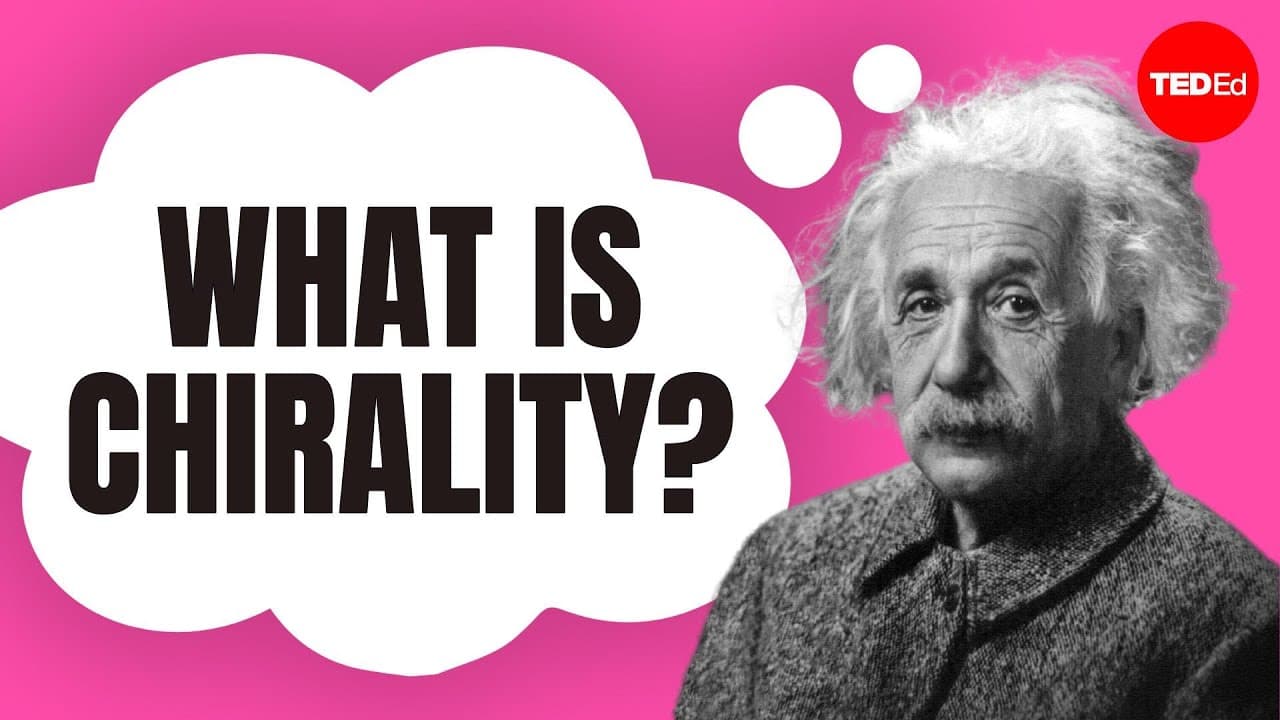
What is chirality and how did it get in my molecules? - Michael Evans
TL;DR
Chirality is the spatial property of an object that cannot be perfectly superimposed on its mirror image. Van't Hoff proposed in 1874 that the four bonds of a saturated carbon point toward the corners of a tetrahedron, linking this geometry to optical rotation in compounds with a central carbon bound to four different groups. Read on to understand the molecular geometry, mirror-image test, and interaction with plane-polarized light.
Transcript
In the early days of organic chemistry, chemists understood that molecules were made of atoms connected through chemical bonds. However, the three-dimensional shapes of molecules were utterly unclear, since they couldn't be observed directly. Molecules were represented using simple connectivity graphs like the one you see here. It was clear to savv... Read More
Key Insights
- 🫀 Chemists initially struggled to understand the three-dimensional structures of molecules until Van't Hoff's hypothesis about tetrahedral carbon atoms provided an explanation.
- ✈️ Optical rotation, the rotation of plane-polarized light caused by chiral molecules, played a crucial role in supporting Van't Hoff's theory.
- 🙂 Chirality is a spatial property shared by chiral molecules and everyday objects, and it affects their behavior and interactions with light.
- 🛟 Chiral molecules are abundant in nature and have diverse applications in chemistry and everyday life.
Install to Summarize YouTube Videos and Get Transcripts
Explore YouTube Video Summarizer or Get YouTube Transcript Extractor
Questions & Answers
Q: What is chirality in chemistry?
Chirality, or handedness, is the spatial property of an object that is not the same as its mirror image. Chiral molecules can contain the same atoms and internal distances yet remain impossible to superimpose perfectly.
Q: How can you tell whether two molecules are chiral mirror images?
Try rotating and translating the molecules to overlay them perfectly. If they are mirror images but perfect superposition remains impossible, they exhibit chirality.
Q: Why are human hands used to explain chirality?
The left and right hands contain the same parts arranged with the same internal relationships, but they cannot be superimposed perfectly. They are mirror images, just like the pair of chiral molecules described in the transcript.
Q: What did Van't Hoff propose about carbon in 1874?
Van't Hoff proposed that the four bonds of a saturated carbon atom point toward the corners of a tetrahedron. The transcript says theoretical validation through the quantum revolution took over 25 years.
Q: What molecular arrangement did Van't Hoff connect with optical rotation?
Van't Hoff observed optical rotation only in compounds containing a central carbon bound to four different atoms or groups. The example carbon is attached to bromine, chlorine, fluorine, and hydrogen.
Q: What is optical rotation?
Optical rotation is the rotation of the plane of plane-polarized light from its original orientation. It occurs because a chiral molecule interacts differently with the light's right-handed and left-handed components, temporarily slowing one relative to the other.
Q: Why could early molecular connectivity graphs not explain chirality?
The graphs showed which atoms were connected but did not reveal molecular shapes in three dimensions. Chemists could not directly observe those shapes, and flat representations could not explain many of their observations.
Q: What everyday objects and actions demonstrate chirality?
Left-handed and right-handed screws demonstrate chirality because screws possess handedness. Screwing together furniture and clapping your hands also involve this spatial property.
Summary & Key Takeaways
-
Definition: Chirality, or handedness, means an object is not the same as its mirror image.
-
When: In 1874, Van't Hoff proposed a three-dimensional structure for saturated carbon.
-
Definition: The four bonds of a saturated carbon point toward the corners of a tetrahedron.
-
Number: Theoretical validation of Van't Hoff's hypothesis took over 25 years.
-
Definition: A central tetrahedral carbon bound to four different groups can produce chiral mirror-image arrangements.
-
Who: Van't Hoff supported his hypothesis by connecting tetrahedral carbon chirality with optical rotation.
-
Definition: Optical rotation is the rotation of the plane of plane-polarized light from its original orientation.
-
Compare: Chiral molecules resemble left and right hands because each pair consists of mirror images that cannot be perfectly superimposed.
-
Tool: Rotating, translating, and attempting to overlay two molecular models tests whether perfect superposition is possible.
-
Compare: Right-handed and left-handed screws are everyday chiral objects with distinct handedness.
-
Definition: Chiral molecules affect plane-polarized light by interacting differently with its right-handed and left-handed components.
Read in Other Languages (beta)
Share This Summary 📚
Summarize YouTube Videos and Get Video Transcripts with 1-Click
Try YouTube Summary with ChatGPT & Claude or YouTube Transcript Generator
Explore More Summaries from TED-Ed 📚



Summarize YouTube Videos and Get Video Transcripts with 1-Click
Try YouTube Summary with ChatGPT & Claude or YouTube Transcript Generator