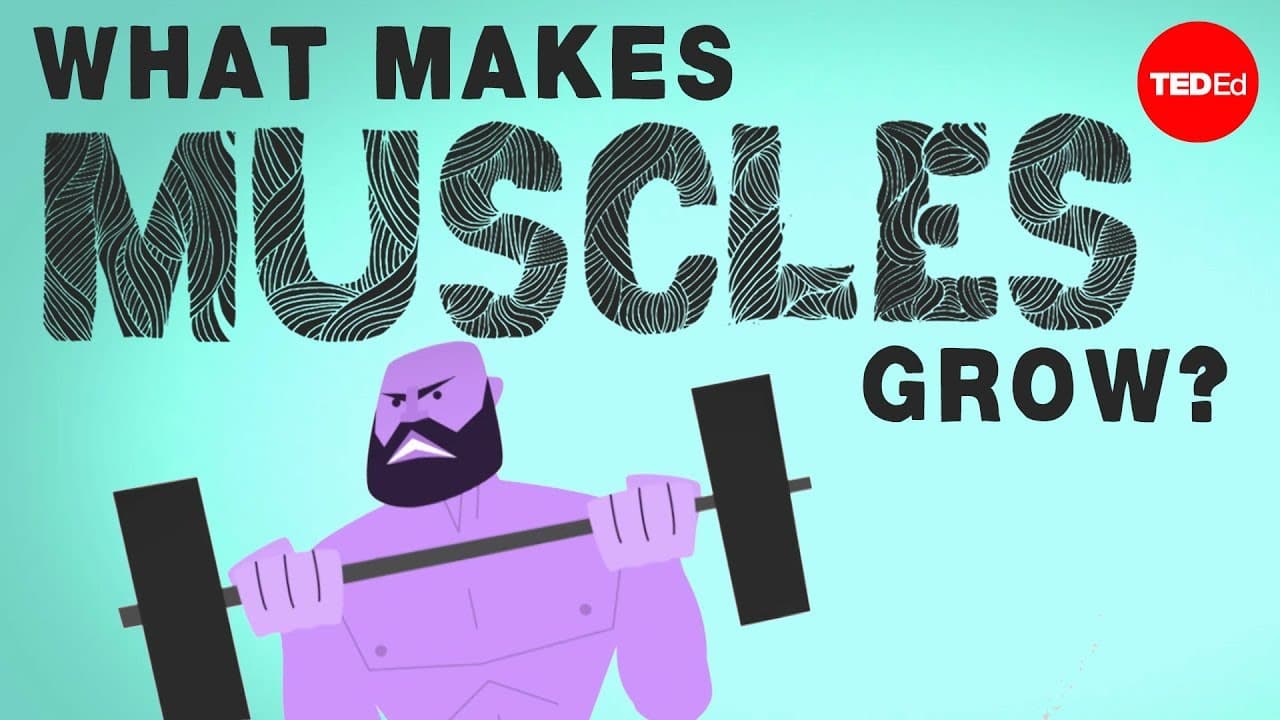
What makes muscles grow? - Jeffrey Siegel
TL;DR
Muscle growth, or hypertrophy, occurs when muscle fibers sustain micro-tears during exercise, followed by repair processes that enhance their size and strength. To maximize growth, focus on progressive overload through increasing weight, maintaining proper nutrition, and allowing adequate recovery time between workouts.
Transcript
Read and summarize the transcript of this video on Glasp Reader (beta).
Install to Summarize YouTube Videos and Get Transcripts
Explore YouTube Video Summarizer or Get YouTube Transcript Extractor
Summary
This video explores the importance of muscles in our bodies and how they require constant attention to grow and adapt. It explains how muscles work together with the brain and nervous system to generate movement and how they undergo cellular changes when exposed to stress. The process of muscle growth and repair is discussed, emphasizing the need for exposing muscles to higher workloads, proper nutrition, hormones, and rest. Factors such as gender, age, and genetics also influence muscle-building potential.
Questions & Answers
Q: How many muscles do we have in our body?
We have over 600 muscles in our body. They make up between 1/3 and 1/2 of our body weight.
Q: What do our muscles do?
Muscles bind us together, hold us up, and help us move. They play a crucial role in generating movement and maintaining our body's structure.
Q: How does the brain communicate with muscles to initiate movement?
The brain sends signals to motor neurons inside the arm, which will then cause muscles to contract and relax. This coordinated action pulls on the bones and generates the required movement.
Q: What happens when we face a challenge that requires more muscle force?
When facing a challenge that requires more force, the brain appeals to other muscles for help. It rallies additional motor units and activates muscles in different parts of the body to generate enough tension and force.
Q: How do muscle fibers change when exposed to stress?
When exposed to stress, muscle fibers undergo microscopic damage, which leads to the release of inflammatory molecules called cytokines. These molecules activate the immune system to repair the muscle injury.
Q: What happens during the process of muscle-building?
The damaged muscle tissue triggers the body's repair mechanism, leading to muscle growth. The more damage to the muscle tissue, the greater the repair required, resulting in bigger and stronger muscles that can adapt to increasing demands.
Q: Why do everyday activities usually not stimulate new muscle growth?
Since our bodies have already adapted to most everyday activities, they don't produce enough stress to stimulate new muscle growth. To build new muscle, we need to expose our cells to higher workloads than they are accustomed to.
Q: What happens if muscles are not regularly exposed to resistance?
If muscles are not continuously exposed to resistance, they will shrink. This process is known as muscular atrophy, where the muscle mass decreases.
Q: What conditions are effective for muscle growth?
Exposing muscles to a high degree of tension, especially during eccentric contractions (when the muscle is lengthening), generates effective conditions for new muscle growth.
Q: What factors other than activity contribute to muscle growth?
Muscles rely on proper nutrition, hormones, and rest for growth. Adequate protein intake provides the building blocks for new tissue, while hormones like insulin-like growth factor and testosterone help shift the body into a state of repair and growth. The majority of repair processes occur during rest, especially while sleeping.
Takeaways
Muscle growth and adaptation require challenging the muscles, exposing them to stress, and providing proper nutrition, hormones, and rest. Regular resistance training and higher workloads are necessary to stimulate muscle growth. While genetics, gender, and age can influence muscle-building potential, consistent effort and care can lead to meaningful muscle growth. Like in life, muscles require challenge and stress for meaningful growth.
Read in Other Languages (beta)
Share This Summary 📚
Summarize YouTube Videos and Get Video Transcripts with 1-Click
Try YouTube Summary with ChatGPT & Claude or YouTube Transcript Generator
Explore More Summaries from TED-Ed 📚


Summarize YouTube Videos and Get Video Transcripts with 1-Click
Try YouTube Summary with ChatGPT & Claude or YouTube Transcript Generator