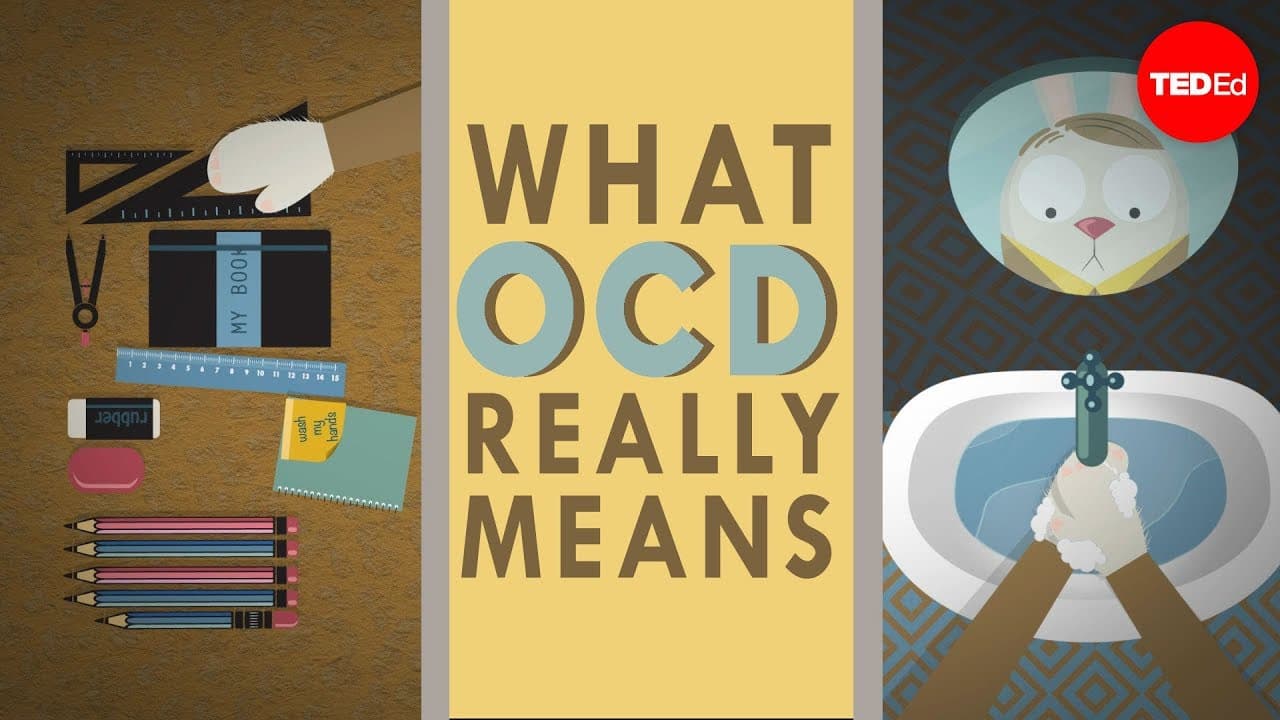
Debunking the myths of OCD - Natascha M. Santos
TL;DR
OCD is a serious psychiatric condition involving intrusive thoughts, images, or impulses called obsessions and compulsive behaviors performed to relieve the resulting anxiety. Unlike ordinary neatness or occasional checking, these symptoms are difficult to control, time-consuming, and disruptive to work, school, or social life. Its exact cause remains unknown, but effective treatments include medication and behavioral therapy. Read on to understand the myths, symptoms, possible causes, and treatments.
Transcript
There's a common misconception that if you like to meticulously organize your things, keep your hands clean, or plan out your weekend to the last detail, you might have OCD. In fact, OCD, which stands for obsessive compulsive disorder, is a serious psychiatric condition that is frequently misunderstood by society and mental health professionals... Read More
Key Insights
- 💭 OCD involves both obsessions (intrusive thoughts) and compulsions (repetitive behaviors) that are beyond a person's control.
- 🤗 Common misconceptions include believing that being neat or organized is synonymous with OCD and that hand washing is the main symptom.
- 💭 Individuals with OCD are often aware of the irrationality of their thoughts and behaviors.
- 🧠 The exact cause of OCD is still unknown, but it is believed to be a neurobiological disorder linked to certain brain regions and serotonin levels.
Install to Summarize YouTube Videos and Get Transcripts
Explore YouTube Video Summarizer or Get YouTube Transcript Extractor
Questions & Answers
Q: What is OCD, and how is it different from being neat or organized?
Obsessive compulsive disorder has two aspects: intrusive thoughts, images, or impulses called obsessions, and behavioral compulsions used to relieve the anxiety they cause. Unlike ordinary neatness or hygiene habits, OCD symptoms are difficult to control, time-consuming, and disruptive to work, school, or social life.
Q: Is excessive hand washing the main symptom of OCD?
No. Although excessive hand washing is the most common popular image of OCD, obsessions and compulsions can take many different forms, including fears about harm, repeated checking, arranging objects, and walking in predetermined patterns.
Q: What are some examples of obsessions in OCD?
Obsessions may involve fears of contamination or illness, worries about harming others, or preoccupations with numbers and patterns. They can also center on morality or sexual identity.
Q: What are some examples of compulsions in OCD?
Compulsions can include excessive cleaning, double-checking things, or arranging objects in a precise way. They may also involve walking in predetermined patterns to relieve anxiety caused by obsessions.
Q: Do people with OCD know that their thoughts and behaviors are irrational?
Many people with OCD understand the relationship between their obsessions and compulsions and recognize their irrationality. Being unable to avoid the thoughts or control their responses despite that awareness is part of what makes OCD so distressing.
Q: What causes OCD?
The exact cause of OCD is unknown, though it is considered a neurobiological disorder. Research has implicated three brain regions involved in social behavior and complex planning, voluntary movement, and emotional and motivational responses, while OCD is also associated with low serotonin levels.
Q: Does low serotonin cause OCD?
OCD is associated with low levels of serotonin, a neurotransmitter involved in communication between brain structures and the regulation of processes such as mood, impulse control, sleep, and appetite. However, it is not known whether serotonin levels and activity in implicated brain regions are causes of OCD or symptoms of an unknown underlying cause.
Q: What treatments are available for OCD?
Effective treatments include medications that increase serotonin in the brain by limiting its reabsorption and behavioral therapy that gradually desensitizes patients to their anxieties. When OCD does not respond to other treatments, electroconvulsive therapy or surgery may be used in some cases.
Summary
Obsessive-Compulsive Disorder (OCD) is frequently misunderstood by society and mental health professionals. This article debunks common myths about OCD and explores its symptoms, causes, and treatments.
Questions & Answers
Q: What is OCD and what are its two aspects?
OCD stands for Obsessive-Compulsive Disorder. It has two aspects: obsessions (intrusive thoughts or impulses) and compulsions (behavioral actions taken to relieve anxiety caused by obsessions).
Q: What differentiates individuals with OCD from those who are simply meticulous or hygiene-obsessed?
People with OCD have little control over their obsessive thoughts and compulsive behaviors, which can be time-consuming and cause significant distress, interfering with work, school, or social life.
Q: Is excessive hand washing the main symptom of OCD?
No, while hand washing is commonly associated with OCD, obsessions and compulsions can take various forms such as fears of contamination, worries about harm, preoccupations with numbers, patterns, morality, or sexual identity.
Q: Do individuals with OCD understand that their actions are irrational?
Many individuals with OCD are aware of the irrationality of their obsessions and compulsions. However, they find it difficult to avoid these thoughts and actions, contributing to the distress associated with OCD.
Q: What are some potential causes of OCD?
The exact cause of OCD is unknown, but research suggests it is a neurobiological disorder. Three brain regions involved in social behavior, voluntary movement, and emotional responses have been implicated. Additionally, low levels of serotonin, a neurotransmitter, are associated with OCD.
Q: Are serotonin levels and brain activity the cause of OCD or symptoms of an underlying cause?
It is unclear whether low serotonin levels and brain activity are the root cause of OCD or symptoms of an unknown underlying cause. Further understanding of the brain is needed to make definitive conclusions.
Q: Are there effective treatments for OCD?
Yes, there are effective treatments for OCD. Medications can increase serotonin levels in the brain, while behavioral therapy gradually helps patients desensitize to their anxieties. In severe cases, electroconvulsive therapy or surgery may be considered if other treatments fail.
Q: How does having OCD feel?
Having OCD can be agonizing as individuals feel as though their own brain is lying to them, while they are unable to resist its commands due to the intrusive thoughts and compulsive behaviors.
Q: How can knowledge and understanding help individuals with OCD?
Knowledge and understanding empower individuals with OCD to seek help and explore available treatments. Future research into the brain may provide further insights and answers to the disorder.
Takeaways
OCD is frequently misunderstood, and its misconceptions can lead to stigma and inadequate treatment. Understanding that OCD involves both obsessions and compulsions, and that it is more than just being overly organized or clean, helps debunk common myths. While the precise cause of OCD remains unknown, it is considered a neurobiological disorder with potential involvement of certain brain regions and low serotonin levels. Effective treatments, such as medication and behavioral therapy, offer hope for those with OCD. Increasing knowledge and research may ultimately unveil more answers and improve the understanding and management of OCD.
Summary & Key Takeaways
-
OCD is frequently misunderstood, and there are common misconceptions about the disorder.
-
OCD is characterized by both obsessions (intrusive thoughts) and compulsions (repetitive behaviors).
-
Hand washing is not the only symptom of OCD, as obsessions and compulsions can take various forms.
Read in Other Languages (beta)
Share This Summary 📚
Summarize YouTube Videos and Get Video Transcripts with 1-Click
Try YouTube Summary with ChatGPT & Claude or YouTube Transcript Generator
Explore More Summaries from TED-Ed 📚


Summarize YouTube Videos and Get Video Transcripts with 1-Click
Try YouTube Summary with ChatGPT & Claude or YouTube Transcript Generator