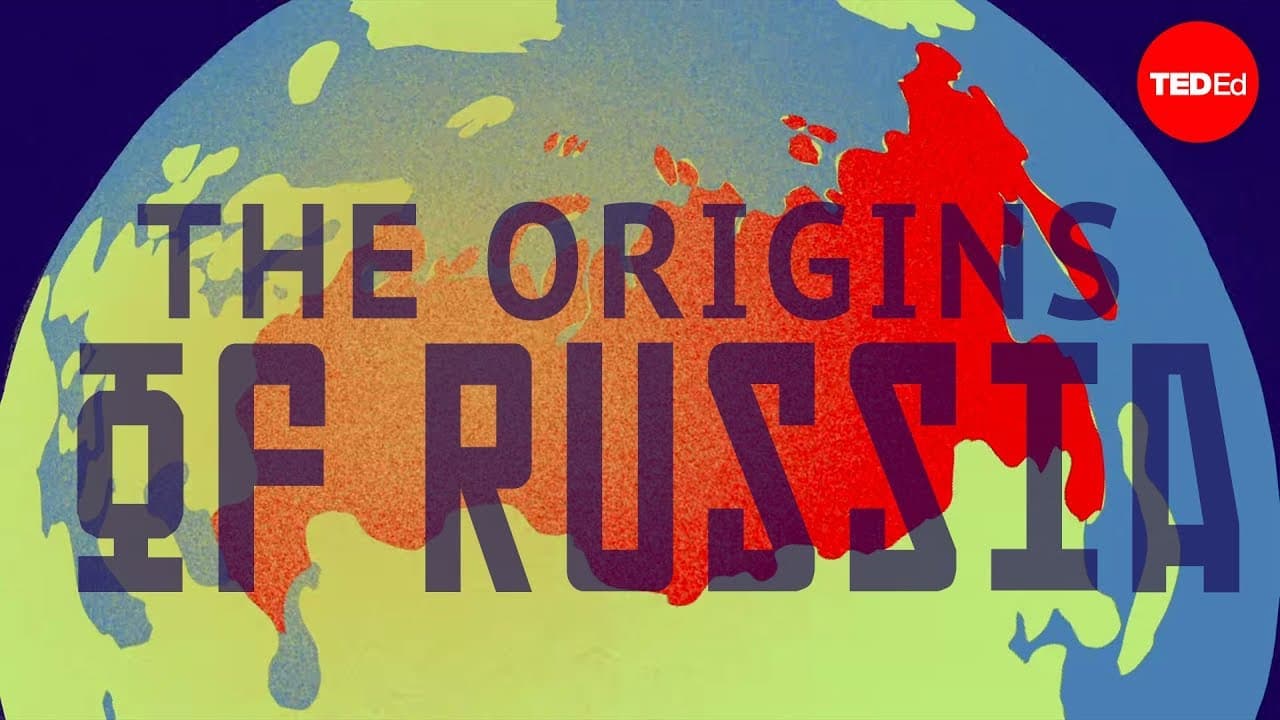
Where did Russia come from? - Alex Gendler
TL;DR
Russia originated from the Kievan Rus, a medieval state formed by tribal groups in Eastern Europe under Viking rule. Its rise involved the spread of Christianity, trade with the Byzantine Empire, and subsequent internal conflicts, culminating in decline due to the Mongol invasion in 1237, which reshaped the region and led to Moscow's emergence as a new power.
Transcript
Where did Russia come from, why is it so big, and what are the differences between it and its neighbors? The answers lie in an epic story of seafaring warriors, nomadic invaders, and the rise and fall of a medieval state known as Kievan Rus. In the first millennium, a large group of tribes spread through the dense woodlands of Eastern Europe. Beca... Read More
Key Insights
- 👥 Kievan Rus originated from tribal groups in Eastern Europe, uniting under Viking rule.
- 🖐️ Christianity played a significant role in Kievan Rus, with the conversion of Prince Vladimir I.
- 💋 The decline of Kievan Rus was marked by internal conflicts, external invasions, and the fragmentation of power.
- 🥺 The Mongol invasion in 1237 led to the end of Kievan Rus, with Moscow emerging as a new power.
- 🏝️ The former lands of Kievan Rus developed differences in society, culture, and language under various influences.
- ™️ Trade with the Byzantine Empire and other civilizations enriched Kievan Rus.
- ✊ Fratricidal disputes over succession weakened central power in Kievan Rus.
Install to Summarize YouTube Videos and Get Transcripts
Explore YouTube Video Summarizer or Get YouTube Transcript Extractor
Questions & Answers
Q: How did the tribes in Eastern Europe unite to form Kievan Rus?
The tribes in Eastern Europe united under Viking rule, eventually consolidating into the powerful empire of Kievan Rus.
Q: What role did Christianity play in the politics of Kievan Rus?
Christianity became influential in Kievan Rus, with Prince Vladimir I converting to Orthodox Christianity, strengthening ties with the Byzantine Empire.
Q: How did the decline of Kievan Rus contribute to the rise of Moscow?
The decline of Kievan Rus after the Mongol invasion allowed Moscow to grow in power, eventually challenging the Mongol rule and expanding its influence.
Q: How did the differences in society, culture, and language develop among the former lands of Kievan Rus?
The former lands of Kievan Rus, ruled by Vikings, influenced by Greeks, and later split by Mongols, developed differences in society, culture, and language that still persist today.
Summary
This video explores the origins and history of Russia, its size, and the differences between Russia and its neighboring countries. Starting with a large group of tribes, the video discusses the sources of information about these tribes and their split into western, southern, and eastern branches. It then delves into the Viking influence, the establishment of the Kievan Rus, and the complex relations with neighboring empires and tribes. Religion and trade played important roles in shaping the Kievan Rus, which flourished for several generations before succumbing to internal disputes, external threats, and ultimately Mongol invasion. The video concludes with the division of the former Kievan Rus territories into the east (under Mongol rule) and the west (influenced by Poland and Lithuania), leading to the development of distinct societies, cultures, and languages.
Questions & Answers
Q: How do we know about the tribes that inhabited Eastern Europe in the first millennium?
We have three main sources of information about these tribes: archaeological evidence, accounts from literate scholars of the Roman Empire and the Middle East, and the Primary Chronicle compiled by a monk named Nestor in the 12th century.
Q: What happened to the tribes after the Vikings from the north subjugated them?
The tribes revolted against the Vikings and drove them back. However, the subsequent chaos led the tribes to invite the Vikings to return and establish order.
Q: Who was sent by the Vikings to rule the region after being invited back?
The Vikings sent a prince named Rurik and his two brothers to rule the region.
Q: How did the Kievan Rus expand its realm under Rurik's son, Oleg?
Oleg expanded the Kievan Rus to the south and moved the capital to Kiev, a former outpost of the Khazar Empire.
Q: What were the relations of the Kievan Rus with its neighbors?
The Kievan Rus had complex relations with its neighbors, including alliance and warfare with the Khazar and Byzantine Empires, as well as neighboring tribes.
Q: What role did religion play in politics during the time of the Kievan Rus?
Religion played an important role in politics. In 987, the Rus prince Vladamir I decided to abandon Slavic paganism and sent emissaries to explore neighboring faiths. He settled on Orthodox Christianity after hearing accounts of its ceremonies.
Q: How did the relationship between the Kievan Rus and the Byzantine Empire deepen?
The relationship deepened through Vladimir's conversion to Orthodox Christianity, his marriage to the Byzantine emperor's sister, continued trade along the Volga route, and the service of Rus Viking warriors as the Byzantine Emperor's elite guard.
Q: What led to the decline of the Kievan Rus?
Fratricidal disputes over succession eroded central power, the Fourth Crusade devastated trade, and Teutonic crusaders posed a threat to the northern territories. The final blow came from the Mongol invasion in 1237.
Q: What happened after the Mongol invasion?
The Kievan Rus cities were sacked, and the age of Kievan Rus came to an end. The eastern territories remained under Mongol rule, while the western regions fell under the influence of Poland and Lithuania.
Q: How did the former lands of Kievan Rus develop over the next few centuries?
The former lands of Kievan Rus, populated by Slavs, ruled by Vikings, taught by Greeks, and divided by Mongols, developed differences in society, culture, and language that continue to exist today.
Takeaways
The history of Russia's origins and development is rich and complex. From the tribes of Eastern Europe, to the Viking rule, the establishment of the Kievan Rus and its flourishing, and the eventual decline and division, the story of Russia's evolution is intertwined with various empires, religion, trade, and invasions. These historical events have shaped the unique differences that exist today between Russia and its neighboring countries.
Summary & Key Takeaways
-
Tribes in Eastern Europe united into Kievan Rus, ruled by Vikings, developing into a powerful empire.
-
Christianity, trade with Byzantines, and internal conflicts led to the decline of Kievan Rus.
-
The Mongol invasion in 1237 marked the end of Kievan Rus, with Moscow emerging as a new power.
Read in Other Languages (beta)
Share This Summary 📚
Summarize YouTube Videos and Get Video Transcripts with 1-Click
Try YouTube Summary with ChatGPT & Claude or YouTube Transcript Generator
Explore More Summaries from TED-Ed 📚

Summarize YouTube Videos and Get Video Transcripts with 1-Click
Try YouTube Summary with ChatGPT & Claude or YouTube Transcript Generator