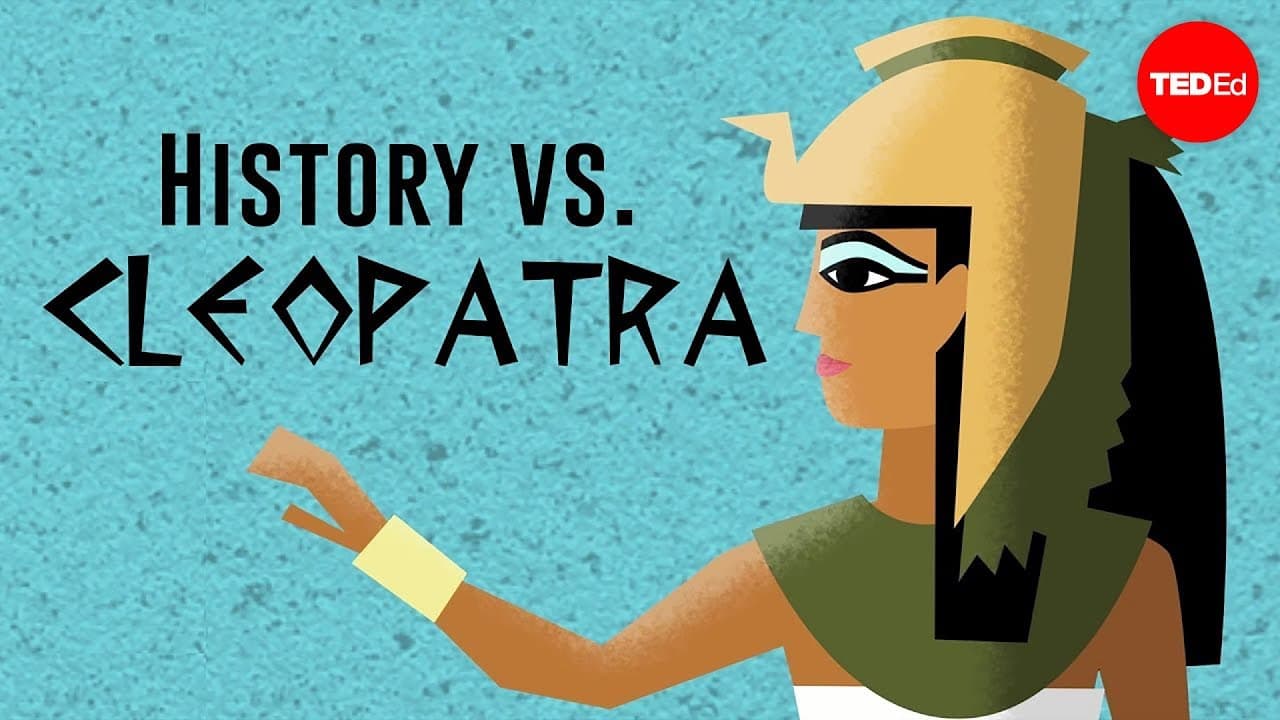
History vs. Cleopatra - Alex Gendler
TL;DR
Cleopatra significantly influenced Roman politics through her alliances with Julius Caesar and Marc Antony, directly impacting the fall of the Roman Republic. Her reign in Egypt was marked by economic stability and social welfare, contrasting sharply with the negative portrayals propagated by her political enemies. Despite her accomplishments, her story has often been clouded by bias and misconceptions driven by the patriarchal narratives of her time.
Transcript
"Order, order. So who do we have here?" "Your Honor, this is Cleopatra, the Egyptian queen whose lurid affairs destroyed two of Rome's finest generals and brought the end of the Republic." "Your Honor, this is Cleopatra, one of the most powerful women in history whose reign brought Egypt nearly 22 years of stability and prosperity." "Uh, why don't ... Read More
Key Insights
- 🇪🇬 Cleopatra's reign brought economic stability and social welfare measures to Egypt, contrasting with Roman propaganda portraying her negatively.
- 🇨🇫 Political alliances with Julius Caesar and Marc Antony propelled Cleopatra into the center of Roman politics, influencing the downfall of the Republic.
- ⌛ Cleopatra's multifaceted talents in areas like military strategy, diplomacy, and education challenged traditional gender roles and stereotypes of her time.
- 🤩 Despite being a key figure in history, Cleopatra's story is often clouded by bias, rumors, and misinterpretations created by her enemies in Rome.
- 🤦♀️ Cleopatra's legacy highlights the struggles faced by powerful women in positions of authority, whose actions were often misconstrued and overshadowed by male counterparts.
- 🕵️♀️ Cleopatra's lasting impact on history serves as a reminder of the complexities and challenges faced by prominent female figures in male-dominated societies.
- 💠 The narrative of Cleopatra's reign and relationships with Caesar and Antony demonstrates the intricate interplay between personal motivations and political consequences in shaping history.
Install to Summarize YouTube Videos and Get Transcripts
Explore YouTube Video Summarizer or Get YouTube Transcript Extractor
Questions & Answers
Q: How did Cleopatra's relationships with Julius Caesar and Marc Antony impact Roman history?
Cleopatra's alliances with Caesar and Antony stirred Roman politics, leading to power struggles and the eventual rise of Emperor Octavian.
Q: What were some unique traits and accomplishments of Cleopatra that set her apart as a ruler?
Cleopatra's linguistic abilities, military leadership, and education in Alexandria's scholarly environment distinguished her as a capable and influential queen.
Q: What were the economic and social policies implemented by Cleopatra during her reign in Egypt?
Cleopatra stabilized the economy, managed bureaucracy efficiently, and enacted social welfare measures like opening granaries during droughts and granting tax amnesties.
Q: How did Cleopatra's image and legacy survive over time, shaping historical narratives about powerful women?
Cleopatra's story has been influenced by Roman propaganda and later writers, highlighting the challenges faced by powerful women in history and the perpetuation of stereotypes.
Summary
In this video, Cleopatra's life and reign are discussed, highlighting her role as the last ruler of the Ptolemaic dynasty in Egypt and her relationship with Rome. The video aims to challenge the biased narratives surrounding Cleopatra's story and encourages a more objective understanding of her life by examining historical facts rather than rumors and stereotypes.
Questions & Answers
Q: Why is there so little visual representation of Cleopatra?
Most of the art and descriptions of Cleopatra came long after her lifetime, in the first century BCE, just like most of the things written about her. Therefore, there is a lack of accurate visual representations of Cleopatra.
Q: What do we actually know about Cleopatra?
Cleopatra VII was a member of the Ptolemaic dynasty, a Macedonian Greek family that ruled Egypt after its conquest by Alexander the Great. She ruled alongside her brother, whom she was also married to, until he had her exiled.
Q: How does Cleopatra's story relate to Rome?
Egypt had been a Roman client state for quite some time, and Cleopatra's father had incurred significant debts to the Roman Republic. When Julius Caesar defeated Pompey in Rome's civil war, Pompey sought refuge in Egypt but was executed by Cleopatra's brother. Caesar found this act unseemly and demanded repayment of Egypt's debt, instead of annexing Egypt he agreed to restore Cleopatra to the throne.
Q: What made Cleopatra so convincing to Caesar?
Cleopatra was a remarkable woman who commanded armies at a young age, spoke multiple languages, and received an education in a city with an exceptional library and renowned scholars. Additionally, she was able to keep Caesar in Egypt for months, making him deeply fascinated by Egypt's culture and knowledge.
Q: What did Caesar do for Rome after his time in Egypt?
Caesar returned to Rome and implemented various reforms, such as reforming the calendar, initiating a census, planning for a public library, and proposing infrastructure projects. These ambitious initiatives ultimately led to his assassination.
Q: How did Cleopatra govern Egypt during her reign?
Cleopatra effectively governed Egypt by stabilizing the economy, managing the vast bureaucracy, and combating corruption among priests and officials. In times of drought, she provided relief to the public by opening the granaries and implementing a tax amnesty. Her reign remained stable and free from revolts.
Q: What went wrong for Cleopatra after Caesar's death?
Following Caesar's assassination, Cleopatra became entangled in Roman politics as different factions sought her support. She ended up supporting Octavian and Marc Antony to avenge Caesar's death, mostly for the sake of their son.
Q: Why is Cleopatra often portrayed negatively?
Cleopatra's story has been primarily preserved through the accounts of her enemies in Rome. Later writers filled the gaps in her story with rumors and stereotypes. This biased portrayal has led to a negative image of Cleopatra.
Q: How did Antony and Cleopatra's relationship impact their public image?
Antony and Cleopatra's relationship offended the Republic due to their extravagant celebrations, where they would sit on golden thrones and dress up as gods. This behavior, along with Octavian's manipulation, convinced the Romans of their megalomania.
Q: Did Cleopatra's womanhood play a role in her downfall?
It is suggested that the Romans' fear of a powerful woman played a significant role in the downfall of Cleopatra and the ending of the Republic. The negative perception of Cleopatra as a woman in power contributed to these events.
Takeaways
Cleopatra's life and reign have been shrouded in biased narratives, rumors, and stereotypes throughout history. By examining historical facts and separating them from fiction, we can gain a more objective understanding of Cleopatra's story. It is crucial to challenge the negative portrayal of powerful women, such as Cleopatra, and evaluate historical events from a more balanced perspective.
Summary & Key Takeaways
-
Cleopatra, the last of the Ptolemaic dynasty, ruled Egypt jointly with her brother and husband, showcasing political acumen.
-
Cleopatra's interactions with Julius Caesar and Marc Antony influenced Rome's political landscape and marked the end of the Republic.
-
Despite Roman propaganda, Cleopatra's reign saw economic stability, bureaucratic management, and social welfare measures in Egypt.
Read in Other Languages (beta)
Share This Summary 📚
Summarize YouTube Videos and Get Video Transcripts with 1-Click
Try YouTube Summary with ChatGPT & Claude or YouTube Transcript Generator
Explore More Summaries from TED-Ed 📚





Summarize YouTube Videos and Get Video Transcripts with 1-Click
Try YouTube Summary with ChatGPT & Claude or YouTube Transcript Generator