How to Build an Effective AI Engineering Loop
TL;DR
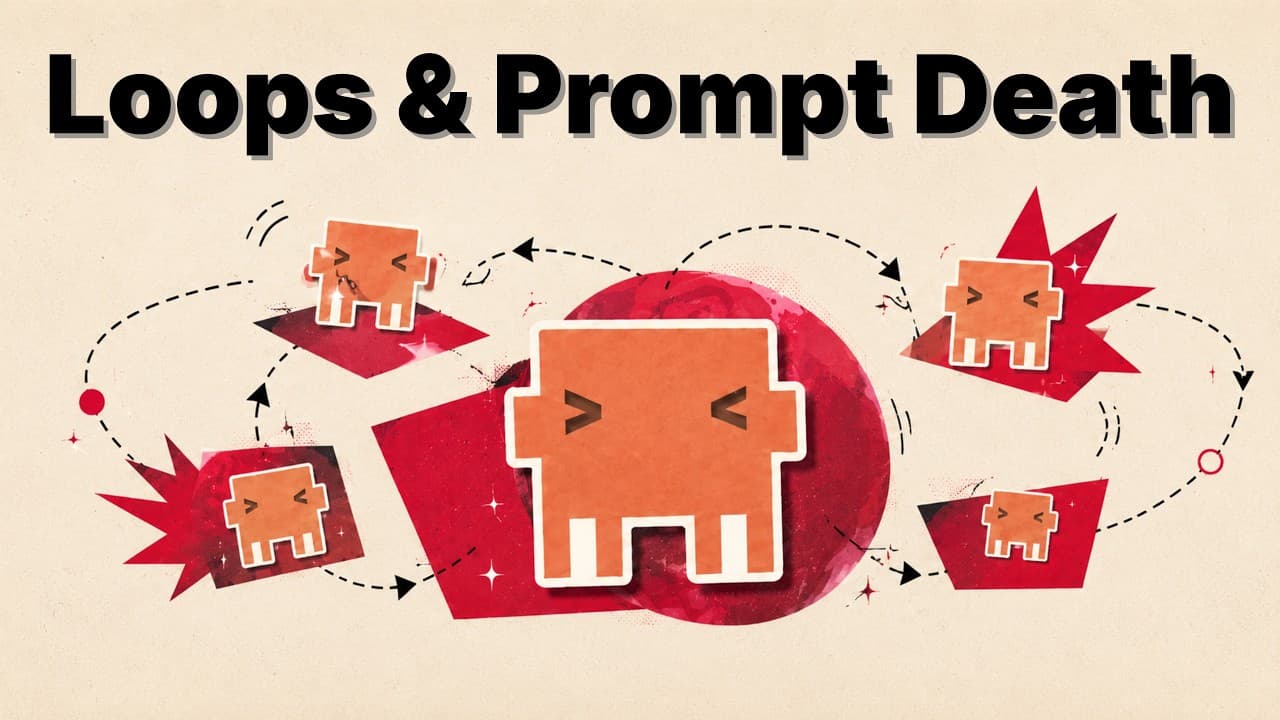
Loop engineering works by repeatedly executing prompts until defined success criteria or stopping conditions are reached. An effective loop needs four phases: a trigger, task execution, verification, and recorded state, while tasks with fuzzy goals may require human review or a hybrid process to avoid unproductive iterations and wasted tokens.
Transcript
The conversation around loop engineering has completely lost the plot. Every single YouTube video and Xthread has the exact same take. Prompt engineering is dead and you should be doing nothing else but loop engineering. But the problem is this is not only completely wrong, it's utterly backwards. And that's because a loop at its core is still a pr... Read More
Key Insights
- Loop engineering is an iterative process in which an AI agent repeatedly attempts a task until it satisfies defined success criteria. The loop adds automation, verification, memory, and stopping logic around prompts rather than replacing prompts with an entirely different method.
- Prompt engineering remains fundamental because a loop is composed of prompts executed repeatedly with additional scaffolding. The emergence of looping does not make individual prompts obsolete, just as discovering one useful tool does not eliminate the need for other tools suited to different jobs.
- The trigger phase is the mechanism that starts a loop automatically. Possible triggers mentioned include scheduled tasks, routines, cron jobs, and webhooks, with the appropriate choice depending on how and when the user wants the recurring process to begin.
- The execution phase is where the AI performs the requested work, often involving coding. A skill can define how the agent should complete a specific task in a specific manner and produce the specific output that the loop will subsequently evaluate.
- The verification phase determines whether an iteration has achieved its goal. Objective measures, such as a Python application's runtime, provide clear evidence of improvement, while subjective measures, such as whether a LinkedIn article is better, make the loop less reliable and efficient.
- State is the stored output and memory that connects one iteration to the next. It should record previous results, attempted methods, successful changes, and failed changes so that subsequent executions can build on evidence rather than repeat isolated or random experiments.
- Stopping criteria are necessary because an automated loop could otherwise continue running and consuming tokens without useful progress. A loop can stop after its goal is verified, after improvement falls below an acceptable level, or after a predetermined number of iterations, such as eight.
- Loop engineering is best suited to tasks with strong goals and clearly measurable success criteria. Tasks with fuzzy criteria can still use loops, but they may require human evaluation or a hybrid workflow to decide whether each result represents meaningful improvement.
Install to Summarize YouTube Videos and Get Transcripts
Explore YouTube Video Summarizer or Get YouTube Transcript Extractor
Questions & Answers
Q: What is loop engineering for AI coding agents?
Loop engineering is the practice of giving an AI coding agent a task and structuring the work so the agent tries repeatedly until it reaches defined success criteria. Instead of issuing one prompt and accepting one attempt, the user adds a trigger, an execution process, verification, recorded state, and stopping conditions. The method is intended to make repeated work efficient, effective, and capable of improvement across iterations.
Q: Why is prompt engineering still important in loop engineering?
Prompt engineering remains important because loops are fundamentally collections of prompts repeated with additional scaffolding. The agent still needs instructions for what to do, how to do it, what output to produce, and how to judge completion. Loop engineering therefore does not replace prompting. It adds iteration, verification, memory, and automation, while both approaches remain tools that fit different types of work.
Q: What are the four phases of an AI engineering loop?
The four phases are trigger, execution, verification, and state. The trigger starts the process through a mechanism such as a schedule, routine, cron job, or webhook. Execution is where the AI performs the task. Verification compares the result with success criteria. State records outputs, prior attempts, successes, and failures so the next iteration can make an informed improvement.
Q: How should success criteria be defined for an AI loop?
Success criteria should state clearly how the system can determine that the task has been completed or improved. Objective measures are especially effective. For example, a loop optimizing a Python application can use runtime as a measurable target. When success is subjective, such as deciding whether an article is better, verification becomes less reliable and may need human judgment or a hybrid process.
Q: Why does an AI loop need to preserve state?
An AI loop needs state so each new iteration can use evidence from earlier attempts. The stored information can include the previous output, the measured result, the changes that were tried, what worked, and what failed. Without this memory, every iteration operates in isolation and may repeat ineffective actions. Preserving state is what supports improvement across repeated runs.
Q: When should an automated AI loop stop running?
An automated loop should stop when it achieves and verifies its target or reaches another predefined limit. The process can also stop when further iterations are no longer producing enough progress, such as when application runtime stops decreasing meaningfully. Another option is a hard iteration limit, with the transcript giving eight iterations as an example, which prevents indefinite token consumption.
Q: What tasks are best suited to loop engineering?
Tasks with clear goals and objective success criteria are best suited to loop engineering. Improving a Python application's runtime is a strong example because every iteration can be measured against a number. When the desired improvement cannot be measured clearly, the loop risks spinning without meaningful progress. Those fuzzy tasks may still work, but they require more careful verification and possibly human participation.
Q: How does loop engineering differ from auto research and slash goal?
Auto research follows many loop engineering principles automatically, but it requires defined, objective success criteria and is not presented as suitable for fuzzy goals. Slash goal iterates toward a condition within a single session and completes one isolated task. Loop engineering has a broader, potentially ongoing horizon, preserving results across recurring runs so work can continue improving over time.
Summary & Key Takeaways
-
Loop engineering gives an AI coding agent a task and directs it to iterate until it meets defined success criteria. It does not replace prompt engineering because every loop still consists of prompts, repeated with additional scaffolding. Prompts and loops are separate tools whose usefulness depends on the specific job and intended output.
-
A complete loop contains four phases: a trigger starts the process, execution performs the task, verification evaluates the result, and state records outputs and memory. State enables later iterations to examine previous results, attempted changes, successes, and failures, allowing the process to improve instead of treating every run as isolated.
-
Tasks with objective measurements are the strongest candidates for looping, such as reducing a Python application's runtime. Fuzzy goals, such as producing better LinkedIn articles, weaken automated verification and may need human participation. Every loop also needs stopping criteria, including reaching the goal, detecting insufficient progress, or completing a fixed number of iterations.
Read in Other Languages (beta)
Share This Summary 📚
Summarize YouTube Videos and Get Video Transcripts with 1-Click
Try YouTube Summary with ChatGPT & Claude or YouTube Transcript Generator
Explore More Summaries from Chase AI 📚

Summarize YouTube Videos and Get Video Transcripts with 1-Click
Try YouTube Summary with ChatGPT & Claude or YouTube Transcript Generator