How to Build an Agentic OS for Claude Code
TL;DR
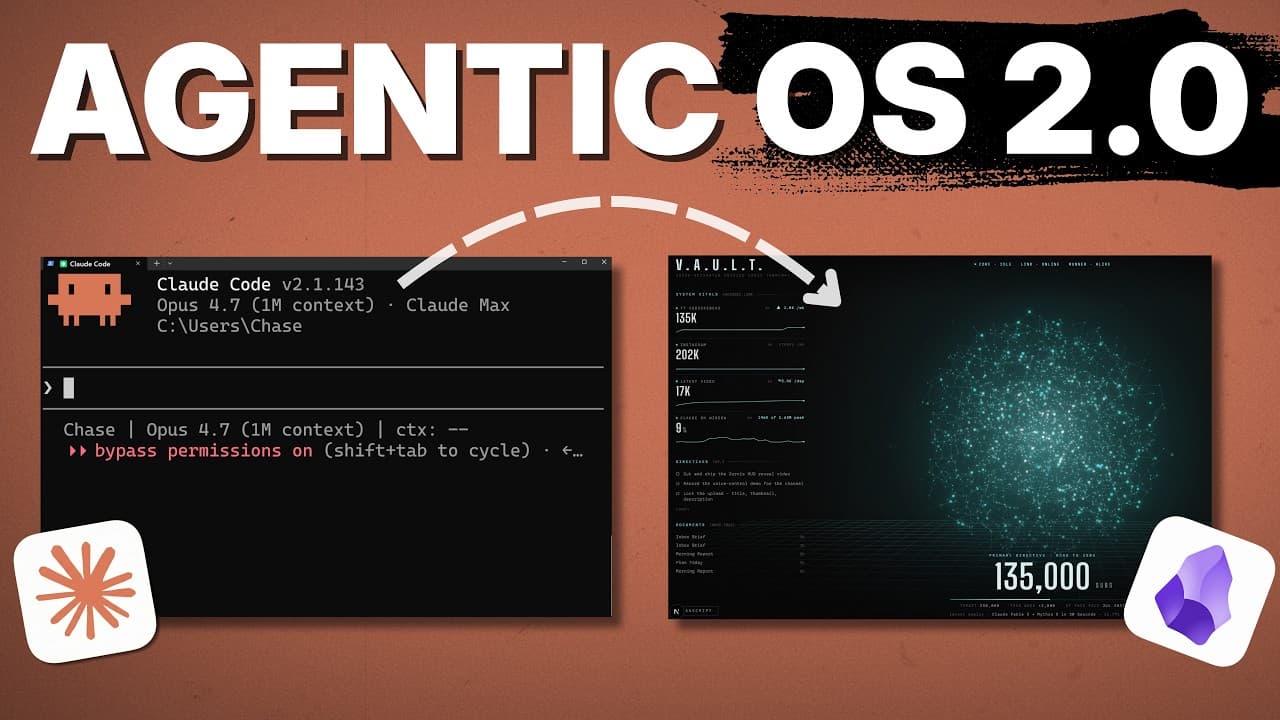
Building an Agentic OS enhances Claude Code by focusing on underlying systems like loop engineering, skill architecture, and state management. This approach allows for creating a second brain, making workflows more efficient and adaptable. The value lies in the unseen processes that transform a simple interface into a powerful tool adaptable for any project.
Transcript
If you don't know how to build your own agentic OS, then you are falling behind. But not for the reason you think. It's not because you need some fancy dashboard or a Jarvis setup because that is not where the value of these systems lie. The value is everything under the hood. Everything you can't see. I'm talking about loop engineering, skill arch... Read More
Key Insights
- Agentic OS focuses on underlying systems such as loop engineering and skill architecture.
- The key to a successful Agentic OS is codifying workflows into skills and automations.
- Memory and state management are crucial for creating a coherent and efficient system.
- A well-structured file system, like using Obsidian, enhances Claude Code's efficiency.
- Visual interfaces can be customized to improve usability and accessibility for non-technical users.
- Distribution of an Agentic OS allows sharing of workflows and tools with team members.
- Customization of dashboards can make AI tools more approachable for clients and team members.
- The majority of an Agentic OS's power comes from the foundational skills and memory management.
Install to Summarize YouTube Videos and Get Transcripts
Explore YouTube Video Summarizer or Get YouTube Transcript Extractor
Questions & Answers
Q: How to build an Agentic OS for Claude Code?
To build an Agentic OS for Claude Code, focus on underlying systems such as loop engineering and skill architecture. Start by codifying workflows into skills and automations, then manage memory and state through a structured file system like Obsidian. Customize visual interfaces to improve usability and share these systems with team members for increased efficiency.
Q: What is the importance of loop engineering in an Agentic OS?
Loop engineering is crucial in an Agentic OS as it allows for creating self-improving systems. By setting up loops that record and analyze past iterations, you can enhance future runs and ensure consistent outputs. This process is foundational to making workflows more efficient and adaptable in Claude Code.
Q: Why use Obsidian for memory management in Claude Code?
Obsidian is used for memory management in Claude Code because it provides a structured file system that enhances data organization and retrieval. By designating a folder as a vault and organizing data into subfolders, Claude Code can access information quickly and efficiently, reducing token usage and improving response times.
Q: How can visual interfaces improve Claude Code usability?
Visual interfaces improve Claude Code usability by providing a customizable and user-friendly environment for interacting with AI tools. By turning complex tasks into simple buttons and metrics, these interfaces make AI tools more approachable for non-technical users, allowing them to leverage Claude Code's power without needing in-depth technical knowledge.
Q: What are the benefits of distributing an Agentic OS?
Distributing an Agentic OS allows team members to access and use pre-built workflows and tools, increasing organizational efficiency. By simplifying complex tasks into easy-to-use interfaces, even non-technical users can benefit from AI capabilities. This sharing of systems helps raise the floor of productivity across the organization.
Q: How does skill architecture enhance Claude Code?
Skill architecture enhances Claude Code by transforming repetitive tasks into codified skills, ensuring consistent and specific outputs. By identifying and automating frequent tasks, skill architecture streamlines workflows and maximizes efficiency, allowing users to focus on higher-level problem-solving and innovation.
Q: What role does state management play in an Agentic OS?
State management in an Agentic OS is crucial for maintaining a coherent and efficient system. It involves creating a database of information that the AI can draw upon when needed. Proper state management ensures that the system can access and utilize past data effectively, enhancing decision-making and task execution.
Q: Why is customization important in Claude Code interfaces?
Customization in Claude Code interfaces is important because it allows users to tailor the system to their specific needs and preferences. By creating dashboards that display relevant metrics and automate frequent tasks, users can improve their workflow efficiency and accessibility, making AI tools more intuitive and effective for diverse applications.
Summary & Key Takeaways
-
Building an Agentic OS involves focusing on unseen systems like loop engineering and skill architecture. These elements allow for creating a second brain, making workflows more efficient and adaptable. Codifying workflows into skills and automations is key to maximizing Claude Code's potential.
-
Memory and state management are crucial components, often enhanced by tools like Obsidian, which help in organizing and accessing information efficiently. A well-structured file system ensures that Claude Code can quickly retrieve and process data.
-
Visual interfaces and dashboards can be customized to improve usability, making AI tools more accessible to non-technical users. Sharing these systems with team members can raise organizational efficiency by simplifying complex tasks into easy-to-use interfaces.
Read in Other Languages (beta)
Share This Summary 📚
Summarize YouTube Videos and Get Video Transcripts with 1-Click
Try YouTube Summary with ChatGPT & Claude or YouTube Transcript Generator
Explore More Summaries from Chase AI 📚





Summarize YouTube Videos and Get Video Transcripts with 1-Click
Try YouTube Summary with ChatGPT & Claude or YouTube Transcript Generator