How to Use Five Overlooked ChatGPT Features
TL;DR
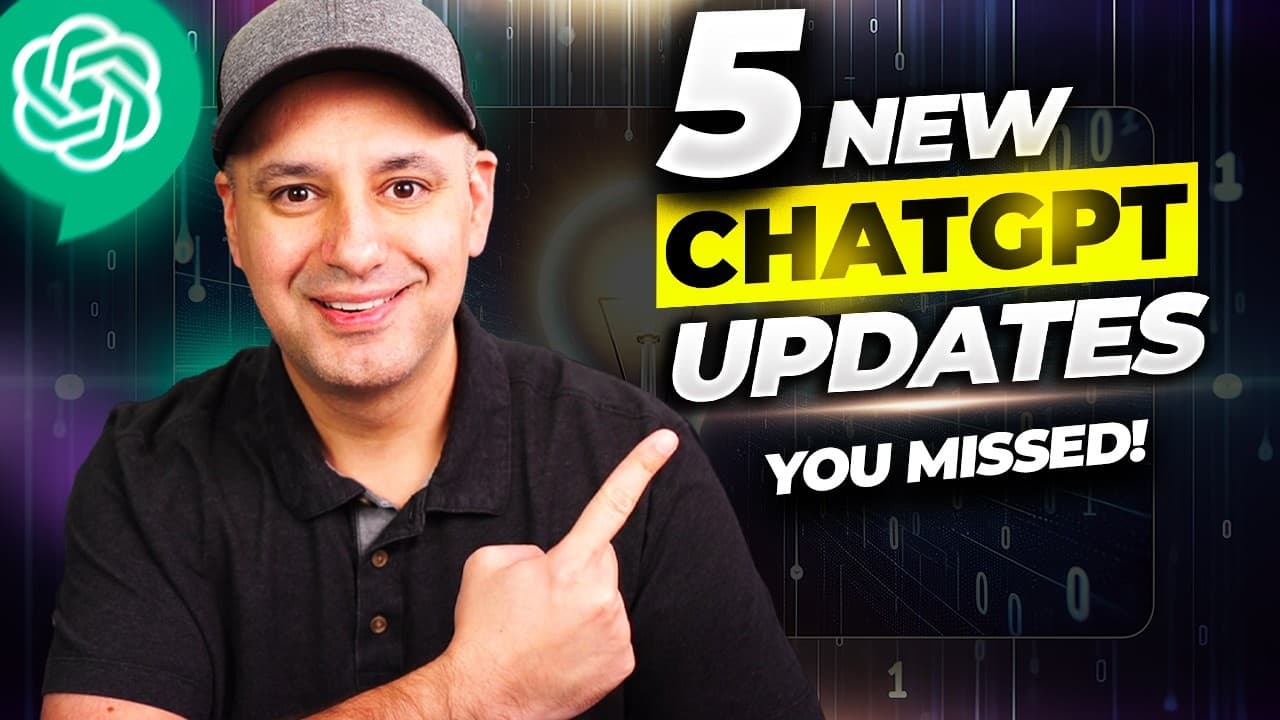
Connect Deep Research to services such as Dropbox or Google Drive so ChatGPT can combine relevant internal documents with information from websites in one sourced report. You can also choose models for custom GPTs, move existing chats into Projects, and restyle generated images without starting a new conversation, making research and organization more efficient.
Transcript
Chat GPT has released a ton of new updates just in the last couple of months and some of them have been big updates that I've already covered on this channel like ChatGpt agents, but a lot of really useful updates went under the radar. So, in this one video, I want to show you a handful of new updates that will really change how you use chat GPT. O... Read More
Key Insights
- Deep Research is a research mode that can examine many websites from a prompt and assemble a detailed, sourced report, while its Sources menu lets users choose connected services that contain their own documents.
- Connectors are integrations that let Deep Research search internal material alongside the web, including content stored in Dropbox, Google Drive, Box, Gmail, GitHub, Canva, calendars, and HubSpot when those services are connected and enabled.
- Source transparency is built into the demonstrated Deep Research workflow because users can inspect the sources tab, distinguish connected files from websites, and open a cited Dropbox source directly, including the specific PDF used in the report.
- Desktop app connections are useful for bringing information from locally used applications into research, with the Mac Notes app, Cursor, VS Code, and Windsurf presented as examples of apps that can support notes or code-related work.
- Custom GPT model selection is available through the Configure tab, where a creator can recommend a default model such as GPT-4o, o3, o3 Pro, or o4-mini for people who open and use that GPT.
- Reasoning models are presented as better choices for tasks involving math, coding, logic, and other sophisticated work, so matching a custom GPT with a relevant model can expand the kinds of tasks it handles.
- Projects are task-focused workspaces that can contain uploaded files, Google Drive material, tools, sources, and dedicated instructions that determine how ChatGPT should behave within that particular project.
- Existing chats can be added to a project from the conversation's three-dot menu, while generated images can be refined or restyled through the image interface without requiring users to begin an entirely new chat.
Install to Summarize YouTube Videos and Get Transcripts
Explore YouTube Video Summarizer or Get YouTube Transcript Extractor
Questions & Answers
Q: How do I use Deep Research with my own files?
Select Deep Research under Tools, open the Sources options, and connect the service containing your documents. The demonstration uses Dropbox, but Google Drive, Box, Gmail, GitHub, Canva, calendars, and HubSpot are also shown or mentioned. After enabling the desired source, submit a research prompt. ChatGPT can then examine relevant connected files and websites while producing a sourced report.
Q: What information can ChatGPT connectors search?
Connectors can give ChatGPT access to relevant information stored in services the user authorizes. The examples include documents in Dropbox, Google Drive, and Box, messages or information in Gmail, repositories in GitHub, Canva content, calendar information, HubSpot material, and other connected sources. In Deep Research, these private sources can be searched together with information found on websites.
Q: How can I verify which sources Deep Research used?
Open the sources tab after Deep Research completes its work. The demonstrated report lists the websites and Dropbox materials it examined, allowing the user to see when research moved between internal files and web pages. A connected Dropbox citation can also be opened directly, taking the user to the specific source file, such as the PDF shown in the demonstration.
Q: How do desktop app connections improve Deep Research?
Desktop app connections let users incorporate information from applications they already use. On a Mac, the presenter highlights the built-in Notes app as a place containing useful notes that could support research. Code-focused applications such as Cursor, VS Code, and Windsurf are also mentioned. Connecting these tools can make existing notes or code-related knowledge available to the research workflow.
Q: How do I choose a default model for a custom GPT?
Open the custom GPT configuration page and go to the Configure tab. Under the recommended model setting, choose the model that should be used by default for the best results. The demonstrated choices include GPT-4o, o3, o3 Pro, and o4-mini. When someone opens the GPT, that recommended model appears as its default, although the user can change it.
Q: Why use a reasoning model with a custom GPT?
Reasoning models are described as particularly useful for math, coding, logic, and more sophisticated tasks. Selecting one as the recommended model allows a custom GPT's instructions and knowledge to operate with a model suited to those kinds of problems. The creator can establish the default choice, while the person using the GPT can still select another available model from the model menu.
Q: How do I add an existing ChatGPT conversation to a Project?
Open the existing conversation, select the three-dot menu near the top, choose Add to project, and select the desired project. The conversation then appears within that project's sources or associated material, and it can be reopened from there. This method avoids returning to the project first, pressing the plus button, and searching manually for where the conversation was saved.
Q: How do I restyle a ChatGPT image without starting over?
Open the generated image inside the existing conversation and use the Style tab. Selecting a style, such as cyberpunk in the demonstration, automatically adds a restyling instruction to the prompt. The same interface also supports refinements involving additions, removals, or replacements. The revised prompt can then be submitted without creating a separate chat or rewriting the full original image description.
Summary & Key Takeaways
-
Deep Research can search websites while also examining connected sources such as Dropbox, Google Drive, Box, Gmail, GitHub, Canva, calendars, and HubSpot. The resulting report identifies its sources, alternates between internal documents and websites, and can link directly to a specific file that contributed relevant information to the final response.
-
Custom GPT creators can now recommend a default model instead of relying only on the standard ChatGPT model. Available choices shown include GPT-4o, o3, o3 Pro, and o4-mini. End users can also change the model, allowing a custom GPT to use reasoning models for math, coding, logic, and sophisticated tasks.
-
Projects provide task-specific files, tools, sources, and instructions. An existing conversation can be moved into a project by opening its three-dot menu and selecting Add to project, eliminating the need to begin every conversation inside the project. ChatGPT images can also be refined or restyled from the existing image interface.
Read in Other Languages (beta)
Share This Summary 📚
Summarize YouTube Videos and Get Video Transcripts with 1-Click
Try YouTube Summary with ChatGPT & Claude or YouTube Transcript Generator
Explore More Summaries from Skill Leap AI 📚



Summarize YouTube Videos and Get Video Transcripts with 1-Click
Try YouTube Summary with ChatGPT & Claude or YouTube Transcript Generator